Product Design, Manufacturing & Innovation Resources
Heim » Finite-Elemente-Methode

Finite-Elemente-Methode

1943
  • Richard Courant
  • Alexander Hrennikoff
  • Olgierd Zienkiewicz
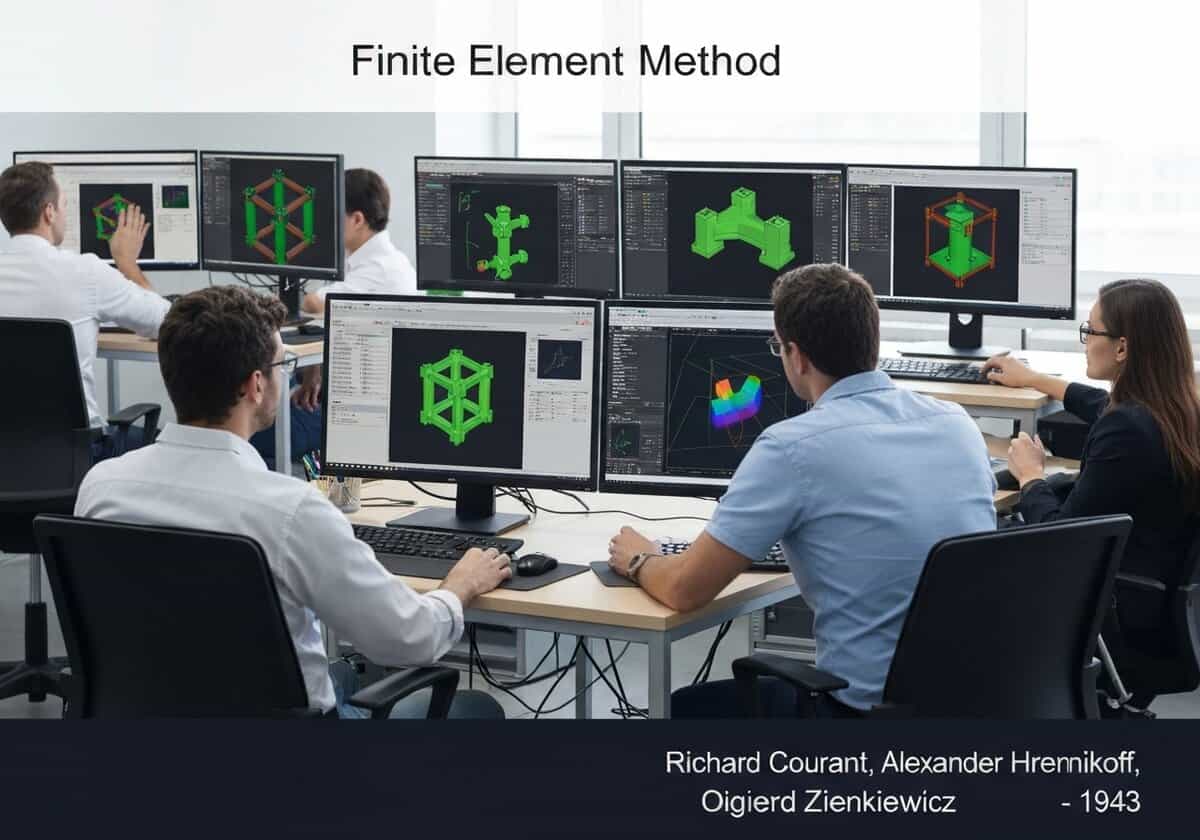
Finite Element Method applied in structural analysis within an engineering office.

(Abbildung dient nur zur Veranschaulichung)

The Finite Element Method (FEM) is a powerful numerical technique for solving complex engineering and physics problems described by partial differential equations. It works by discretizing a continuous domain into a set of smaller, simpler subdomains called ‘finite elements’. This allows for the approximate numerical solution of problems in structural analysis, heat transfer, fluid flow, and electromagnetism.

The FEM process begins with the ‘discretization’ of the problem domain into a mesh of finite elements (e.g., triangles or quadrilaterals in 2D, tetrahedra or hexahedra in 3D). Within each element, the unknown field variable (e.g., displacement) is approximated by simple polynomial functions, known as shape functions. The values of the field at the element nodes become the new unknowns of the problem.

A system of algebraic equations for the entire domain is derived, typically using a variational principle like the principle of minimum potential energy or a weighted residual method like the Galerkin method. This process generates an ‘element stiffness matrix’ [latex][k_e][/latex] for each element, which relates the nodal forces [latex]\{f_e\}[/latex] to the nodal displacements [latex]\{u_e\}[/latex] via [latex][k_e] \{u_e\} = \{f_e\}[/latex]. These individual element matrices are then systematically combined (‘assembled’) into a single global stiffness matrix [latex][K][/latex] for the entire structure. After applying known boundary conditions (forces and constraints), the resulting large system of linear equations, [latex][K] \{U\} = \{F\}[/latex], is solved numerically for the unknown global displacement vector [latex]\{U\}[/latex]. Once the nodal displacements are known, other quantities like strains and stresses can be calculated for each element.

UNESCO Nomenclature: 1208
– Numerical analysis

Typ

Software/Algorithm

Störung

Revolutionary

Verwendung

Weitverbreitete Verwendung

Vorläufer

  • Variationsrechnung
  • Matrizenalgebra
  • Das Aufkommen digitaler Computer
  • Elastizitätstheorie und Kontinuumsmechanik
  • Rayleigh-Ritz-Methode zur Näherung von Lösungen

Anwendungen

  • Strukturanalysesoftware (z. B. Ansys, Abaqus, Nastran)
  • Autocrashsimulationen
  • Konstruktion und Spannungsanalyse von Luft- und Raumfahrtkomponenten
  • thermische Analyse elektronischer Komponenten
  • biomechanische Simulation von Implantaten und Geweben

Patente:

NA

Potenzielle Innovationsideen

  • Echtzeit-Chirurgiesimulatoren mit FEM zur Weichteildeformation zur Ausbildung von Chirurgen
  • ai-driven generative design tools that iteratively optimize a part’s topology using fem feedback
  • predictive ‘digital twins’ of entire cities to manage infrastructure stress and fluid dynamics
  • personalisierte Arzneimittelabgabemodelle basierend auf patientenspezifischen Organsimulationen
  • virtuelles Testen neuartiger Verbundwerkstoffe zur Vorhersage von Ausfallarten vor der Herstellung
  • seismische Simulation für erdbebensichere Gebäudeplanung
  • Akustik modeling of concert halls and speaker enclosures for optimal sound quality
  • wearable technology that uses fem to predict tissue stress and prevent pressure ulcers
Related to: finite element method, fem, numerical analysis, simulation, structural analysis, partial differential equations, meshing, computational mechanics.

Historischer Kontext

Finite-Elemente-Methode

1930
1936
1940
1943
1950
1950
1953
1930
1931
1939
1940
1950
1950
1952
1956

(wenn das Datum unbekannt oder nicht relevant ist, z. B. „Strömungsmechanik“, wird eine gerundete Schätzung seines bemerkenswerten Auftretens bereitgestellt)

10. Jahr Jubiläum

Bilder in voller Größe und Downloads sind ausschließlich für registrierte Mitglieder kostenlos verfügbar.

> Login <