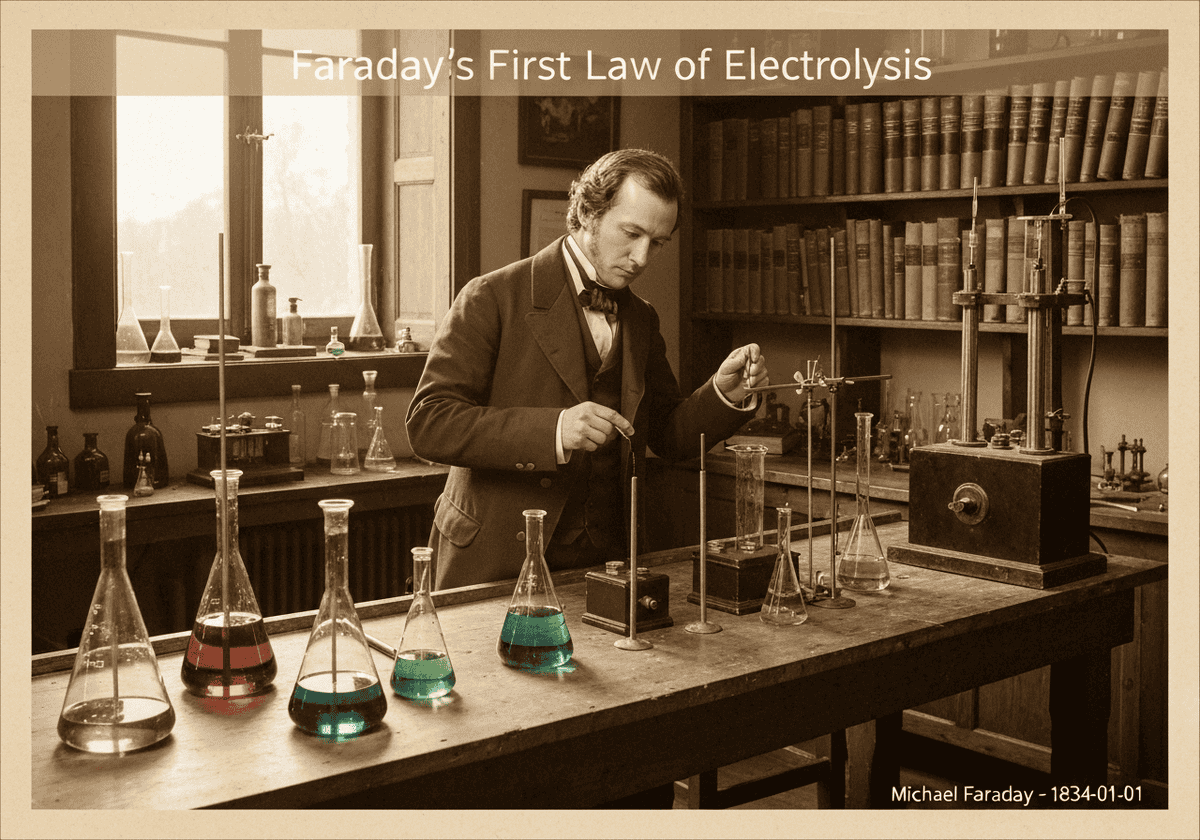
Faraday’s First Law of Electrolysis
This law states that the mass of a substance altered at an electrode during electrolysis is directly proportional to the quantity of electricity transferred. The relationship is expressed by the formula \(m = \frac{Q}{F} \frac{M}{z}\), where m is mass, Q is total electric charge, F is the Faraday constant, M is molar mass, and z is the valence number of ions of the substance.
Faraday’s first law of electrolysis provides a quantitative relationship between electricity and chemical change. It establishes that the amount of chemical reaction that occurs at an electrode is directly proportional to the electric charge passed through the electrolyte. The charge, Q, is the product of the current (I) and the time (t), so Q = It. The formula can be rewritten as \(m = (\frac{M}{zF})It\), highlighting this dependency.
In this equation, the term \(\frac{M}{zF}\) is known as the electrochemical equivalent of the substance. It represents the mass of the substance deposited or liberated per unit of charge. The Faraday constant, F, is a fundamental physical constant representing the magnitude of electric charge per mole of electrons, approximately 96,485 coulombs per mole. The variable ‘z’ represents the number of moles of electrons transferred per mole of the substance in the electrode reaction (e.g., z=1 for Na⁺, z=2 for Cu²⁺, z=3 for Al³⁺).
This law was a monumental step in connecting the previously separate fields of electricity and chemistry. Before Faraday, the relationship was qualitative at best. His meticulous experiments, which involved passing known currents for measured times through various solutions and weighing the resulting deposits, provided the empirical evidence for this precise mathematical relationship. It laid the groundwork for electrochemistry as a quantitative science and demonstrated that electrical forces were directly linked to chemical bonding and reactions at a fundamental level, predating the discovery of the electron itself.
UNESCO Nomenclature: 2406
– Electrochemistry
Precursors
- invention of the voltaic pile by alessandro volta
- humphry davy’s isolation of sodium and potassium using electrolysis
- discovery of the relationship between electricity and magnetism by hans christian Ørsted
Applications
- electroplating
- electrowinning and electrorefining of metals
- coulometry for chemical analysis
- production of industrial chemicals
- battery capacity measurement
Potential Innovations Ideas
Due to scrapping bot traffic, currently more than 40k per day, this content is reserved to community members.
> Login < or > Register < (100% free) to access this, so as all other restricted content and tools.
Related to: faraday’s law, electrolysis, electrochemistry, quantity of electricity, faraday constant, electrochemical equivalent, electroplating, coulometry.