Product Design, Manufacturing & Innovation Resources
Home » Electromagnetism and Electromagnets

Electromagnetism and Electromagnets

1820
  • Hans Christian Ørsted
  • William Sturgeon
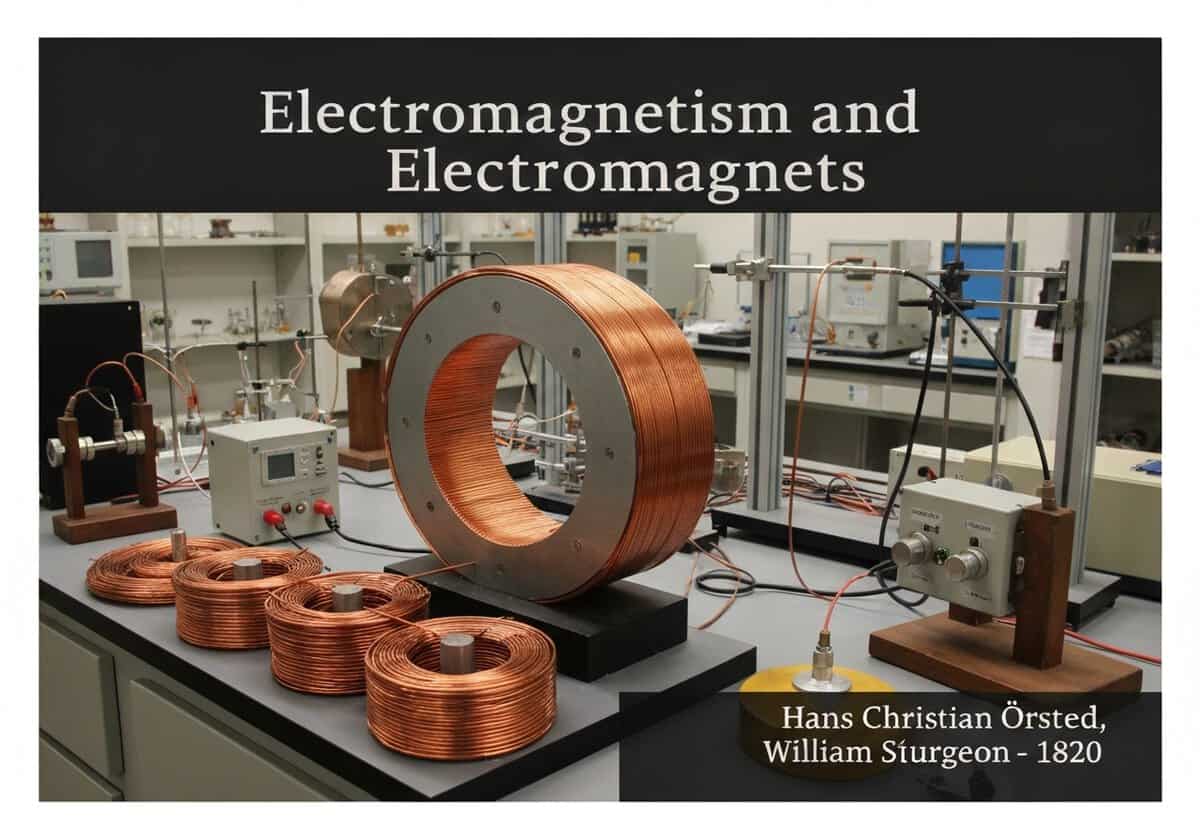
Electromagnet in a laboratory demonstrating electromagnetism principles.

(generated image for illustration only)

An electromagnet is a type of magnet in which the magnetic field is produced by an electric current. The field disappears when the current is turned off. Typically, it consists of a wire wound into a coil. The strength of the magnetic field is proportional to the current and the number of turns in the coil. This principle was discovered by Hans Christian Ørsted.
In 1820, Hans Christian Ørsted discovered that an electric current produces a magnetic field, a foundational moment in physics that linked electricity and magnetism. Shortly after, in 1824, William Sturgeon created the first practical electromagnet by wrapping a current-carrying wire around an iron core. The iron core significantly enhances the magnetic field, a phenomenon known as magnetic permeability. The core becomes strongly magnetized by the field from the coil, and its own magnetic field adds to the coil’s, creating a much stronger total field. This is a form of induced magnetism.

The direction of the magnetic field can be determined by the right-hand grip rule: if the fingers of the right hand are curled in the direction of the current flow around the coil, the thumb points in the direction of the magnetic north pole. The key advantage of an electromagnet over a permanent magnet is that its magnetic field can be rapidly changed by controlling the amount of electric current in the winding. This control is the basis for a vast array of modern technologies, from simple relays that act as electrically-controlled switches to the powerful superconducting magnets used in MRI scanners and particle accelerators, which require enormous magnetic fields.

UNESCO Nomenclature: 2212
– Electromagnetism

Type

Physical Device

Disruption

Revolutionary

Usage

Widespread Use

Precursors

  • invention of the voltaic pile (battery) by Alessandro Volta
  • understanding of electric circuits
  • knowledge of permanent magnets (lodestones)

Applications

  • electric motors and generators
  • relays and solenoids
  • loudspeakers
  • mri machines
  • particle accelerators
  • magnetic levitation (maglev) trains
  • scrap yard cranes

Patents:

NA

Potential Innovations Ideas

Due to scrapping bot traffic, currently more than 40k per day, this content is reserved to community members.
> Login < or > Register < (100% free) to access this, so as all other restricted content and tools.

Related to: electromagnet, electromagnetism, Øersted, Sturgeon, electric current, magnetic field, solenoid, coil, right-hand rule, induced magnetism.

Historical Context

Electromagnetism and Electromagnets

1816
1816-11-16
1820
1820
1822
1824
1827
1811
1816-11-16
1820
1820
1821
1822
1827
1831

(if date is unknown or not relevant, e.g. "fluid mechanics", a rounded estimation of its notable emergence is provided)

Related Invention, Innovation & Technical Principles

Full size images and downloads are only available, 100% free, for registered members.

> Login <