Product Design, Manufacturing & Innovation Resources
Home » Electromagnetic Waves

Electromagnetic Waves

1865
  • James Clerk Maxwell (prediction)
  • Heinrich Hertz (demonstration)
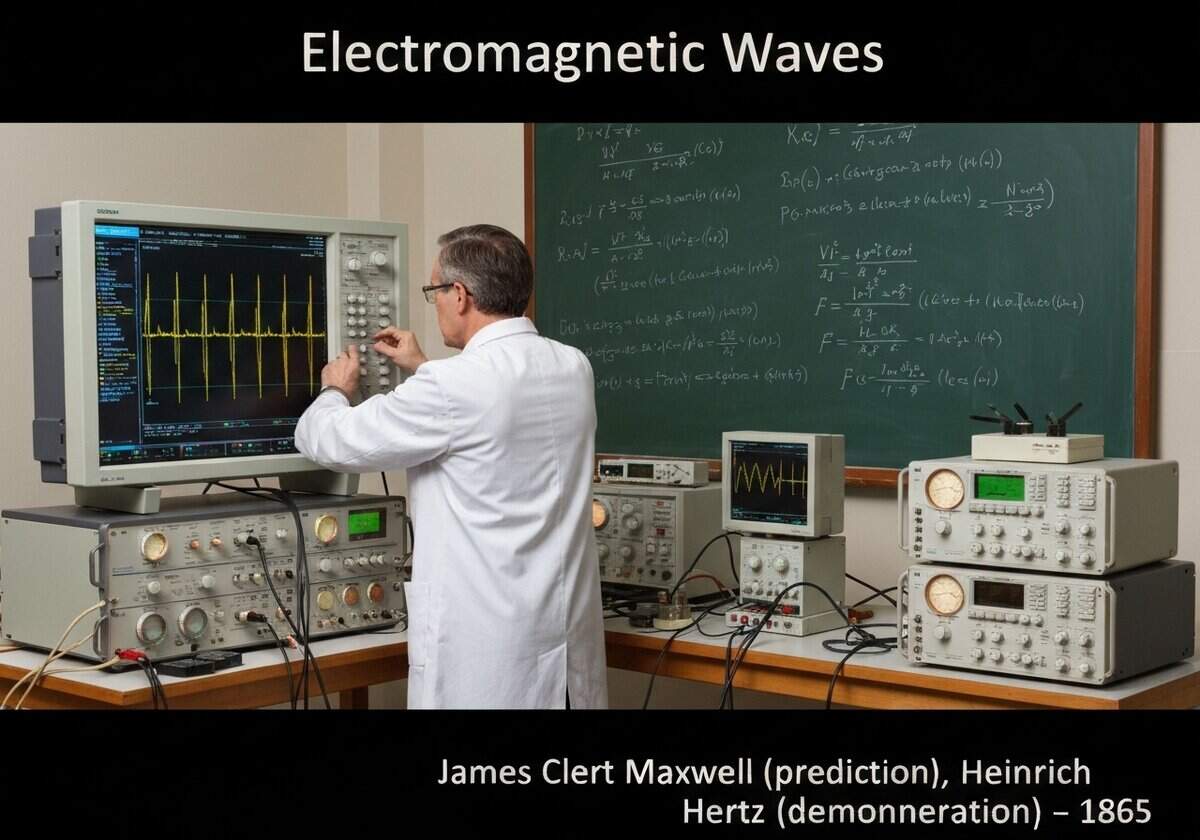
Laboratory experiment demonstrating electromagnetic waves with oscilloscope and equations.

(generated image for illustration only)

Electromagnetic waves are disturbances of the electromagnetic field that propagate through space, carrying energy. They are created by accelerating electric charges and consist of synchronized, perpendicular oscillations of electric and magnetic fields. In a vacuum, they travel at the speed of light, \(c\). The electromagnetic spectrum encompasses radio waves, microwaves, infrared, visible light, ultraviolet, X-rays, and gamma rays.

The existence of electromagnetic waves was a direct theoretical consequence of Maxwell’s equations. By manipulating the equations for a region of space with no charges or currents, one can derive the wave equation for both the electric and magnetic fields. For the electric field, this equation is \(\nabla^2 \mathbf{E} = \mu_0 \varepsilon_0 \frac{\partial^2 \mathbf{E}}{\partial t^2}\). This is the standard mathematical form of a wave equation, where the propagation speed is given by \(v = 1/\sqrt{\mu_0 \varepsilon_0}\). Using the experimentally determined values for the vacuum permeability (\(\mu_0\)) and permittivity (\(\varepsilon_0\)), this speed was calculated to be the known speed of light, \(c\).

This theoretical unification was a monumental achievement, proving that light is an electromagnetic phenomenon. These waves are transverse, meaning the electric and magnetic field oscillations are perpendicular to each other and also perpendicular to the direction of energy propagation. The experimental confirmation came in the 1880s when Heinrich Hertz generated and detected radio waves in his laboratory, verifying Maxwell’s prediction and paving the way for radio communication and all subsequent wireless technologies.

UNESCO Nomenclature: 2205
– Electricity and Magnetism

Type

Physical Phenomenon

Disruption

Revolutionary

Usage

Widespread Use

Precursors

  • Maxwell’s equations
  • Wave theory of light (Huygens, Young, Fresnel)
  • Experiments on electricity and magnetism by Faraday and Ampère
  • Accurate measurement of the speed of light by Fizeau and Foucault

Applications

  • all forms of wireless communication
  • medical imaging (x-rays)
  • heating (microwaves)
  • remote sensing and astronomy
  • vision and optics
  • spectroscopy
  • radar

Patents:

NA

Potential Innovations Ideas

Due to scrapping bot traffic, currently more than 40k per day, this content is reserved to community members.
> Login < or > Register < (100% free) to access this, so as all other restricted content and tools.

Related to: electromagnetic wave, electromagnetic radiation, speed of light, Maxwell’s equations, Hertz, spectrum, light, radio waves, transverse wave, photon.

Historical Context

Electromagnetic Waves

1859
1860
1861
1865
1869
1871
1876
1854
1859
1861
1865
1868
1870
1873
1877

(if date is unknown or not relevant, e.g. "fluid mechanics", a rounded estimation of its notable emergence is provided)

Full size images and downloads are only available, 100% free, for registered members.

> Login <