Einstein Field Equations
1915-11
- Albert Einstein
- David Hilbert
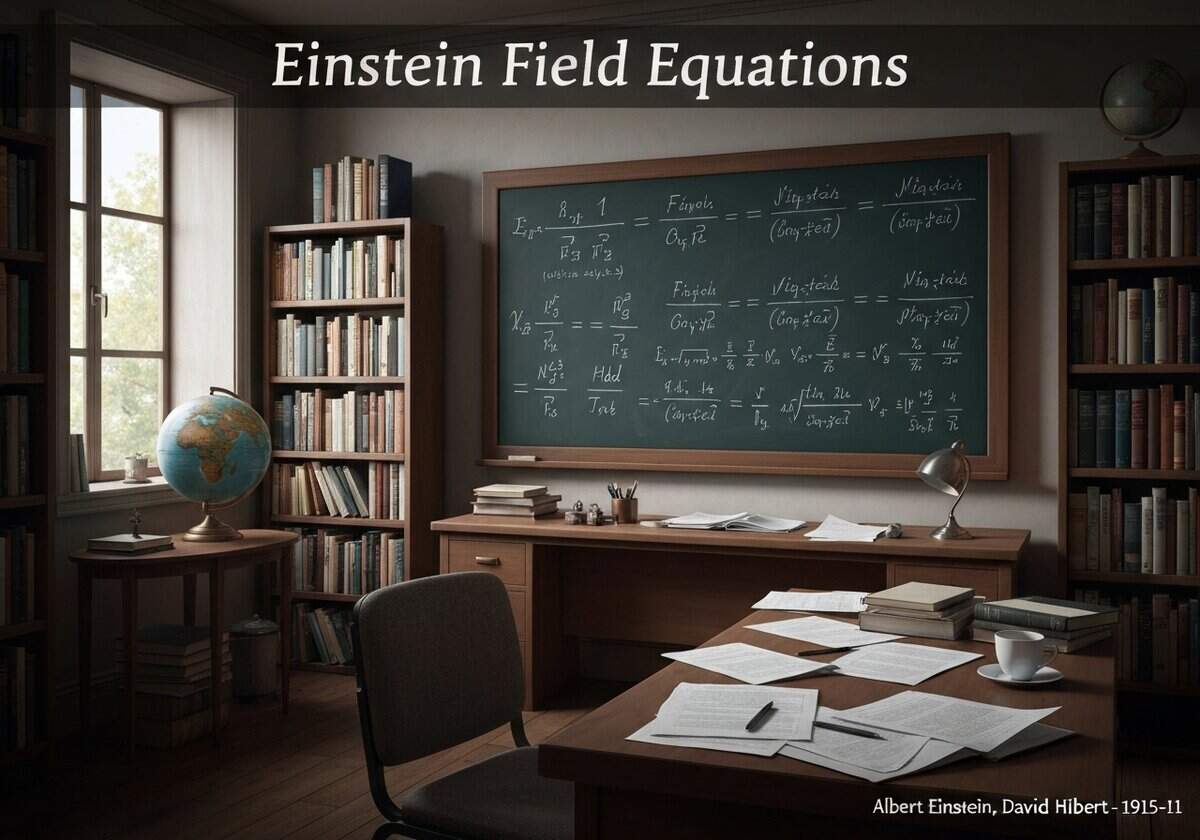
The Einstein Field Equations (EFE) are a set of ten coupled, non-linear partial differential equations that form the core of general relativity. They describe the fundamental interaction of gravitation as a result of spacetime being curved by matter and energy. The equation is concisely written as \(G_{\mu\nu} + \Lambda g_{\mu\nu} = \frac{8\pi G}{c^4} T_{\mu\nu}\), relating spacetime geometry to its energy-momentum content.
These equations are the mathematical foundation of general relativity. In the equation \(G_{\mu\nu} + \Lambda g_{\mu\nu} = \kappa T_{\mu\nu}\), the left side represents the geometry of spacetime, while the right side represents the matter and energy content within it. The Einstein tensor, \(G_{\mu\nu}\), is a specific combination of the Ricci tensor and the scalar curvature, which are derived from the metric tensor \(g_{\mu\nu}\). The metric tensor itself defines all geometric properties of spacetime, such as distance, volume, and curvature. The term \(\Lambda\) is the cosmological constant, originally introduced by Einstein to allow for a static universe and now associated with dark energy and cosmic acceleration.
On the right side, the stress-energy tensor, \(T_{\mu\nu}\), is a mathematical object that describes the density and flux of energy and momentum in spacetime. It acts as the source of the gravitational field, analogous to how mass is the source of gravity in Newton’s theory. The constant \(\kappa = \frac{8\pi G}{c^4}\) is the Einstein gravitational constant, which ensures that the theory’s predictions match Newtonian gravity in the weak-field, low-velocity limit.
Solving these equations is notoriously difficult due to their non-linear nature. The equations show that matter tells spacetime how to curve, and curved spacetime tells matter how to move. This feedback loop is the source of the non-linearity. Only a handful of exact analytical solutions are known, such as the Schwarzschild solution for a spherical mass (a black hole) and the Friedmann–Lemaître–Robertson–Walker (FLRW) metric for a homogeneous, isotropic universe, which forms the basis of modern cosmology.
UNESCO Nomenclature: 2211
– Physics of fields and elementary particles
Precursors
- Newton’s law of universal gravitation
- Special Relativity
- Riemannian geometry
- Tensor calculus
Applications
- cosmology
- black hole physics
- gravitational lensing calculations
- predicting gravitational waves
- GPS accuracy
Potential Innovations Ideas
Due to scrapping bot traffic, currently more than 40k per day, this content is reserved to community members.
> Login < or > Register < (100% free) to access this, so as all other restricted content and tools.
Related to: einstein field equations, general relativity, spacetime curvature, stress-energy tensor, metric tensor, cosmological constant, gravitation, non-linear equations.