Product Design, Manufacturing & Innovation Resources
Home » Direct Stiffness Method

Direct Stiffness Method

1956
  • M. J. Turner
  • R. W. Clough
  • H. C. Martin
  • L. J. Topp
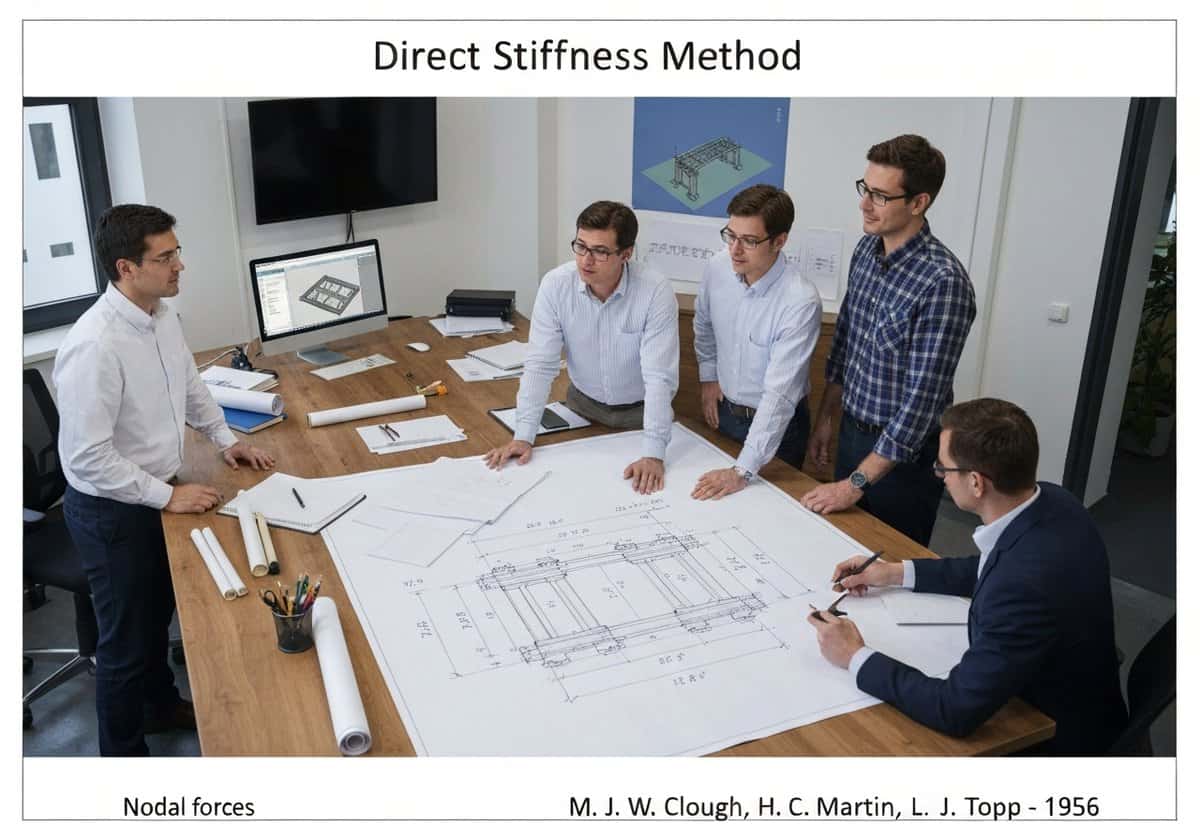
Civil engineering office with structural engineers analyzing bridge design using direct stiffness method.

(generated image for illustration only)

A matrix method of structural analysis fundamental to the finite element method (FEM). It models a structure as an assembly of elements connected at nodes. The method relates nodal forces \({R}\) to nodal displacements \({D}\) through a global stiffness matrix \([K]\), expressed as \([K]{D} = {R}\). Solving this system of linear equations yields the unknown nodal displacements.


The Direct Stiffness Method operationalized structural analysis for computers. The process involves three main stages. First, the structure is discretized into a finite number of elements (e.g., beams, shells, solids), each with a defined stiffness matrix \([k]\) in a local coordinate system. This element stiffness matrix relates forces and displacements at the element’s nodes.

Second, a global stiffness matrix \([K]\) for the entire structure is assembled by systematically combining the individual element stiffness matrices. This assembly process enforces compatibility (displacements must match at shared nodes) and equilibrium (forces must balance at each node). Boundary conditions, such as fixed supports where displacements are zero, are then applied to modify the global system of equations.

Finally, the resulting system of linear algebraic equations, \([K]{D} = {R}\), is solved for the unknown nodal displacements \({D}\). Once the displacements are known, they can be used to calculate the internal strains and stresses within each element, providing a complete picture of the structure’s response to the applied loads.

UNESCO Nomenclature: 3305
– Civil engineering

Type

Software/Algorithm

Disruption

Incremental

Usage

Widespread Use

Precursors

  • matrix algebra
  • concept of stiffness from classical mechanics
  • framework analysis methods like the slope-deflection method
  • early computational machines
  • theory of elasticity

Applications

  • finite element analysis (fea) software (e.g., ansys, abaqus, nastran)
  • computer-aided design (cad) and engineering (cae) systems
  • aerospace vehicle design
  • civil engineering infrastructure design (bridges, dams, skyscrapers)
  • biomechanical analysis of implants and tissues

Patents:

NA

Potential Innovations Ideas

Due to scrapping bot traffic, currently more than 40k per day, this content is reserved to community members.
> Login < or > Register < (100% free) to access this, so as all other restricted content and tools.

Related to: direct stiffness method, matrix analysis, finite element method, fem, stiffness matrix, nodal displacement, structural mechanics, computational analysis, civil engineering, aerospace engineering.

Historical Context

Direct Stiffness Method

1950
1950
1955
1956
1960
1960
1960
1950
1950
1950
1955
1958
1960
1960
1960

(if date is unknown or not relevant, e.g. "fluid mechanics", a rounded estimation of its notable emergence is provided)

Related Invention, Innovation & Technical Principles

Full size images and downloads are only available, 100% free, for registered members.

> Login <