Product Design, Manufacturing & Innovation Resources
Home » Depth of Discharge (DoD)

Depth of Discharge (DoD)

1980
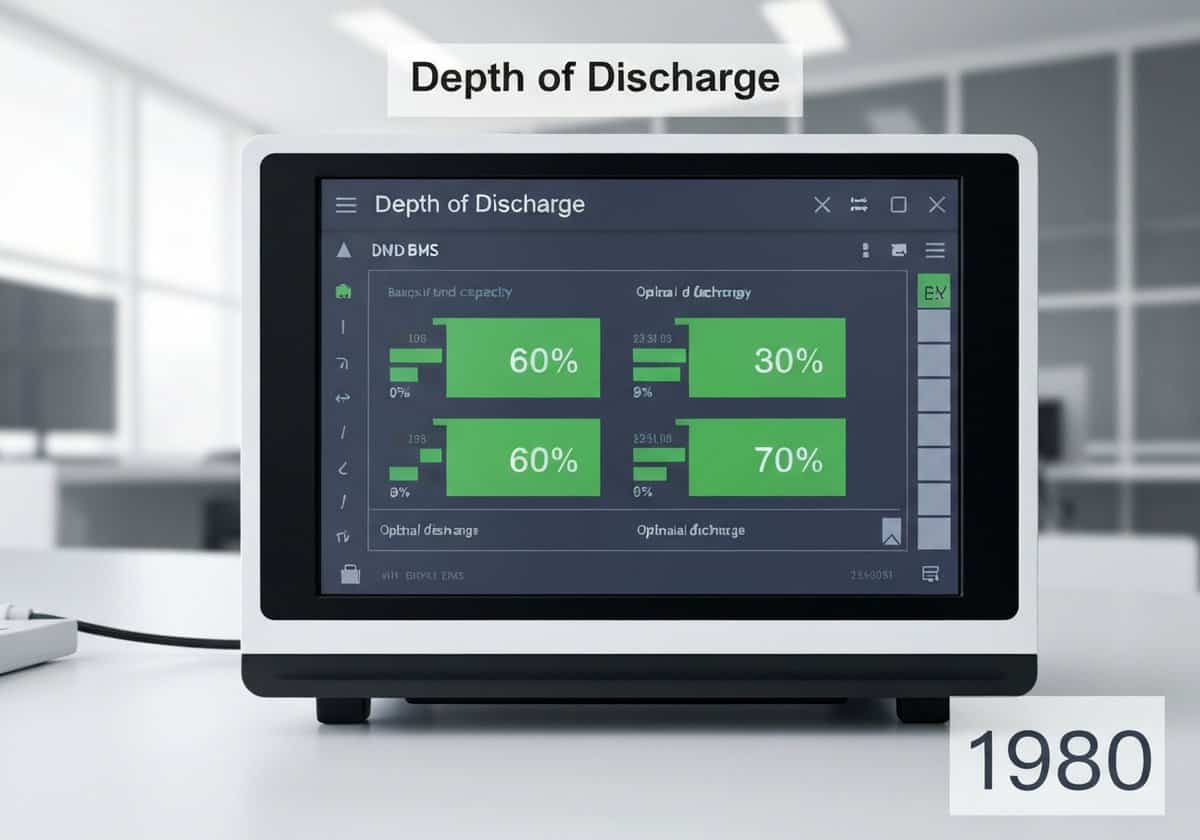
Battery management system interface showing Depth of Discharge metrics for electric vehicles.

(generated image for illustration only)

Depth of Discharge (DoD) indicates the percentage of a battery’s capacity that has been discharged. It is the inverse of State of Charge (SoC), where 100% DoD means the battery is empty. A battery’s cycle life is highly dependent on its average DoD; lower DoD cycles (e.g., discharging to only 80% capacity) significantly increase the number of cycles a battery can endure.

Depth of Discharge is a critical concept for the practical application and longevity of rechargeable batteries. While a battery has a nominal capacity, using 100% of that capacity in every cycle causes maximum stress on the battery’s internal components, leading to faster degradation. This degradation can manifest as capacity fade (a permanent loss of energy storage ability) or an increase in internal resistance. For example, a lithium-ion battery might last for 500 cycles if regularly discharged to 100% DoD, but could last for several thousand cycles if only discharged to 50% DoD.

This relationship is not linear and varies significantly between battery chemistries. Lead-acid batteries are particularly sensitive to deep discharge, while some lithium chemistries like Lithium Iron Phosphate (LFP) are more robust and can handle higher DoD with less degradation. Battery Management Systems (BMS) actively use the DoD concept. They often limit the user-accessible capacity, creating buffers at the top and bottom of the charge range. For instance, when an EV shows ‘100%’ charge, it might only be at 95% of its true maximum charge, and ‘0%’ might correspond to 10% of its true capacity, thereby avoiding the high-stress regions and extending the battery pack’s service life.

UNESCO Nomenclature: 2204
– Electrochemistry

Type

Abstract System

Disruption

Incremental

Usage

Widespread Use

Precursors

  • understanding of material fatigue and stress in mechanical systems
  • empirical studies on battery degradation and failure modes
  • development of microcontrollers capable of implementing battery management algorithms

Applications

  • battery management systems (bms) in evs to prolong battery life
  • optimizing grid-scale storage systems for longevity
  • programming off-grid solar power systems
  • extending the lifespan of consumer electronics
  • calculating usable capacity in uninterruptible power supplies (ups)

Patents:

NA

Potential Innovations Ideas

Due to scrapping bot traffic, currently more than 40k per day, this content is reserved to community members.
> Login < or > Register < (100% free) to access this, so as all other restricted content and tools.

Related to: depth of discharge, DoD, state of charge, SoC, cycle life, battery degradation, battery management system, BMS, capacity fade, lithium-ion.

Historical Context

Depth of Discharge (DoD)

1970
1975
1980
1980
1980
1984
1986
1970
1974-11-15
1980
1980
1980
1984
1985
1986

(if date is unknown or not relevant, e.g. "fluid mechanics", a rounded estimation of its notable emergence is provided)

Related Invention, Innovation & Technical Principles

Full size images and downloads are only available, 100% free, for registered members.

> Login <