Product Design, Manufacturing & Innovation Resources
Home » Concentrated Solar Power (CSP)

Concentrated Solar Power (CSP)

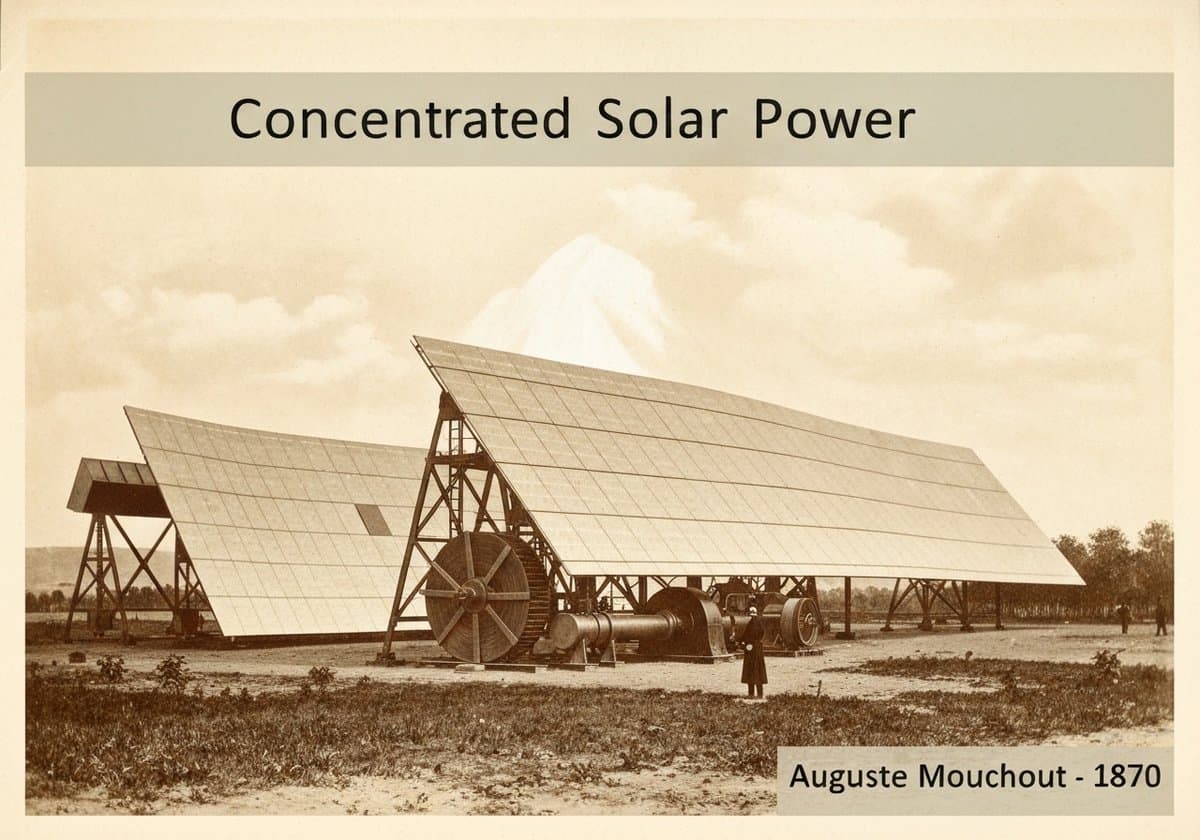
1870
  • Auguste Mouchout
Concentrated solar power system with mirrors and steam turbine by Auguste Mouchout.

(generated image for illustration only)

Concentrated solar power systems use mirrors or lenses to concentrate a large area of sunlight onto a receiver. The concentrated light heats a fluid, which then drives a heat engine (usually a steam turbine) connected to an electrical power generator. This method contrasts with photovoltaics, which convert light directly into electricity. CSP allows for thermal energy storage.
Concentrated solar power technology harnesses thermal energy from the sun. There are several primary designs. Parabolic troughs use curved mirrors to focus sunlight onto a receiver tube running along the focal line, heating a fluid (like synthetic oil) that passes through it. Solar power towers, or central receivers, use a large field of computer-controlled mirrors called heliostats to track the sun and reflect its light onto a central receiver atop a tower. This receiver contains a heat-transfer fluid, such as molten salt, which can reach very high temperatures (over 565 °C). Dish-Stirling systems use a parabolic dish to focus sunlight onto a receiver at the dish’s focal point, where it heats a gas (like hydrogen or helium) to drive a Stirling engine. A key advantage of CSP, particularly tower and trough designs, is the ability to integrate thermal energy storage. The heated fluid, often molten salt, can be stored in large insulated tanks. This stored heat can be used to generate steam and produce electricity whenever needed, including at night or during cloudy periods, making CSP a more dispatchable form of solar energy compared to photovoltaics.

The historical roots of CSP go back centuries, with legends of Archimedes using mirrors to set ships on fire. The first modern solar steam engine was built by Auguste Mouchout in the 1860s. However, the technology saw limited development until the energy crises of the 1970s spurred renewed interest. The first commercial-scale CSP plants were built in the 1980s in California’s Mojave Desert.

UNESCO Nomenclature: 3322
– Power engineering

Type

Engineering System

Disruption

Incremental

Usage

Niche/Specialized

Precursors

  • understanding of optics and reflection (ancient greece)
  • invention of the steam engine (18th century)
  • development of thermodynamics
  • advances in materials science for high-temperature fluids and receivers

Applications

  • utility-scale electricity generation
  • thermal energy storage for dispatchable power
  • solar-powered desalination plants
  • industrial process heat generation
  • production of solar fuels like hydrogen

Patents:

NA

Potential Innovations Ideas

Due to scrapping bot traffic, currently more than 40k per day, this content is reserved to community members.
> Login < or > Register < (100% free) to access this, so as all other restricted content and tools.

Related to: CSP, concentrated solar power, heliostat, parabolic trough, solar tower, stirling engine, thermal energy storage, molten salt, dispatchable power, renewable energy.

Historical Context

Concentrated Solar Power (CSP)

1850
1850
1860
1870
1876
1882-01-01
1886-04-23
1850
1850
1850
1867
1875-01-01
1881
1884
1890

(if date is unknown or not relevant, e.g. "fluid mechanics", a rounded estimation of its notable emergence is provided)

Full size images and downloads are only available, 100% free, for registered members.

> Login <