Product Design, Manufacturing & Innovation Resources
Home » CNC Motion Interpolation

CNC Motion Interpolation

1950
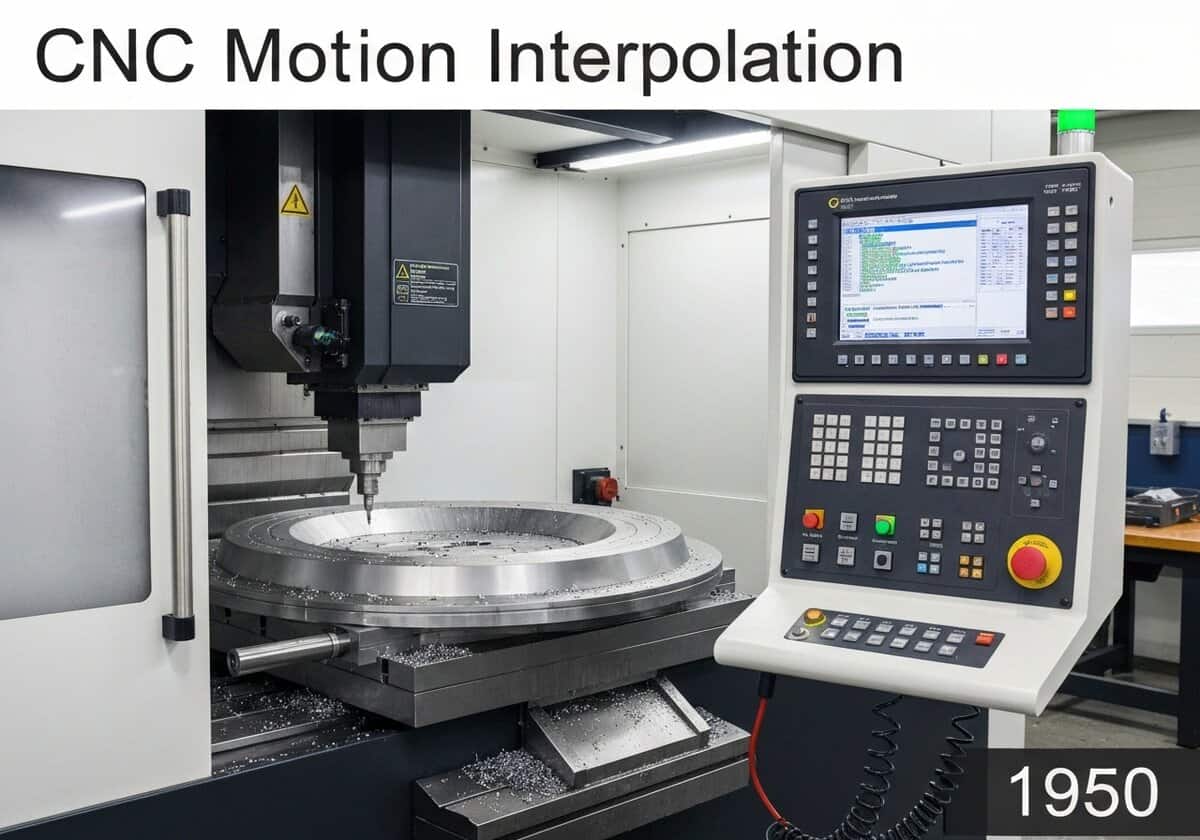
CNC machine executing motion interpolation for complex geometries in applied mathematics.

(generated image for illustration only)

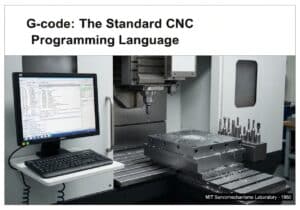
Interpolation is the computational process within a CNC controller that generates a sequence of intermediate coordinate points to create a smooth path between programmed endpoints. The most fundamental types are linear interpolation (G01) for straight lines and circular interpolation (G02/G03) for arcs. This allows complex profiles to be machined from simple geometric commands in the G-code program.


The interpolator is the mathematical heart of a CNC controller. Without it, a machine could only move from one absolute point to another in a disjointed, ‘point-to-point’ fashion. The interpolator enables ‘contouring’, or continuous path control, which is essential for all modern machining. When the controller reads a G-code block like ‘G01 X10 Y20’, it knows the current position (e.g., X0 Y0) and the target position. The interpolator’s job is to break down this single vector into a series of very small, discrete step commands for each axis motor (e.g., X and Y). It calculates the required velocity for each axis so that they start and stop simultaneously, resulting in a perfectly straight line between the two points. The algorithm used is often a variation of a Digital Differential Analyzer (DDA) or Bresenham’s line algorithm.

For circular interpolation (G02/G03), the calculation is more complex. The G-code provides the start point (current position), the end point, and the center of the circle (or the radius). The interpolator must then calculate a series of intermediate points that lie on the specified arc. It does this by solving the circle equation incrementally, generating coordinated velocity commands for the X and Y axes that maintain the correct tangential speed and radial distance. Advanced CNC controllers feature higher-order interpolation, such as helical (combining circular motion with linear motion in a third axis), spline, or NURBS (Non-Uniform Rational B-Spline) interpolation. NURBS interpolation is particularly powerful as it allows the machine to follow complex, free-form curves defined by a single mathematical equation, resulting in smoother motion and better surface finishes than approximating the curve with many small linear segments.

UNESCO Nomenclature: 1202
– Applied mathematics

Type

Software/Algorithm

Disruption

Foundational

Usage

Widespread Use

Precursors

  • coordinate geometry (cartesian and polar systems)
  • differential equations describing motion
  • development of digital computing hardware
  • numerical analysis methods like the digital differential analyzer (DDA)

Applications

  • machining of curved surfaces and complex geometries
  • robot arm trajectory planning
  • 3d printing layer path generation
  • automated welding along non-linear seams
  • computer graphics for rendering smooth curves
  • automated inspection and scanning paths

Patents:

NA

Potential Innovations Ideas

Due to scrapping bot traffic, currently more than 40k per day, this content is reserved to community members.
> Login < or > Register < (100% free) to access this, so as all other restricted content and tools.

Related to: interpolation, cnc, linear interpolation, circular interpolation, nurbs, toolpath, controller, numerical analysis, dda, contouring.

Historical Context

CNC Motion Interpolation

1936
1940
1943
1950
1950
1953
1960
1931
1939
1940
1950
1950
1952
1956
1960

(if date is unknown or not relevant, e.g. "fluid mechanics", a rounded estimation of its notable emergence is provided)

Related Invention, Innovation & Technical Principles

Full size images and downloads are only available, 100% free, for registered members.

> Login <