Product Design, Manufacturing & Innovation Resources
Home » Cauchy Stress Tensor

Cauchy Stress Tensor

1822
  • Augustin-Louis Cauchy
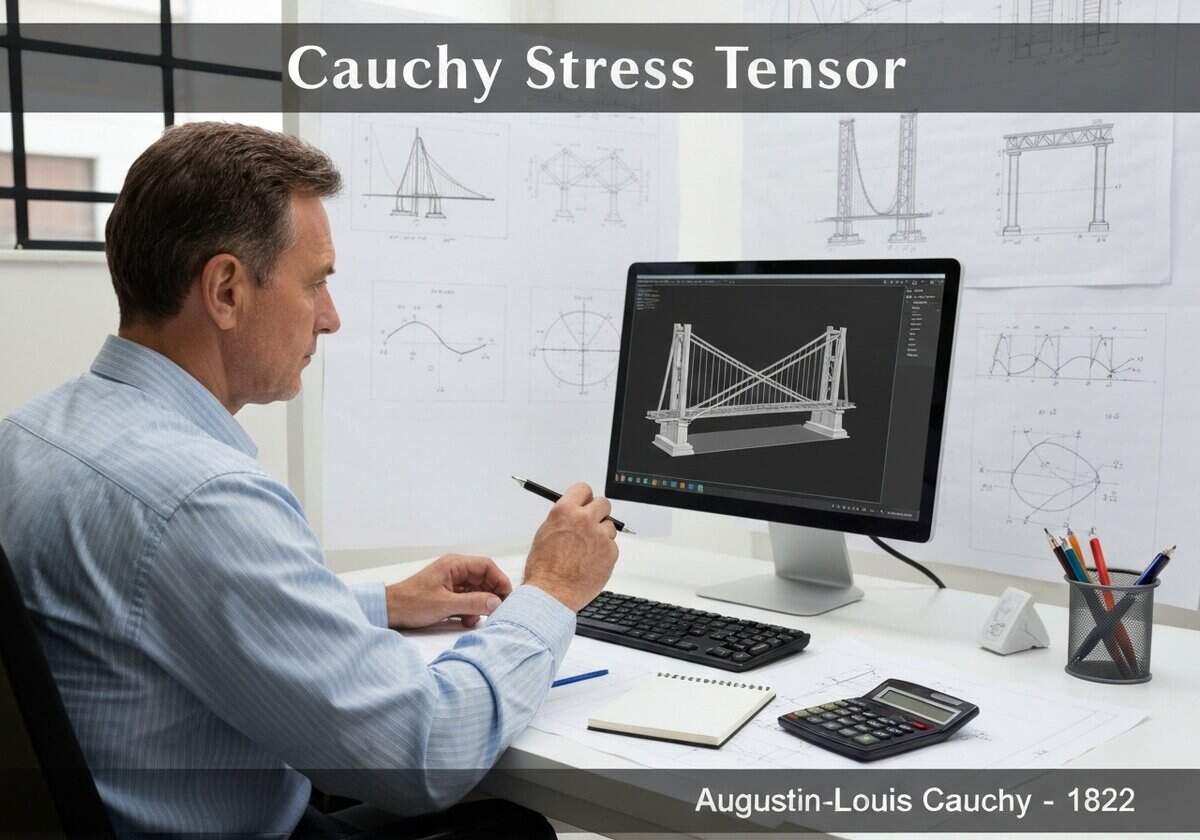
Structural engineer analyzing stress in bridge design using Cauchy stress tensor principles.

(generated image for illustration only)

The Cauchy stress tensor, denoted \(\boldsymbol{\sigma}\), is a second-order tensor that completely defines the state of stress at a point inside a material. It relates the traction vector (force per unit area) \(\mathbf{T}\) on any surface passing through that point to the surface’s normal vector \(\mathbf{n}\) via the linear relationship \(\mathbf{T} = \boldsymbol{\sigma} \cdot \mathbf{n}\).

The Cauchy stress tensor provides a complete description of the internal forces acting within a deformable body. Imagine an infinitesimal cube of material at a point P. Forces are exerted on each face of this cube by the surrounding material. The stress tensor \(\boldsymbol{\sigma}\) is a 3×3 matrix whose components \(\sigma_{ij}\) represent the stress on the i-th face in the j-th direction. The diagonal components (\(\sigma_{11}, \sigma_{22}, \sigma_{33}\)) are normal stresses, representing pulling (tension) or pushing (compression) perpendicular to the face. The off-diagonal components (\(\sigma_{12}, \sigma_{23},\) etc.) are shear stresses, representing forces acting parallel to the face.

A key result, known as Cauchy’s stress theorem, states that knowledge of the stress vectors on three mutually perpendicular planes is sufficient to determine the stress vector on any other plane passing through that point. This is encapsulated in the formula \(\mathbf{T}^{(\mathbf{n})} = \boldsymbol{\sigma}^T \mathbf{n}\). Furthermore, the conservation of angular momentum requires the stress tensor to be symmetric (\(\sigma_{ij} = \sigma_{ji}\)), which reduces the number of independent components from nine to six. This tensor is fundamental because it allows engineers to analyze the stress state at any point within an object, regardless of its orientation, and to predict whether the material will yield or fracture under applied loads by comparing the stress state to the material’s strength properties.

UNESCO Nomenclature: 2210
– Mechanics

Type

Abstract System

Disruption

Foundational

Usage

Widespread Use

Precursors

  • Newton’s laws of motion
  • Euler’s concept of pressure in fluids
  • The mathematical framework of vectors and matrices (tensors)
  • Coulomb’s work on friction and soil mechanics

Applications

  • structural analysis of buildings, bridges, and aircraft to predict failure
  • geomechanics for analyzing stresses in rock and soil for tunneling and foundation design
  • materials science for understanding material failure mechanisms like fracture and fatigue
  • biomechanics for calculating stresses in bones and tissues under load

Patents:

NA

Potential Innovations Ideas

Due to scrapping bot traffic, currently more than 40k per day, this content is reserved to community members.
> Login < or > Register < (100% free) to access this, so as all other restricted content and tools.

Related to: stress, tensor, Cauchy stress tensor, normal stress, shear stress, traction vector, continuum mechanics, internal forces.

Historical Context

Cauchy Stress Tensor

1820
1820
1821
1822
1827
1831
1831
1816-11-16
1820
1820
1822
1824
1827
1831
1831

(if date is unknown or not relevant, e.g. "fluid mechanics", a rounded estimation of its notable emergence is provided)

Related Invention, Innovation & Technical Principles

Full size images and downloads are only available, 100% free, for registered members.

> Login <