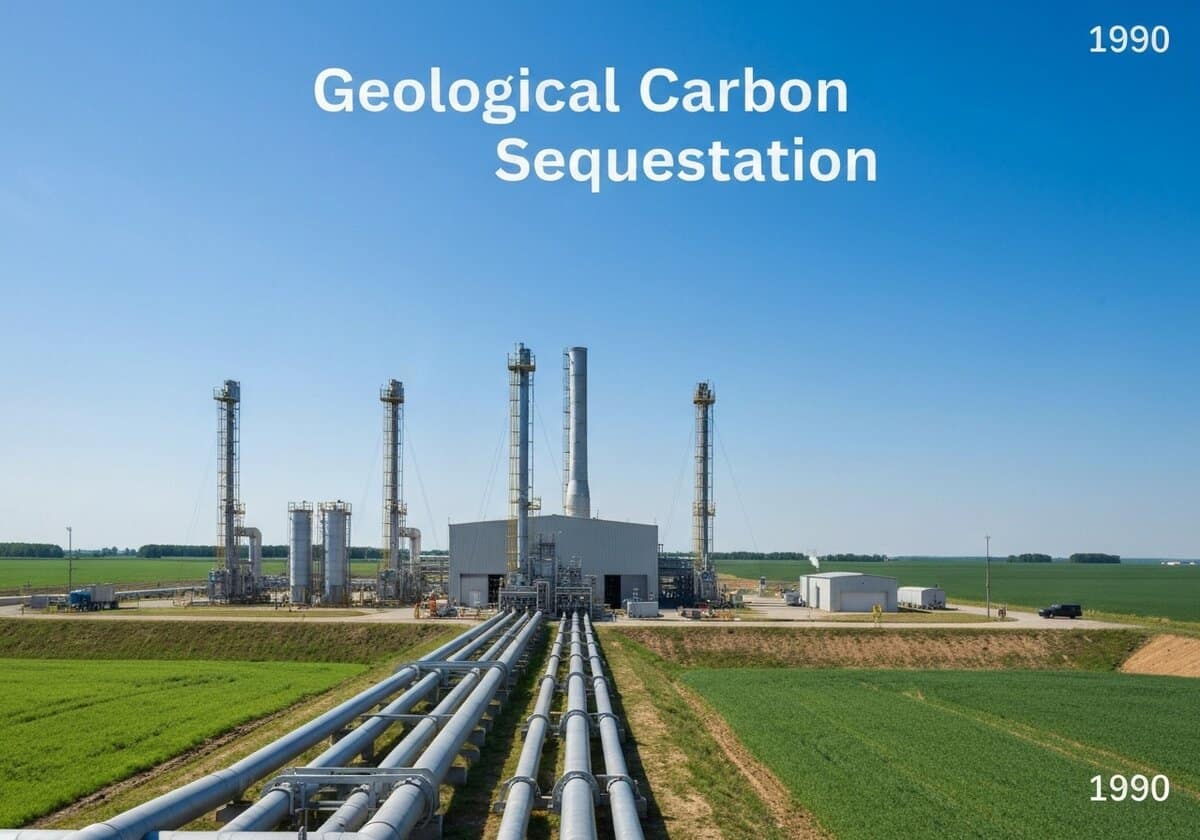
Geological Carbon Sequestration
The process of capturing carbon dioxide (CO2) from large point sources like power plants and injecting it into deep underground rock formations for long-term storage. Suitable formations include saline aquifers, depleted oil and gas reservoirs, and unmineable coal seams. The CO2 is trapped by an impermeable caprock and through various physical and chemical mechanisms, preventing its atmospheric release.
Geological sequestration is a key component of Carbon Capture and Storage (CCS) strategies. The process begins with capturing CO2, typically from industrial flue gas, compressing it into a supercritical fluid, and then injecting it deep underground, usually at depths greater than 800 meters. At these depths, the pressure and temperature keep the CO2 in a dense, liquid-like state, allowing for efficient storage.
Several trapping mechanisms ensure the long-term containment of the CO2. The primary mechanism is structural trapping, where an impermeable layer of rock, known as a caprock (e.g., shale or salt), acts as a physical barrier, preventing the buoyant CO2 from migrating upwards. Over time, other mechanisms become important. Residual trapping immobilizes CO2 as disconnected droplets in the pore spaces of the rock. Solubility trapping involves the CO2 dissolving into the formation water (brine). The slowest but most permanent mechanism is mineral trapping, where the dissolved CO2 reacts with minerals in the host rock to form stable carbonate minerals, effectively locking the carbon into a solid state.
Site selection is critical and involves extensive geological characterization to ensure the storage reservoir has adequate porosity and permeability, and that the caprock has sufficient integrity to prevent leaks. Long-term monitoring, using techniques like seismic imaging and atmospheric CO2 sensing, is essential to verify containment and ensure the safety of the storage site.
UNESCO Nomenclature: 2505
– Geology
Precursors
- understanding of petroleum geology and reservoir mechanics
- development of enhanced oil recovery (EOR) techniques
- advances in seismic imaging and well-drilling technology
- knowledge of fluid dynamics in porous media
- basic principles of geochemistry and mineralogy
Applications
- sleipner CO2 storage project (norway)
- weyburn-midale CO2 project (canada)
- gorgon carbon dioxide injection project (australia)
- enhanced oil recovery (EOR) operations worldwide
Potential Innovations Ideas
Due to scrapping bot traffic, currently more than 40k per day, this content is reserved to community members.
> Login < or > Register < (100% free) to access this, so as all other restricted content and tools.
Related to: geological sequestration, carbon capture and storage, saline aquifer, depleted oil reservoir, caprock, CO2 injection, climate change mitigation, CCS, supercritical CO2, geochemistry.