Product Design, Manufacturing & Innovation Resources
Home » Beer-Lambert Law

Beer-Lambert Law

1852
  • Pierre Bouguer
  • Johann Heinrich Lambert
  • August Beer
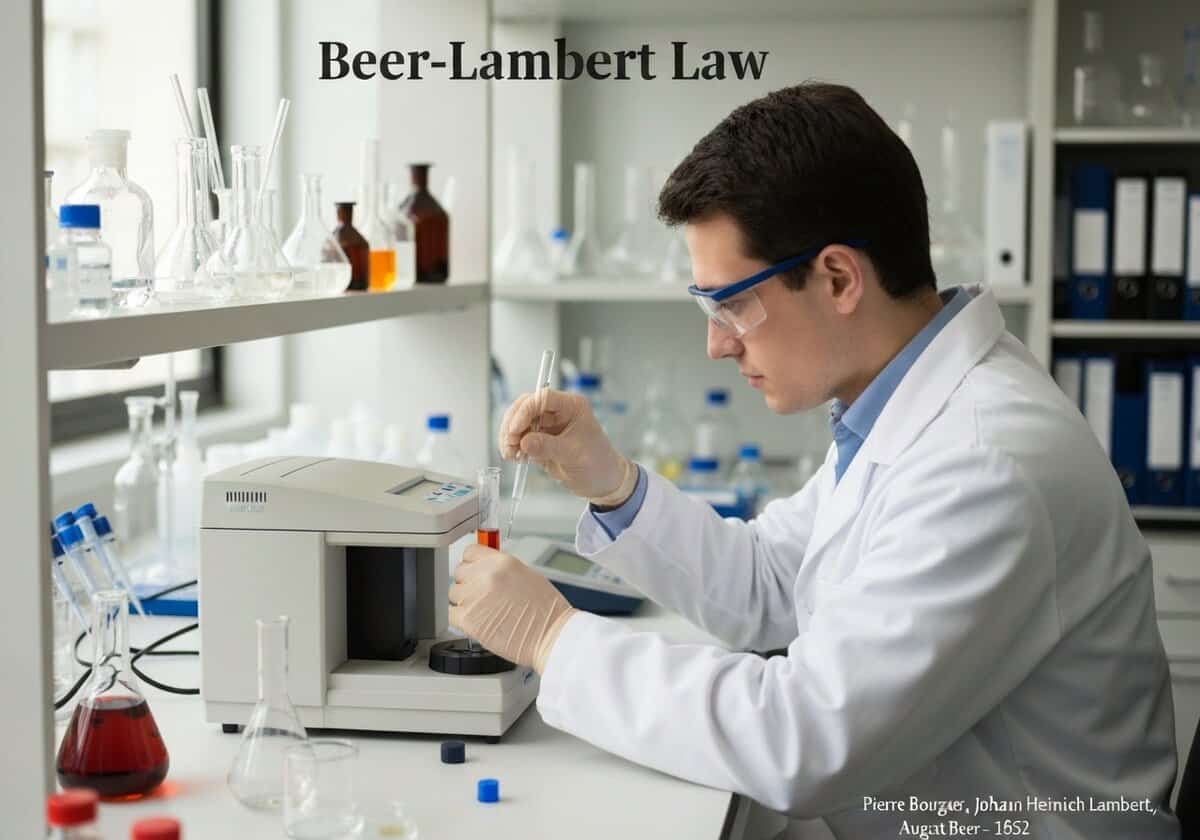
Laboratory analysis of absorbance using UV-Vis spectroscopy in analytical chemistry.

(generated image for illustration only)

The Beer-Lambert law relates the attenuation of light to the properties of the material through which it is traveling. It states that the absorbance (\(A\)) of a solution is directly proportional to the concentration (\(c\)) of the absorbing species and the path length (\(l\)) of the light through the solution. The relationship is expressed as \(A = \epsilon c l\), where \(\epsilon\) is the molar absorptivity.
The Beer-Lambert law, also known as the Beer–Lambert–Bouguer law, is the cornerstone of quantitative absorption spectroscopy. It combines the findings of several scientists over more than a century. Pierre Bouguer (1729) and Johann Lambert (1760) established that the fraction of light absorbed is proportional to the thickness of the absorbing medium. August Beer (1852) then discovered that the absorbance is also proportional to the concentration of the absorbing substance in a solution. The law is typically written as \(A = \log_{10}(I_0/I) = \epsilon c l\), where \(I_0\) is the intensity of the incident light and \(I\) is the intensity of the transmitted light. The molar absorptivity, \(\epsilon\), is a constant that is characteristic of the absorbing substance at a specific wavelength. This means that for a given substance and path length, a plot of absorbance versus concentration will be a straight line, allowing for the creation of a calibration curve. By measuring the absorbance of an unknown sample, its concentration can be determined from this curve. The law holds true for monochromatic light and for dilute solutions where interactions between solute molecules are negligible. Deviations can occur at high concentrations due to chemical and instrumental effects.

UNESCO Nomenclature: 2501
– Analytical chemistry

Type

Physical Law

Disruption

Substantial

Usage

Widespread Use

Precursors

  • Pierre Bouguer’s work on light attenuation in the atmosphere (1729)
  • Johann Heinrich Lambert’s publication “Photometria” formalizing the relationship between absorption and path length (1760)
  • Development of early photometers and colorimeters

Applications

  • quantitative chemical analysis using uv-vis spectroscopy
  • determining concentrations of solutes in solutions
  • atmospheric science to describe solar radiation absorption
  • quality control in beverage and pharmaceutical industries
  • clinical chemistry for measuring components in blood samples

Patents:

NA

Potential Innovations Ideas

Due to scrapping bot traffic, currently more than 40k per day, this content is reserved to community members.
> Login < or > Register < (100% free) to access this, so as all other restricted content and tools.

Related to: Beer-Lambert law, absorbance, concentration, quantitative analysis, spectrophotometry, molar absorptivity, path length, transmittance, analytical chemistry, UV-vis.

Historical Context

Beer-Lambert Law

1650
1800
1852
1900
1912
1940
1940
1950
1800
1838
1872
1910
1940
1940
1946

(if date is unknown or not relevant, e.g. "fluid mechanics", a rounded estimation of its notable emergence is provided)

Related Invention, Innovation & Technical Principles

Full size images and downloads are only available, 100% free, for registered members.

> Login <