Product Design, Manufacturing & Innovation Resources
Lar » Lei Beer-Lambert

Lei Beer-Lambert

1852
  • Pierre Bouguer
  • Johann Heinrich Lambert
  • August Beer
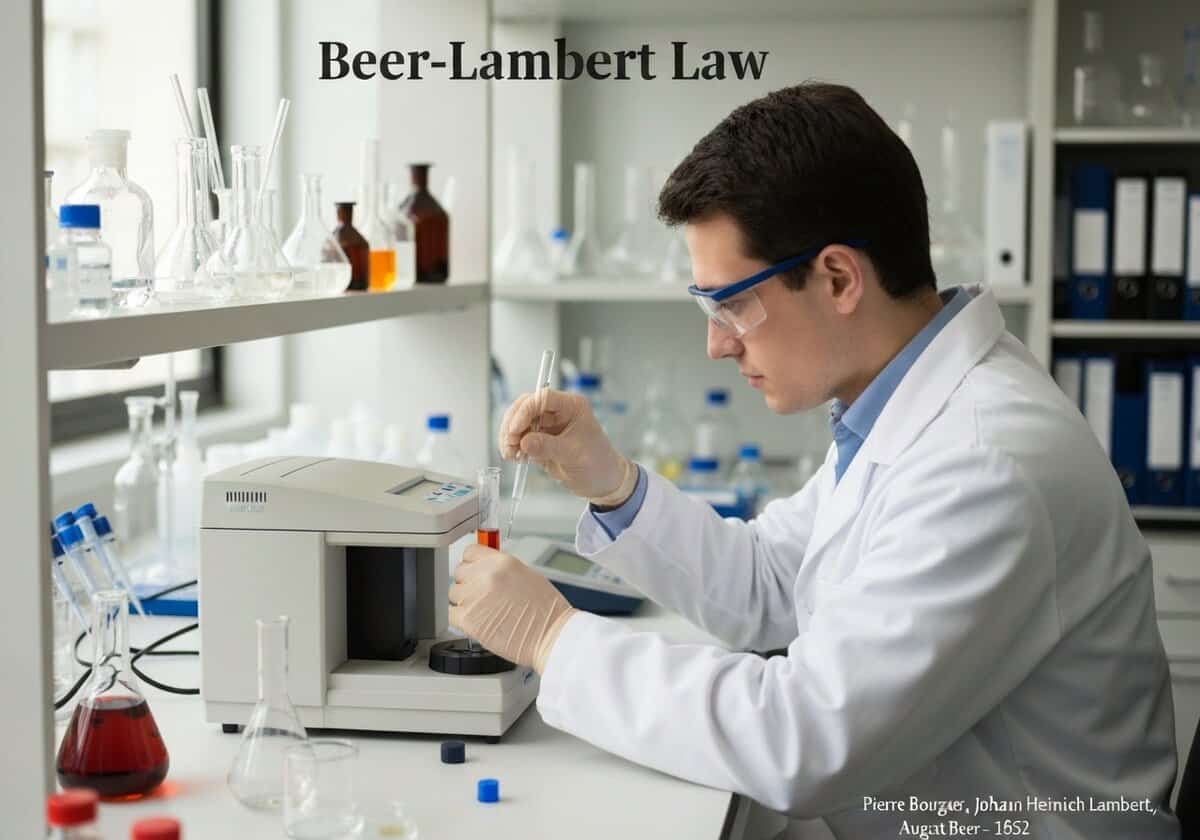
Análise laboratorial de absorbância usando espectroscopia UV-Vis em química analítica.

(Imagem gerada apenas para fins ilustrativos)

A lei de Beer-Lambert relaciona a atenuação da luz às propriedades do material através do qual ela se propaga. Ela afirma que a absorbância (A) de uma solução é diretamente proporcional à concentração (c) da espécie absorvente e ao comprimento do percurso (l) da luz através da solução. A relação é expressa como A = εcl, onde ε é a absortividade molar.
The Beer-Lambert law, also known as the Beer–Lambert–Bouguer law, is the cornerstone of quantitative absorption spectroscopy. It combines the findings of several scientists over more than a century. Pierre Bouguer (1729) and Johann Lambert (1760) established that the fraction of light absorbed is proportional to the thickness of the absorbing medium. August Beer (1852) then discovered that the absorbance is also proportional to the concentration of the absorbing substance in a solution. The law is typically written as [latex]A = \log_{10}(I_0/I) = \epsilon c l[/latex], where [latex]I_0[/latex] is the intensity of the incident light and [latex]I[/latex] is the intensity of the transmitted light. The molar absorptivity, [latex]\epsilon[/latex], is a constant that is characteristic of the absorbing substance at a specific wavelength. This means that for a given substance and path length, a plot of absorbance versus concentration will be a straight line, allowing for the creation of a calibration curve. By measuring the absorbance of an unknown sample, its concentration can be determined from this curve. The law holds true for monochromatic light and for dilute solutions where interactions between solute molecules are negligible. Deviations can occur at high concentrations due to chemical and instrumental effects.

UNESCO Nomenclature: 2501
Química analítica

Tipo

Lei Física

Interrupção

Substancial

Uso

Uso generalizado

Precursores

  • Obra de Pierre Bouguer sobre a atenuação da luz na atmosfera (1729)
  • Johann Heinrich Lambert’s publication “Photometria” formalizing the relationship between absorption and path length (1760)
  • Desenvolvimento dos primeiros fotômetros e colorímetros

Aplicações

  • Análise química quantitativa por espectroscopia UV-Vis
  • Determinação da concentração de solutos em soluções
  • ciência atmosférica para descrever a absorção da radiação solar
  • Controle de qualidade nas indústrias de bebidas e farmacêuticas
  • Química clínica para medir componentes em amostras de sangue

Patentes:

NA

Ideias de Inovação Potencial

Devido ao tráfego de bots de coleta de dados, atualmente superior a 40 mil por dia, este conteúdo é reservado aos membros da comunidade.
> Login < ou > Registrar < (100% gratuito) para acessar isso, assim como todo o restante do conteúdo e das ferramentas restritas.

Relacionado a: Lei de Beer-Lambert, absorbância, concentração, análise quantitativa, espectrofotometria, absortividade molar, comprimento do percurso óptico, transmitância, química analítica, UV-vis.

Contexto histórico

Lei Beer-Lambert

1650
1800
1852
1900
1912
1940
1940
1950
1800
1838
1872
1910
1940
1940
1946

(Caso a data seja desconhecida ou irrelevante, por exemplo, "mecânica dos fluidos", é fornecida uma estimativa aproximada de seu surgimento notável)

Princípios relacionados à invenção, inovação e tecnologia

Imagens em tamanho real e downloads estão disponíveis apenas, 100% gratuitos, para membros registrados.