Product Design, Manufacturing & Innovation Resources
Home » Assumptions of ANOVA

Assumptions of ANOVA

1930
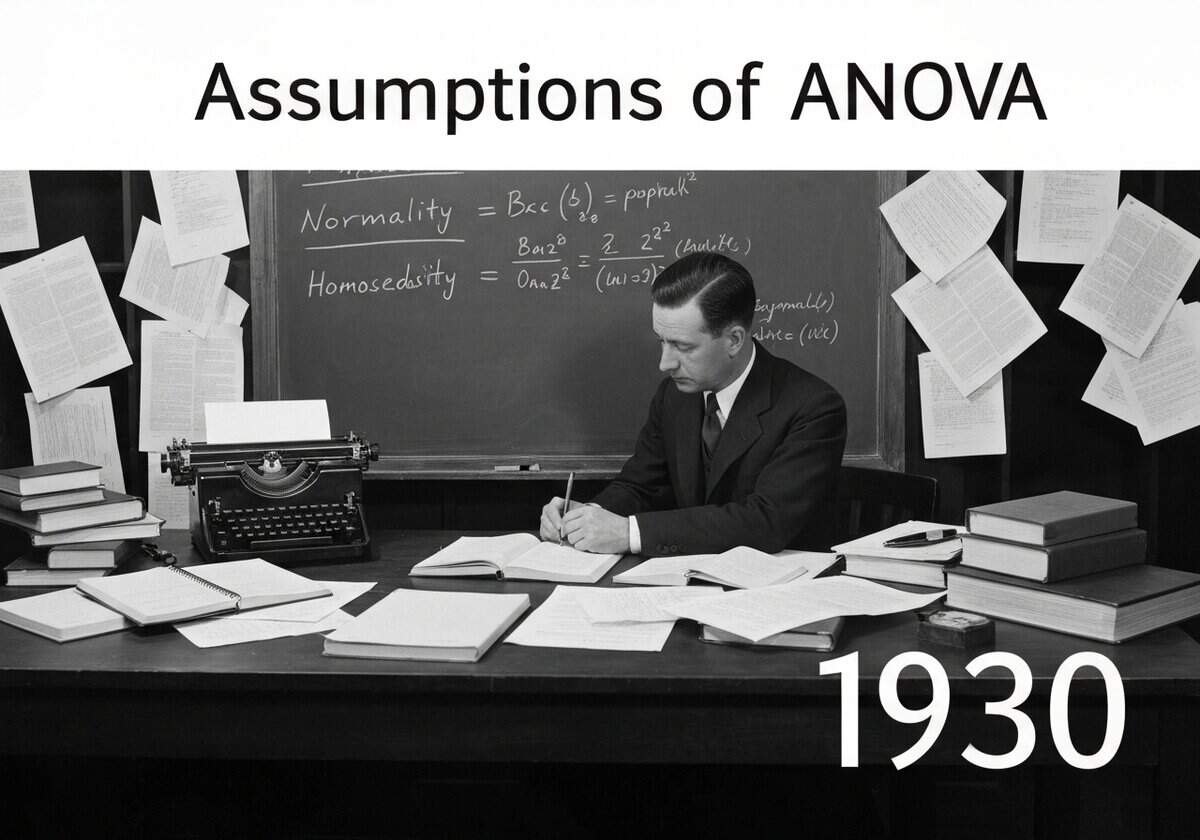
Statistician validating ANOVA assumptions in a 1930s office setting.

(generated image for illustration only)

For the results of an ANOVA to be considered valid, several key assumptions about the data must be met. These are: (1) Independence of observations, meaning the errors are uncorrelated. (2) Normality, where the residuals for each group are approximately normally distributed. (3) Homoscedasticity, or homogeneity of variances, meaning the variance of residuals is equal across all groups.

These assumptions relate to the residuals (the differences between observed values and the group means), not the raw data itself. Independence is the most critical assumption and is typically ensured by proper experimental design and random sampling; violations can lead to severely biased results. Normality means the distribution of residuals within each group should follow a bell curve. ANOVA is considered relatively robust to moderate violations of this assumption, especially with large and balanced sample sizes, due to the Central Limit Theorem. Homoscedasticity (\(\sigma_1^2 = \sigma_2^2 = \dots = \sigma_k^2\)) means the spread or scatter of data points around their group mean should be similar for all groups. Significant violation of this assumption (heteroscedasticity) can increase the rate of Type I errors. Statisticians have developed diagnostic tools to check these assumptions. For example, Q-Q plots can assess normality, and Levene’s test or Bartlett’s test can check for homogeneity of variances. If assumptions are severely violated, researchers may need to transform the data or use alternative statistical methods that do not rely on these assumptions.

UNESCO Nomenclature: 1209
– Statistics

Type

Abstract System

Disruption

Incremental

Usage

Widespread Use

Precursors

  • Central Limit Theorem (Abraham de Moivre, Pierre-Simon Laplace)
  • Theory of the normal distribution (Carl Friedrich Gauss)
  • Concept of statistical residuals from regression models
  • Development of formal hypothesis testing (Jerzy Neyman, Egon Pearson)

Applications

  • diagnostic checking in statistical modeling to ensure validity
  • guiding data transformation (e.g., log transform to correct for heteroscedasticity)
  • informing the choice of non-parametric alternatives like the Kruskal-Wallis test when assumptions are violated
  • ensuring the reliability of scientific research findings published in peer-reviewed journals
  • validating the results of A/B testing in business analytics

Patents:

NA

Potential Innovations Ideas

Due to scrapping bot traffic, currently more than 40k per day, this content is reserved to community members.
> Login < or > Register < (100% free) to access this, so as all other restricted content and tools.

Related to: ANOVA assumptions, independence, normality, homoscedasticity, residuals, Levene’s test, Shapiro-Wilk test, robustness, statistical validity, data diagnostics.

Historical Context

Assumptions of ANOVA

1922
1925
1928
1930
1936
1940
1943
1914
1924
1925
1930
1931
1939
1940
1950

(if date is unknown or not relevant, e.g. "fluid mechanics", a rounded estimation of its notable emergence is provided)

Related Invention, Innovation & Technical Principles

Full size images and downloads are only available, 100% free, for registered members.

> Login <