Atomic Arrangement in Alloys
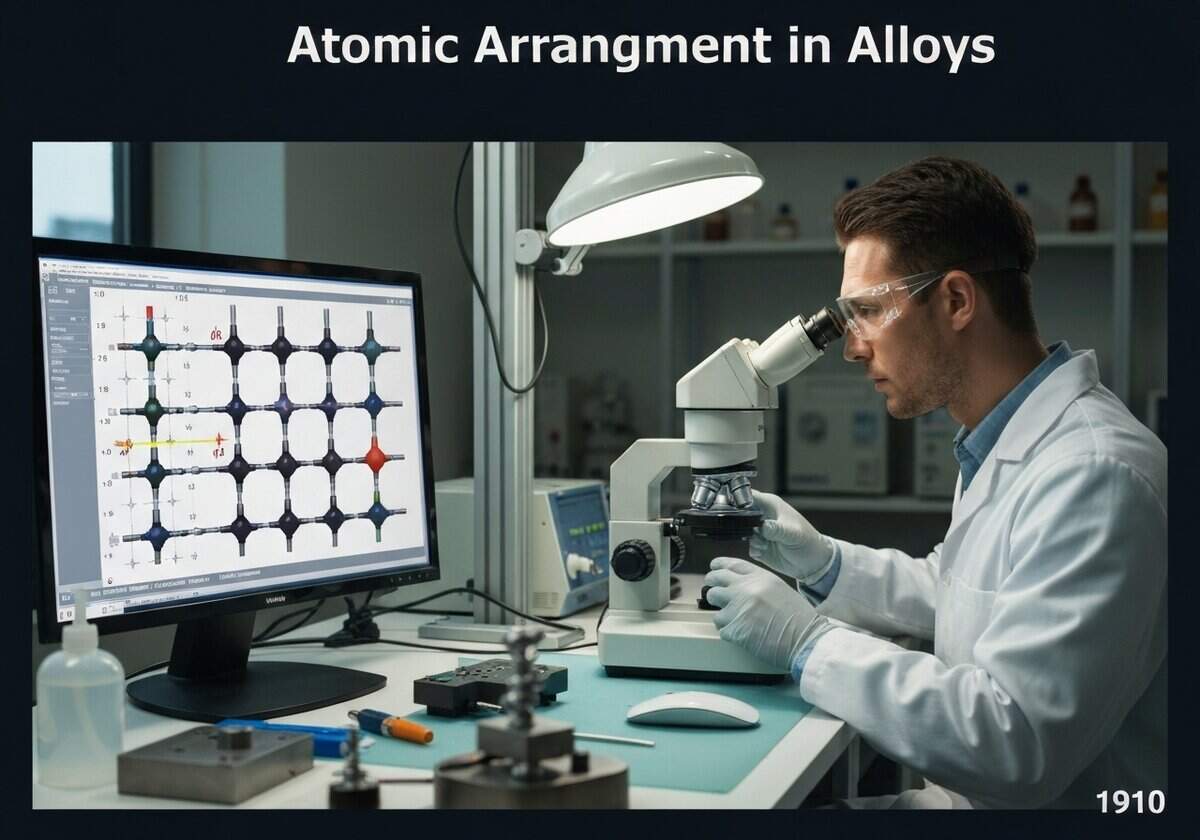
Alloys are classified based on atomic arrangement. In substitutional alloys, atoms of the solute element replace atoms of the solvent in the crystal lattice, common when atomic sizes are similar. In interstitial alloys, smaller solute atoms, like carbon in iron, fit into the spaces (interstices) between the larger solvent atoms. This structural difference fundamentally dictates the alloy’s mechanical properties.
The distinction between substitutional and interstitial solid solutions is fundamental to physical metallurgy and alloy design. The type of solid solution that forms is primarily governed by the relative sizes of the solute and solvent atoms. Substitutional alloys typically form when the atomic radii of the two elements are within about 15% of each other, a guideline known as the Hume-Rothery size-factor rule. When a solute atom replaces a solvent atom, it introduces localized lattice strain, which impedes dislocation motion and thus increases the material’s strength and hardness, but often reduces its ductility. Examples include brass (zinc in copper) and bronze (tin in copper).
Interstitial alloys, on the other hand, form when the solute atoms are significantly smaller than the solvent atoms, allowing them to occupy the interstitial sites within the crystal lattice without displacing a solvent atom. Common interstitial atoms are hydrogen, boron, carbon, and nitrogen. The presence of these atoms causes significant lattice distortion, which provides a very effective mechanism for blocking dislocation movement, leading to a substantial increase in hardness and strength. The most prominent example is steel, where carbon atoms occupy interstitial sites in the iron lattice. The amount of carbon and its location, which can be controlled by heat treatment, determines the final properties of the steel, from ductile low-carbon steel to hard, brittle high-carbon steel.
UNESCO Nomenclature: 3308
– Metallurgy
Precursors
- John Dalton’s atomic theory
- discovery of crystal structures through x-ray diffraction by William Henry Bragg and William Lawrence Bragg
- basic concepts of chemical mixtures and solutions
- early metallographic studies of metal microstructures
Applications
- design of high-strength steels (interstitial carbon in iron)
- creation of corrosion-resistant brass (substitutional zinc in copper)
- development of sterling silver for durability (substitutional copper in silver)
- formulation of nichrome heating elements (substitutional nickel and chromium)
Potential Innovations Ideas
Due to scrapping bot traffic, currently more than 40k per day, this content is reserved to community members.
> Login < or > Register < (100% free) to access this, so as all other restricted content and tools.
Related to: substitutional alloy, interstitial alloy, crystal lattice, solid solution, solute, solvent, metallurgy, atomic arrangement, lattice strain, steel.