Product Design, Manufacturing & Innovation Resources
Home » Accuracy vs. Precision

Accuracy vs. Precision

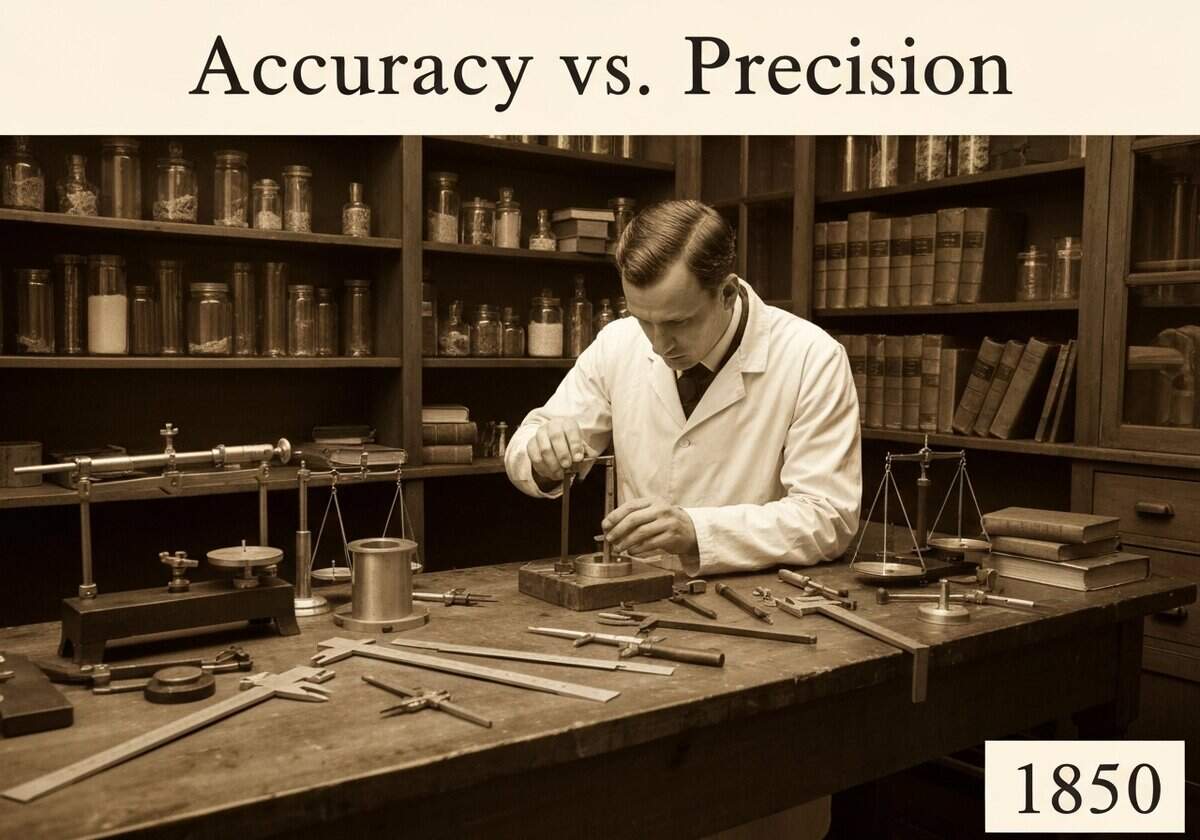
1850
Precision measuring instruments in a 1850s laboratory for scientific experimentation.

(generated image for illustration only)

Accuracy refers to the closeness of a measured value to a standard or known true value. Precision refers to the closeness of two or more measurements to each other. A measurement system can be precise but not accurate, accurate but not precise, neither, or both. These two concepts are independent of each other in measurement theory.


The distinction between accuracy and precision is a cornerstone of measurement science (metrology). Accuracy describes the degree of conformity to a true value, which is often an accepted reference standard. It is primarily affected by systematic errors, also known as bias. A systematic error causes measurements to be consistently wrong in the same direction. For example, a miscalibrated scale that always reads 5 grams higher than the true weight has a systematic error and is therefore inaccurate, even if it gives the exact same reading every time (making it precise).

Precision, on the other hand, describes the reproducibility or repeatability of measurements. It is affected by random errors, which are unpredictable fluctuations in the readings of a measurement apparatus. These errors can be caused by factors like electronic noise in an instrument, slight variations in experimental conditions, or observer inconsistencies. A high-precision instrument will produce very similar results when measuring the same quantity multiple times under the same conditions, regardless of whether those results are close to the true value. The common analogy used to illustrate this is a target. Accuracy is how close the shots are to the bullseye, while precision is how tightly grouped the shots are. It’s possible to have a tight cluster of shots (high precision) far from the bullseye (low accuracy).

UNESCO Nomenclature: 1209
– Statistics

Type

Abstract System

Disruption

Foundational

Usage

Widespread Use

Precursors

  • Development of the scientific method
  • Carl Friedrich Gauss’s work on the theory of errors and the method of least squares
  • Early developments in metrology and standardization of units
  • Philosophical distinctions between truth and consistency

Applications

  • scientific experimentation
  • industrial quality control
  • engineering design and manufacturing
  • medical diagnostics
  • computer simulations

Patents:

NA

Potential Innovations Ideas

Due to scrapping bot traffic, currently more than 40k per day, this content is reserved to community members.
> Login < or > Register < (100% free) to access this, so as all other restricted content and tools.

Related to: accuracy, precision, measurement, systematic error, random error, bias, repeatability, reproducibility.

Historical Context

Accuracy vs. Precision

1822
1828
1848
1850
1854
1884
1896
1822
1827
1829
1850
1854
1854
1895
1899

(if date is unknown or not relevant, e.g. "fluid mechanics", a rounded estimation of its notable emergence is provided)

Related Invention, Innovation & Technical Principles

Full size images and downloads are only available, 100% free, for registered members.

> Login <