Product Design, Manufacturing & Innovation Resources
Home » The 5S Framework for Workplace Organization

The 5S Framework for Workplace Organization

1980
  • Hiroyuki Hirano
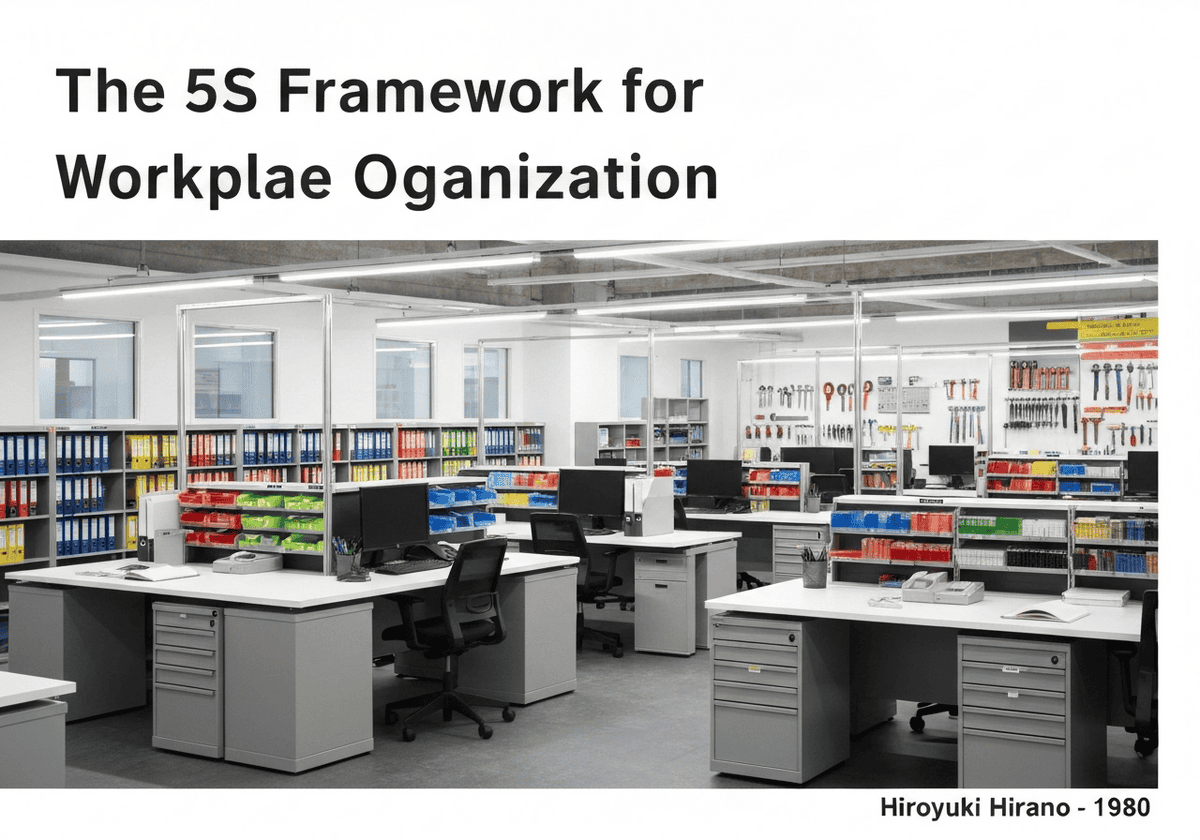
Organized office workspace demonstrating the 5S framework for efficiency in management.

(generated image for illustration only)

5S is a workplace organization method that uses a list of five Japanese words: Seiri (Sort), Seiton (Set in Order), Seisō (Shine), Seiketsu (Standardize), and Shitsuke (Sustain). This system aims to improve efficiency and eliminate waste by organizing a workspace for effectiveness. It is a foundational component of Kaizen and lean manufacturing, creating the stable environment necessary for improvement.

The 5S framework is a systematic approach that enables teams to organize their workplaces in the safest and most efficient manner. Each ‘S’ represents a step in the process. ‘Seiri’ (Sort) involves going through all items in a workspace and removing anything that is not needed for current operations. This declutters the area and frees up space. ‘Seiton’ (Set in Order) is the process of arranging the necessary items in a logical way so they can be easily located and retrieved. The principle ‘a place for everything, and everything in its place’ is central to this step. ‘Seisō’ (Shine) involves cleaning the workspace and equipment regularly. This is not just about aesthetics; it helps in identifying potential problems like leaks, cracks, or misalignments that might be hidden by dirt. ‘Seiketsu’ (Standardize) establishes the procedures and schedules to ensure the repetition of the first three ‘S’ practices. This creates consistency and makes the improvements part of the normal routine. It often involves visual controls, checklists, and clear instructions. ‘Shitsuke’ (Sustain) is the most challenging step. It involves making 5S a habit and embedding it into the organizational culture. This requires ongoing training, communication, and management commitment to maintain the standards and continue the improvement cycle. By implementing 5S, organizations create a visual, clean, and organized environment where deviations from the standard become immediately obvious, facilitating quicker problem-solving and preventing waste.

UNESCO Nomenclature: 5311
– Management

Type

Abstract System

Disruption

Substantial

Usage

Widespread Use

Precursors

  • Toyota Production System (tps) principles
  • henry ford’s assembly line concepts of order and efficiency
  • principles of scientific management by frederick winslow taylor

Applications

  • lean manufacturing implementation
  • healthcare facility management (e.g., organizing operating rooms)
  • software development (e.g., ‘5S for code’)
  • office and administrative process improvement
  • warehouse and logistics management

Patents:

NA

Potential Innovations Ideas

Due to scrapping bot traffic, currently more than 40k per day, this content is reserved to community members.
> Login < or > Register < (100% free) to access this, so as all other restricted content and tools.

Related to: 5S, lean manufacturing, workplace organization, seiri, seiton, seiso, seiketsu, shitsuke.

Historical Context

The 5S Framework for Workplace Organization

1960
1965
1970
1980
1983
1990
1992
1960
1960
1970
1980
1980
1986
1990
1992

(if date is unknown or not relevant, e.g. "fluid mechanics", a rounded estimation of its notable emergence is provided)

Related Invention, Innovation & Technical Principles

Full size images and downloads are only available, 100% free, for registered members.

> Login <