Product Design, Manufacturing & Innovation Resources
घर » गैसों का क्रांतिक तापमान

गैसों का क्रांतिक तापमान

1869
  • Thomas Andrews
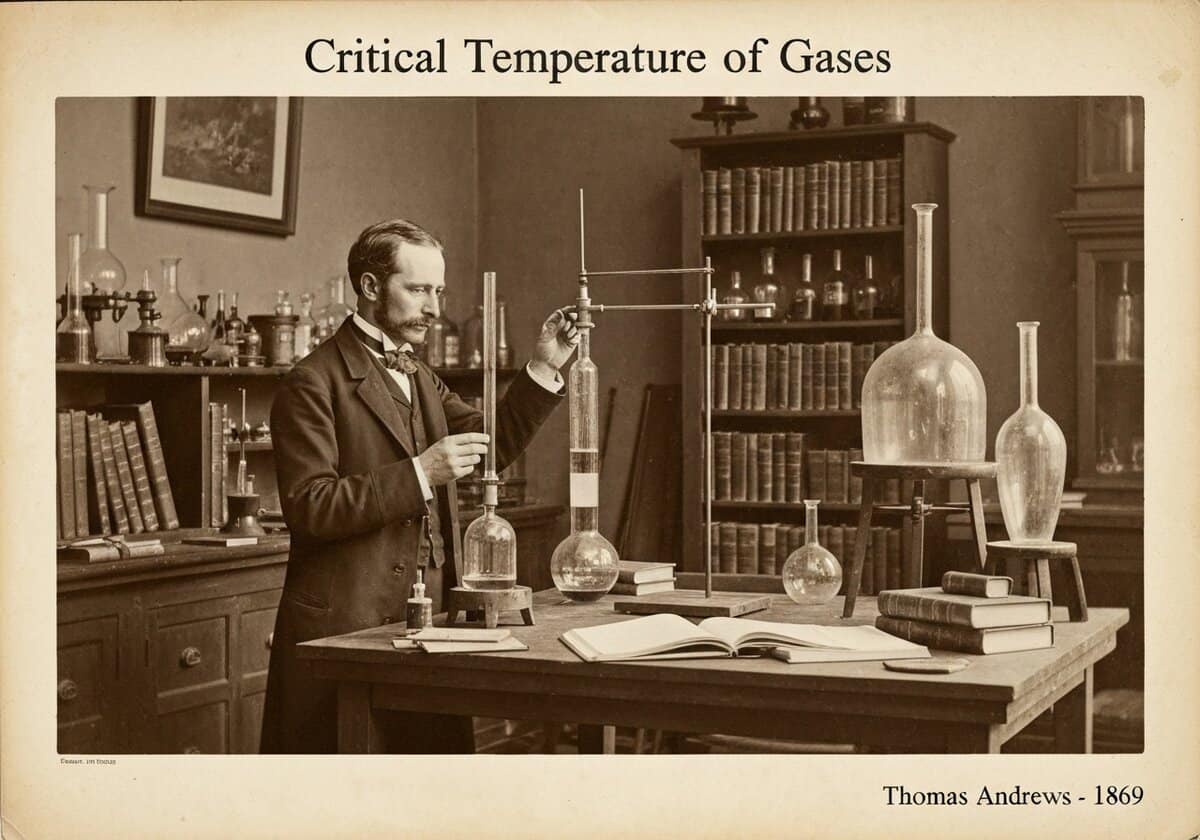
ऊष्मागतिकी में गैसों के क्रिटिकल तापमान को दर्शाता 19वीं सदी का प्रयोगशाला दृश्य।.

(यह छवि केवल उदाहरण के लिए बनाई गई है)

क्रांतिक तापमान वह तापमान है जिसके ऊपर एक विशिष्ट तरल चरण नहीं बन सकता है, चाहे कितना भी दबाव लगाया जाए। प्रत्येक गैस का एक अद्वितीय क्रांतिक तापमान होता है। किसी गैस को द्रवीभूत करने के लिए, उसे पहले इस तापमान से नीचे ठंडा करना होगा। थॉमस एंड्रयूज द्वारा स्थापित यह अवधारणा, किसी भी द्रवीकरण प्रक्रिया के लिए मौलिक है।
Thomas Andrews’ experiments in the 1860s on carbon dioxide were pivotal. He meticulously measured its pressure-volume-temperature (P-V-T) relationships and discovered that above approximately 30.98 °C (304.1 K), CO2 could not be liquefied no matter how much pressure was applied. He termed this the ‘critical temperature.’ Below this temperature, increasing the pressure on the gas would eventually cause it to condense into a liquid. At the critical temperature itself, the gas transitions into a liquid at a specific ‘critical pressure’ and ‘critical volume,’ a state known as the critical point. At this point, the densities of the liquid and gas phases become equal, and the meniscus separating them disappears. The substance becomes a supercritical fluid, possessing properties of both a gas and a liquid. This discovery was crucial because it explained why earlier attempts by scientists like Faraday to liquefy gases such as oxygen, nitrogen, and हाइड्रोजन had failed; they were not cooling the gases below their respective, much lower, critical temperatures, a prerequisite for liquefaction by compression.

UNESCO Nomenclature: 2212
ऊष्मागतिकी

Type

भौतिक सिद्धांत

व्यवधान

मूलभूत

उपयोग

व्यापक उपयोग

शगुन

  • बॉयल का नियम (दबाव और आयतन के बीच संबंध)
  • चार्ल्स का नियम (आयतन और तापमान के बीच संबंध)
  • उच्च दबावों पर गैस संपीड्यता पर अमागाट के प्रयोग
  • Michael Faraday’s earlier, partially successful attempts at gas liquefaction

आवेदन

  • प्राकृतिक गैस का द्रवीकरण (एलएनजी)
  • औद्योगिक और चिकित्सा उपयोग के लिए तरल ऑक्सीजन और नाइट्रोजन का उत्पादन
  • प्रशीतन और वातानुकूलन प्रणालियाँ
  • अतिक्रांतिक द्रव निष्कर्षण (उदाहरण के लिए, कॉफी से कैफीन का निष्कासन)
  • सुपरक्रिटिकल द्रव क्रोमैटोग्राफी

पेटेंट:

NA

संभावित नवाचार विचार

  • miniaturized supercritical fluid reactors for नैनोकण synthesis
  • advanced क्रायोजेनिक propellant management for long-duration space missions
  • जटिल प्लास्टिक के पुनर्चक्रण के लिए अतिक्रांतिक द्रव-आधारित प्रणालियाँ
  • अतिक्रांतिक CO2 का उपयोग करके उच्च दबाव खाद्य संरक्षण
  • अतिक्रांतिक तरल पदार्थों को कार्यशील माध्यम के रूप में उपयोग करके भूतापीय ऊर्जा निष्कर्षण
  • हरित रसायन अनुप्रयोगों के लिए नवीन विलायकों का विकास
  • नियंत्रित चरण संक्रमणों का उपयोग करके क्रायोप्रिजर्वेशन तकनीकें
  • औषधियों के शुद्धिकरण के लिए सुपरक्रिटिकल फ्लूइड क्रोमैटोग्राफी
  • सुपरक्रिटिकल CO2 इंजेक्शन का उपयोग करके उन्नत तेल पुनर्प्राप्ति तकनीकें
  • compact cooling systems for high-performance electronics based on phase change
संबंधित विषय: क्रांतिक तापमान, चरण संक्रमण, द्रवीकरण, थॉमस एंड्रयूज, क्रांतिक बिंदु, गैस, तरल, दबाव, ऊष्मागतिकी, अतिक्रांतिक द्रव।

ऐतिहासिक संदर्भ

गैसों का क्रांतिक तापमान

1860
1861
1865
1869
1871
1876
1877
1859
1861
1865
1868
1870
1873
1877
1880

(यदि तिथि अज्ञात है या प्रासंगिक नहीं है, उदाहरण के लिए "द्रव यांत्रिकी", तो इसके उल्लेखनीय उद्भव का एक अनुमानित आंकड़ा प्रदान किया गया है)

नवीनतम परिवर्धन

शीर्ष पोस्ट और लेख

शीर्ष मूल उपकरण

10वां वर्ष सालगिरह

पंजीकृत सदस्यों के लिए पूर्ण आकार की छवियाँ और डाउनलोड 100% निःशुल्क उपलब्ध हैं।