Product Design, Manufacturing & Innovation Resources
घर » रासायनिक बंधन

रासायनिक बंधन

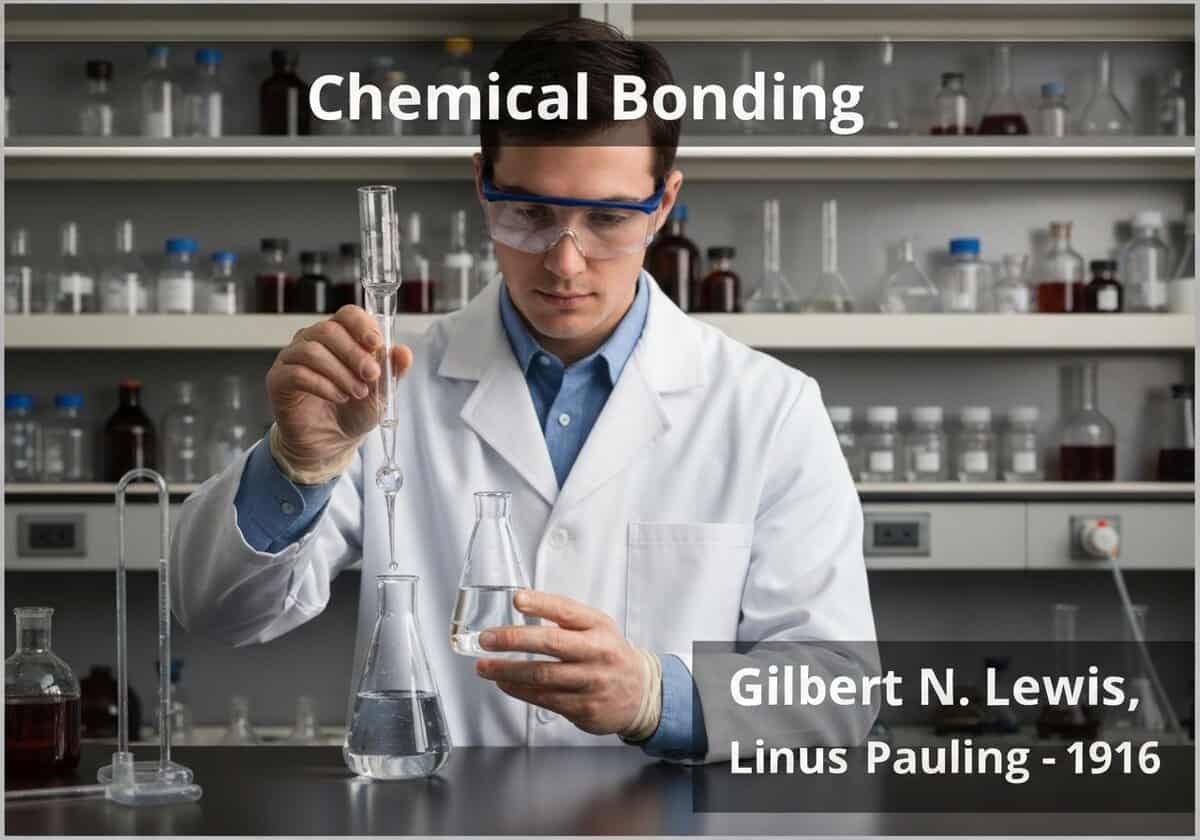
1916
  • Gilbert N. Lewis
  • Linus Pauling
प्रयोगशाला का दृश्य जो भौतिक रसायन विज्ञान में रासायनिक बंधन को दर्शाता है।

(यह छवि केवल उदाहरण के लिए बनाई गई है)

रासायनिक बंधन परमाणुओं, आयनों या अणुओं के बीच एक स्थायी आकर्षण है जो रासायनिक यौगिकों के निर्माण को सक्षम बनाता है। बंधन विपरीत आवेश वाले आयनों (आयनिक बंधन) के बीच स्थिरवैद्युत आकर्षण बल या इलेक्ट्रॉनों के साझाकरण (सहसंयोजक बंधन) के माध्यम से उत्पन्न होते हैं। बंधनों की शक्ति और प्रकार किसी पदार्थ की संरचना और गुणों को निर्धारित करते हैं।

The concept of chemical bonding explains how individual atoms combine to form the vast array of substances we observe. Gilbert N. Lewis’s 1916 proposal of the covalent bond, where atoms share pairs of electrons to achieve a stable electron configuration (the ‘octet rule’), was a monumental step. This simple yet powerful idea, visualized with Lewis structures, provided the first clear picture of bonding in non-ionic compounds. Ionic bonds, in contrast, are formed by the complete transfer of one or more electrons from an atom with low electronegativity (typically a metal) to one with high electronegativity (a nonmetal), creating charged ions that are held together by electrostatic attraction.

Our understanding was deepened significantly by the application of quantum mechanics. Linus Pauling’s valence bond theory, introduced in the 1930s, described covalent bonds as the result of the overlap of atomic orbitals. This theory introduced the concepts of hybridization (e.g., sp, sp2, sp3) and resonance to explain observed molecular geometries and bond properties. An alternative and often more powerful approach is molecular orbital (MO) theory, which considers electrons to be delocalized across the entire molecule in molecular orbitals formed from the combination of atomic orbitals. MO theory is essential for explaining the properties of conjugated systems, magnetism, and excited states. Beyond these primary types, there are also metallic bonds, characterized by a ‘sea’ of delocalized electrons, and weaker intermolecular forces like hydrogen bonds and वैन डेर वाल्स forces, which are critical for the properties of liquids, solids, and biological macromolecules like DNA.

UNESCO Nomenclature: 2209
भौतिक रसायन विज्ञान

Type

सार प्रणाली

व्यवधान

मूलभूत

उपयोग

व्यापक उपयोग

शगुन

  • atomic theory (John Dalton)
  • discovery of the electron (J.J. Thomson)
  • development of the nuclear model of the atom (Ernest Rutherford)
  • early concepts of ‘affinity’ and ‘valence’

आवेदन

  • materials science and engineering (e.g., creating alloys, polymers)
  • drug design and pharmacology
  • synthesis of new chemical compounds
  • understanding biological processes (e.g., protein folding)
  • development of adhesives and composites
  • predicting molecular geometry (vsepr theory)

पेटेंट:

NA

संभावित नवाचार विचार

  • ‘programmable’ molecules that change shape and function in response to light or heat by altering their bonding
  • self-healing materials with reversible covalent bonds that reform after fracture
  • two-dimensional materials beyond graphene with unique bonding configurations for advanced electronics
  • bio-integrated electronics using conductive polymers with biocompatible bonding properties
  • ‘mechanophores’ that change color or fluoresce when a specific chemical bond is broken by mechanical stress
  • artificial enzymes with active sites designed to form and break specific covalent bonds with high precision
  • adhesives that can be switched ‘on’ and ‘off’ using an electrical field to modulate ionic bonding
  • quantum materials where electron sharing in covalent bonds leads to exotic states like superconductivity
  • energy storage systems based on forming and breaking उच्च ऊर्जा chemical bonds in ‘solar fuels’
  • computational platforms for designing novel compounds by predicting bonding from first principles
Related to: chemical bond, covalent bond, ionic bond, metallic bond, Gilbert N. Lewis, Linus Pauling, electronegativity, valence electrons, molecular orbital theory, intermolecular forces.

ऐतिहासिक संदर्भ

रासायनिक बंधन

1912
1915
1915-11
1916
1918
1919-05-29
1920
1911-04-08
1913
1915
1916
1917
1918
1920
1920

(यदि तिथि अज्ञात है या प्रासंगिक नहीं है, उदाहरण के लिए "द्रव यांत्रिकी", तो इसके उल्लेखनीय उद्भव का एक अनुमानित आंकड़ा प्रदान किया गया है)

नवीनतम परिवर्धन

शीर्ष पोस्ट और लेख

शीर्ष मूल उपकरण

10वां वर्ष सालगिरह

पंजीकृत सदस्यों के लिए पूर्ण आकार की छवियाँ और डाउनलोड 100% निःशुल्क उपलब्ध हैं।