क्या आपने कभी सोचा है कि कुछ उत्पादों का उपयोग करना आनंददायक क्यों होता है जबकि अन्य नहीं? इसका मूल कारण यह है कि... उपयोगिता अनुसंधान। किसी उत्पाद के बाजार में आने से पहले, उसका पूरी तरह से परीक्षण किया जाना चाहिए। प्रयोगकर्ता का अनुभवइससे यह सुनिश्चित होता है कि यह उच्च उपयोगिता मानकों को पूरा करता है। लेकिन, सही मूल्यांकन, चाहे वह रचनात्मक हो या योगात्मक, चुनना महत्वपूर्ण है।
उत्पाद निर्माण में फॉर्मेटिव और समेटिव यूज़ेबिलिटी टेस्ट की अलग-अलग भूमिका होती है। फॉर्मेटिव टेस्टिंग शुरुआती डिज़ाइन चरणों में उत्पाद को बेहतर बनाने में मदद करती है। वहीं, समेटिव टेस्टिंग यह जांचती है कि लगभग तैयार उत्पाद प्रभावी, कुशल और संतोषजनक है या नहीं। इन विधियों का उपयोग कब और कैसे करना है, यह जानना आपके उत्पाद की सफलता के लिए अत्यंत महत्वपूर्ण है।
मुख्य बातें
- डिजाइन चक्र के दौरान कम से कम दो बार रचनात्मक उपयोगिता परीक्षण किए जाने चाहिए, जिनका ध्यान डिजाइन में सुधार पर केंद्रित हो।
- वायरफ्रेम प्रोटोटाइप के साथ प्रारंभिक रचनात्मक परीक्षणों में आमतौर पर 5-8 उपयोगकर्ता शामिल होते हैं।
- विकास चरण से ठीक पहले, न्यूनतम व्यवहार्य उत्पादों (एमवीपी) पर प्रारंभिक परीक्षण करना आवश्यक है, और यह परीक्षण 5-8 उपयोगकर्ताओं के साथ भी किया जाना चाहिए।
- 15-20 उपयोगकर्ताओं के साथ किए गए समग्र उपयोगिता परीक्षण, उपयोगिता मानकों के आधार पर उत्पाद को मान्य करते हैं।
- प्रारंभिक मूल्यांकन निरंतर जारी रहते हैं और डिजाइन को आकार देते हैं, जबकि अंतिम मूल्यांकन अंतिम सत्यापन और मानकीकरण प्रदान करते हैं।
- अनुसंधान के लक्ष्यों के आधार पर, दोनों प्रकार के मूल्यांकन गुणात्मक या मात्रात्मक हो सकते हैं।
- दोनों पद्धतियों को मिलाकर समय के साथ और प्रतिस्पर्धियों के मुकाबले एक व्यापक मूल्यांकन सुनिश्चित किया जा सकता है।
उपयोगिता अध्ययन का परिचय
उपयोगकर्ताओं के लिए बेहतर ढंग से काम करने वाले उत्पाद बनाने के लिए उपयोगिता अध्ययन महत्वपूर्ण हैं। इनमें उपयोगिता परीक्षण तकनीक और उपयोगिता मूल्यांकन विधियों का उपयोग किया जाता है। इससे यह सुनिश्चित होता है कि उत्पाद मानकों के अनुरूप हैं और सुचारू रूप से चलते हैं। इन अध्ययनों को प्रारंभिक और अंतिम चरणों में विभाजित किया जाता है। प्रत्येक चरण के अपने लक्ष्य और कार्यप्रणाली होती है।
उपयोगिता परीक्षण को समझना
उपयोगिता परीक्षण में उपयोगकर्ताओं को उत्पाद का उपयोग करते हुए देखा जाता है ताकि कमियों का पता लगाया जा सके। विभिन्न उपयोगिता परीक्षण तकनीकों का उपयोग करके, शोधकर्ताओं को मूल्यवान प्रतिक्रिया मिलती है। प्रारंभिक उपयोगिता परीक्षण 5-7 उपयोगकर्ताओं के साथ किया जाता है। यह अंतिम परीक्षण की तुलना में तेज़ और सस्ता होता है। अंतिम परीक्षण में 15-20 उपयोगकर्ता शामिल होते हैं। यह अंतिम उत्पाद की जाँच करता है और आमतौर पर अधिक महंगा होता है।
उत्पाद विकास में उपयोगिता अध्ययन का महत्व
उत्पाद विकास में उपयोगिता मूल्यांकन विधियों का उपयोग करना अत्यंत महत्वपूर्ण है। ये डिज़ाइन संबंधी समस्याओं को शुरुआती चरण में ही पकड़ लेती हैं और उत्पाद को उपयोगकर्ता की आवश्यकताओं के अनुरूप बनाती हैं। उदाहरण के लिए, मानव कारक इंजीनियरों द्वारा किए गए मूल्यांकन वस्तुनिष्ठ अंतर्दृष्टि प्रदान करते हैं। इससे आंतरिक पूर्वाग्रह से बचने और गलतियों को पकड़ने में मदद मिलती है। इस तरह, उत्पाद व्यापक दर्शकों के लिए आकर्षक बनता है। उपयोगिता परीक्षण के दोनों प्रकारों पर ध्यान केंद्रित करने से उपयोगकर्ता का विश्वास बढ़ता है, लॉन्च के बाद की समस्याएं कम होती हैं और बाजार में उत्पाद की उपस्थिति मजबूत होती है।
अब आइए देखते हैं कि फॉर्मेटिव और समेटिव यूजेबिलिटी टेस्टिंग में क्या अंतर है:
| विशेषता | रचनात्मक उपयोगिता परीक्षण | समग्र उपयोगिता परीक्षण |
|---|---|---|
| उपयोगकर्ता की संख्या | 5-7 | 15-20 |
| Stage | प्रारंभिक डिजाइन और विकास | बाजार में लॉन्च के बाद |
| लागत | कम महंगा | अधिक महंगा |
| समय की खपत | कम समय लेने वाला | अधिक समय लेने वाला |
| डेटा प्रकार | गुणात्मक | मात्रात्मक |
| मूल्यांकनकर्ता | आंतरिक या बाहरी | बाहरी रूप से अनुशंसित |
फॉर्मेटिव यूजेबिलिटी टेस्टिंग क्या है?
प्रारंभिक उपयोगिता परीक्षण डिजाइन प्रक्रिया के शुरुआती चरण में ही उत्पाद को बेहतर बनाने में मदद करता है। यह समस्याओं को दूर करने के लिए उपयोगकर्ता की प्रतिक्रिया का उपयोग करता है। इससे उत्पाद उपयोगकर्ताओं की आवश्यकताओं को बेहतर ढंग से पूरा कर पाता है।

परिभाषा एवं उद्देश्य
यह उत्पाद के डिजाइन चरण का मूल्यांकन करता है। इसके मुख्य लक्ष्य हैं:
- उपयोगिता संबंधी समस्याओं की पहचान करना और उनका समाधान आरंभिक चरण में ही करना।
- गहन जानकारी प्राप्त करने के लिए गुणात्मक उपयोगिता अध्ययनों का उपयोग करना।
- यह सुनिश्चित करना कि उत्पाद का डिज़ाइन उपयोगकर्ता की मांगों को पूरा करता है।
- वायरफ्रेम प्रोटोटाइप या मिनिमम वायबल प्रोडक्ट्स (एमवीपी) के साथ परीक्षण करना।
इस परीक्षण में आमतौर पर 5-8 उपयोगकर्ता शामिल होते हैं।
रचनात्मक उपयोगिता परीक्षण कब करें
डिजाइन के दौरान दो चरणों के परीक्षण करने की सलाह दी जाती है। ये परीक्षण आवश्यक हैं:
- जैसे ही कोई प्रारंभिक प्रोटोटाइप उपलब्ध हो जाए, जैसे कि वायरफ्रेम या एमवीपी।
- किसी भी महत्वपूर्ण डिजाइन संबंधी निर्णय को अंतिम रूप देने से पहले।
- डिजाइन में निरंतर सुधार सुनिश्चित करने के लिए इसे बार-बार विकसित किया जाता है।
उदाहरण और अनुप्रयोग
इसमें विभिन्न तकनीकों और उपकरणों का उपयोग किया जाता है, जिनमें शामिल हैं:
- निम्न-विश्वसनीयता वाले प्रोटोटाइप: कागज या स्थिर पृष्ठों का उपयोग करके प्रारंभिक प्रतिक्रिया एकत्र करना।
- वास्तविक समय अवलोकन: यह देखने के लिए कि उपयोगकर्ता उत्पाद के साथ कैसे इंटरैक्ट करते हैं।
- प्रायोगिक अध्ययन: तकनीकी या कार्यप्रवाह संबंधी समस्याओं को ठीक करने के लिए प्रारंभिक परीक्षण।
यहां फॉर्मेटिव और समेटिव यूजेबिलिटी टेस्ट की तुलना दी गई है:
| पहलू | रचनात्मक परीक्षण | योगात्मक परीक्षण |
|---|---|---|
| केंद्र | गुणात्मक अंतर्दृष्टि | मात्रात्मक मेट्रिक्स |
| समय | विकास के प्रारंभिक चरण में | विकास चक्र का अंत |
| नमूने का आकार | 5-8 उपयोगकर्ता | 15-20 उपयोगकर्ता |
| प्रोटोटाइप | वायरफ्रेम, एमवीपी | पूरी तरह से कार्यात्मक उत्पाद |
What is Summative Usability Testing?
Summative Usability Testing is key in उपयोगकर्ता केंद्रित design. It checks a product’s effectiveness and efficiency after development. Quantitative measures confirm if usability goals are met before the product launch.
परिभाषा एवं उद्देश्य
It involves assessing the overall design with several users, usually between 15-20. The main goal is to measure how effective, efficient, and satisfying a product is for the users.
When to Conduct Summative Usability Testing
This testing phase is done right before a product’s release. It ensures all usability marks are met. Metrics like task completion rates and satisfaction are key.
Formative versus Summative Studies in Usability
Knowing the difference between formative and summative usability studies is key for product development. Formative and summative usability tests have different goals. They are used at different times in the development process. Formative testing is about exploring early design stages. It aims to find and fix issues early. Common tools for this are heuristic evaluation, interviews, and contextual analysis.
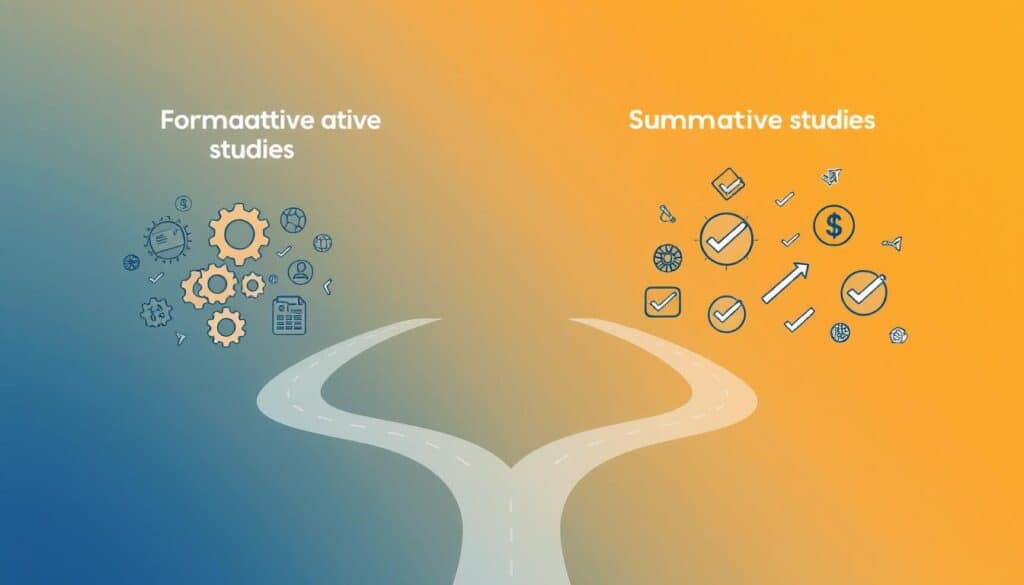
Formative testing usually involves small groups. About 4-5 people per user group work with early designs like wireframes. This phase focuses on qualitative data. It looks at what users do, think, and feel in real-time. The benefits include spotting problems early, making design better over time, improving user experience, and lowering development risks.
In contrast, summative usability testing happens near the end of developing a product. Its goal is to check if the product is easy to use. Usually, 15-20 people per user group take part in this testing. Tests measure things like how long tasks take, completion rates, and overall success. This method involves careful collection of data with specific measurements.
The comparison between these two types of testing shows why both are important. Formative testing helps make designs better early on with feedback. Summative testing checks if the final product meets usability goals before it goes out. Using both types of tests can make a product more user-friendly and successful.
| पहलू | रचनात्मक उपयोगिता परीक्षण | समग्र उपयोगिता परीक्षण |
|---|---|---|
| उद्देश्य | Exploratory, to shape design early | Confirmatory, to validate final product |
| When Conducted | Early stages (concept, prototype testing) | End stages (right before/after redesign) |
| Participants | 4-5 per user group | 15-20 per user group |
| Common Methods |
|
|
| डेटा प्रकार | Qualitative (observations, thought processes) | Quantitative (task completion time, errors) |
Formative and summative usability studies are both valuable. Formative testing ensures problems are found and fixed early. This makes design better and more efficient. Summative testing, on the other hand, makes sure the final product has been properly checked. It confirms usability before the product goes to market.
Order and Purpose of Usability Studies
Usability studies are essential in the design process integration. They follow a specific order to be most effective.

Role in the Design Process
Design process begins with formative usability testing. It involves a team of 5-7 users. They look for issues by using methods like Think-aloud protocol and prototype testing.
This helps find problems early on. It makes fixing them cheaper and easier.
Once the product is out, summative usability testing takes place. It’s for checking if the design works well with more users. Tools like First click testing see how fast and accurately users perform tasks.
Benefits of Conducting Usability Studies
Usability studies offer key advantages. Early stage testing, or formative testing, spots problems soon. This can save money and improve design quickly.
Summative testing checks if the product meets user needs before launch. It looks at how well redesigns work and compares usability improvements. This puts the product in a stronger position in the market.
Using both testing types improves product making. It boosts user satisfaction and makes the development process smoother.
Industries and Types of Products Benefiting from Usability Studies
Usability studies are key in many sectors to ensure products meet user needs well. They are especially valuable in technology, healthcare, and retail. These sectors use specific tests to make their products better.
- तकनीकी: firms like एप्पल and Microsoft use usability studies a lot. They do this to improve software and hardware, making them easy to use.
- Healthcare: usability studies are mandatory by regulation in making medical devices and health IT. The Mayo Clinic, for example, uses them to make electronic health records (EHR) systems better.
- Retail: giants like Amazon and Walmart test their e-commerce sites thoroughly. They want to make sure shopping is smooth for all customers.

Many products, from complex software to simple gadgets, undergo usability studies. These studies are vital. They find and fix design problems that might stop users from enjoying the product.
Different kinds of tests are used in various industries. Here’s a brief look at how they work:
| Evaluation Type | आवृत्ति | Common Methods | Objectives |
|---|---|---|---|
| रचनात्मक उपयोगिता परीक्षण | Multiple times during development | Heuristic evaluation, usability testing, interviews | Find out what users need, like, and want. |
| समग्र उपयोगिता परीक्षण | Less often, after launch | A/B testing, शुद्ध प्रोमोटर स्कोर surveys | See if the product works well, makes users happy. |
Usability studies are super helpful. They give companies important data and insights. With these, businesses can make products that truly connect with people. By using tests that fit their industry, companies can boost user happiness and product success.
Optional or Mandatory: Are Both Usability Studies Needed?
Choosing if you need formative and summative usability studies involves several factors. These include how complex the product is, the goals of your project, and what the industry standards say. It’s vital to look closely at these factors to decide wisely.
Factors to Consider
What kind of usability testing requirements your product needs is key. Let’s say you’re working with early prototypes or wireframes. You should look at how a small group of five to eight users react to them. This step finds problems early, so you can fix them and better the user experience.
You’ll look at things like if users can complete tasks, how long tasks take, mistakes made, and if users are happy with the product. Starting formative testing early can avoid issues, lower risks, and make sure users enjoy the product.
Regulations and Industry Standards
Usability studies might be needed because of industry rules. Some fields, like healthcare, have strict testing rules to follow. This makes sure the product is safe and works well. For example, using ePROs in clinical trials shows how important usability is becoming in healthcare tech.
Authorities now focus more on what patients say about their treatment. This stresses the importance of both formative and summative usability testing. Using both types of testing can really improve your product and make users happy. Formative tests improve design, while summative tests check the product meets all requirements.
| Study Type | Stage | मेट्रिक्स | लाभ |
|---|---|---|---|
| रचनात्मक उपयोगिता परीक्षण | Early development | Task completion rates, Time on task, Error rates, User satisfaction, SUS | Early problem identification, Improved user experience, Risk reduction |
| समग्र उपयोगिता परीक्षण | Post-development | Overall usability, Compliance with regulations | Validation, Regulatory compliance |
Duration and Personnel Involved in Usability Studies
Usability studies can take different amounts of time. This is because what you need to test can vary a lot. Knowing how to plan these studies helps decide how much time and people you need.
Timeframe Expectations
Formative usability tests are quick and done over and over. They might just need a few people, which lets you make changes quickly. Jakob Nielsen says five is the best number of people for these tests. They help fix problems early on.
Summative tests take longer and need careful planning. They often involve 20 people per group, as Nielsen recommends, or even up to 50 for everyday items, according to ISO 20282.
Who Should Conduct the Studies?
A good usability test needs a team with UX/UI designers, usability experts, and psychologists. They find design problems and what users like. Each person has important skills for collecting data and analyzing it.
Formative tests often need someone to help participants and use the think-aloud method. Summative tests are different. They use remote, unmoderated methods focused on statistical analysis of how users behave.
A clear distinction exists between the roles for formative and summative usability studies, emphasizing the importance of tailored usability study planning and the strategic composition of the testing team to achieve reliable and actionable results. Data analysis for formative tests is qualitative, concentrating on usability themes and severity ratings, whereas summative tests necessitate statistical evaluations like time on task, success rates, and overall यूएक्स scores.
| पहलू | रचनात्मक परीक्षण | योगात्मक परीक्षण |
|---|---|---|
| अवधि | Quick, iterative | Extensive, planned |
| Participants | 5-10 per group | 20-50 per group |
| केंद्र | Identifying issues early | Statistical validity, benchmarks |
| Team Composition | UX/UI designers, moderators | Usability specialists, data loggers |
| Data Output | गुणात्मक | मात्रात्मक |
निष्कर्ष
Combining formative and summative usability studies in product development is crucial. It ensures products are technically sound and satisfy users. Designers can find and fix problems early by doing formative testing often. This involves 4-5 users per group using methods like evaluations, testing, interviews, and analysis.
Exploratory testing, A/B testing, and comparing with competitors provide valuable feedback. This guides designers to improve. Summative testing, done later, checks if the design works well with more users, about 15-20 per group. It uses final product tests to confirm usability goals are achieved and provides proof of the design’s effectiveness.
The Human Factors/Usability Engineering process includes steps like making usability tasks, doing validation tests, analyzing data, and identifying risks from use errors. These steps boost product usability and success. Formative evaluations build knowledge while summative evaluations test it, similar to education. Integrating these studies ensures the final product stands out in fulfilling needs and surpassing market standards.
पूरक पठन सामग्री एवं विधियाँ
- उपयोगकर्ता अनुभव (UX) डिज़ाइन: wireframing, Prototyping, user journey mapping
- Cognitive Psychology: mental models, perception studies, cognitive load analysis
- ह्यूमन कंप्यूटर इंटरेक्शन (एचसीआई): interaction design, task analysis, interface evaluation
- Accessibility testing: screen reader testing, keyboard navigation testing, color contrast analysis
- ए/बी टेस्टिंग: split testing, multivariate testing, conversion rate optimization
- सूचना वास्तुकला (IA): card सॉर्टिंग, tree testing, content inventory
- Heuristic evaluation: expert review, usability principles analysis, Nielsen’s heuristics
- Eye tracking studies: heatmaps, gaze plot analysis, fixation patterns
- Personas and user profiles: user interviews, surveys, behavioral segmentation
- Agile and lean UX: rapid iterative testing, Sprint planning, न्यूनतम व्यवहार्य उत्पाद (एमवीपी) विकास
अक्सर पूछे जाने वाले प्रश्न
फॉर्मेटिव यूजेबिलिटी स्टडीज क्या हैं?
प्रारंभिक उपयोगिता अध्ययन डिजाइन चरण के शुरुआती दौर में किए जाते हैं। इनसे समस्याओं का पता लगाने और समाधानों का परीक्षण करने में मदद मिलती है। इन परीक्षणों का उद्देश्य उपयोगकर्ता की प्रतिक्रिया के आधार पर डिजाइन में सुधार करना होता है।
समेटिव यूज़ेबिलिटी स्टडीज़ क्या हैं?
संपूर्ण उपयोगिता अध्ययन किसी पूर्ण विकसित उत्पाद का मूल्यांकन करते हैं। वे यह जांचते हैं कि उत्पाद प्रभावी और कुशल है या नहीं, और उपयोगिता लक्ष्यों को पूरा करने के लिए संख्याओं का उपयोग करते हैं।
फॉर्मेटिव यूजेबिलिटी टेस्टिंग कब आयोजित की जानी चाहिए?
उत्पाद विकास के शुरुआती चरण में ही प्रारंभिक परीक्षण शुरू करना सबसे अच्छा होता है। इससे डिज़ाइन संबंधी समस्याओं का जल्द पता चल जाता है और यह सुनिश्चित हो जाता है कि उत्पाद उपयोगकर्ताओं की अपेक्षाओं को पूरा करता है।
समेटिव यूज़ेबिलिटी टेस्टिंग कब आयोजित की जानी चाहिए?
उत्पाद तैयार होने के बाद समेटिव टेस्टिंग की जाती है। यह सुनिश्चित करने का अंतिम चरण है कि उत्पाद बाजार में जाने से पहले सभी उपयोगिता आवश्यकताओं को पूरा करता है।
फॉर्मेटिव और समेटिव यूजेबिलिटी स्टडीज के बीच मुख्य अंतर क्या है?
मुख्य अंतर इनके उद्देश्य और समय में है। प्रारंभिक परीक्षण डिजाइन को शुरुआती चरण में आकार देने के लिए किया जाता है, जबकि अंतिम परीक्षण लॉन्च से पहले अंतिम उत्पाद की उपयोगिता की जांच करता है।
उपयोगिता अध्ययन करने के क्या लाभ हैं?
उपयोगिता अध्ययन उपयोगकर्ताओं को अधिक संतुष्ट करते हैं, पुनर्रचना लागत बचाते हैं और बाजार में उनकी स्थिति में सुधार करते हैं। ये डिज़ाइन संबंधी समस्याओं को प्रारंभिक चरण में ही पहचान लेते हैं और सुनिश्चित करते हैं कि अंतिम उत्पाद उपयोगकर्ता की आवश्यकताओं को पूरा करता है।
उपयोगिता अध्ययन से किन उद्योगों को लाभ होता है?
प्रौद्योगिकी, स्वास्थ्य सेवा और खुदरा उद्योग उपयोगिता अध्ययनों से बहुत लाभ उठाते हैं। ये अध्ययन उत्पादों को उपयोग में आसान और अधिक आनंददायक बनाते हैं, जो उपयोगकर्ताओं की आवश्यकताओं के अनुरूप होते हैं।
क्या रचनात्मक और योगात्मक दोनों प्रकार के उपयोगिता अध्ययन हमेशा आवश्यक होते हैं?
आपको दोनों परीक्षणों की आवश्यकता है या नहीं, यह आपके उत्पाद, उद्योग के नियमों और आपके लक्ष्यों पर निर्भर करता है। अपने उत्पाद की जटिलता और उपयोगकर्ताओं पर इसके प्रभाव के बारे में सोचें। कुछ उद्योगों में कानून द्वारा विशिष्ट परीक्षण अनिवार्य होते हैं।
उपयोगिता अध्ययन आमतौर पर कितने समय तक चलते हैं?
अध्ययन की अवधि इस बात पर निर्भर करती है कि आप किसका परीक्षण कर रहे हैं। रचनात्मक अध्ययन आमतौर पर छोटे और दोहराए जाने वाले होते हैं। योगात्मक अध्ययन अधिक समय लेते हैं क्योंकि वे अधिक विस्तृत होते हैं।
उपयोगिता अध्ययन किसे करना चाहिए?
UX/UI डिज़ाइनर, यूज़ेबिलिटी विशेषज्ञ और मनोवैज्ञानिक जैसे विशेषज्ञों को ये अध्ययन करने चाहिए। वे डिज़ाइन संबंधी समस्याओं को पहचानने और उपयोगकर्ताओं की पसंद को समझने में माहिर होते हैं।
रचनात्मक और योगात्मक उपयोगिता अध्ययन पर बाहरी लिंक
अंतर्राष्ट्रीय मानक
(सामग्री का हमारा विवरण देखने के लिए लिंक पर होवर करें)
प्रयुक्त शब्दों की शब्दावली
Conversion Rate (CR): किसी वेबसाइट या लैंडिंग पेज पर आने वाले आगंतुकों का वह प्रतिशत जो वांछित कार्रवाई पूरी करते हैं, जैसे खरीदारी करना या न्यूज़लेटर के लिए साइन अप करना, इसकी गणना रूपांतरणों की संख्या को कुल आगंतुकों की संख्या से विभाजित करके की जाती है।
Human-Computer Interaction (HCI): यह एक बहुविषयक क्षेत्र है जो मानव उपयोग के लिए इंटरैक्टिव कंप्यूटिंग सिस्टम के डिजाइन, मूल्यांकन और कार्यान्वयन पर केंद्रित है, जिसमें उपयोगिता, उपयोगकर्ता अनुभव और प्रौद्योगिकी के संबंध में उपयोगकर्ता के व्यवहार और प्राथमिकताओं के अध्ययन पर जोर दिया जाता है।
International Organization for Standardization (ISO): एक गैर-सरकारी अंतर्राष्ट्रीय निकाय जो विभिन्न उद्योगों और क्षेत्रों में गुणवत्ता, सुरक्षा, दक्षता और अंतर-संचालनीयता सुनिश्चित करने के लिए मानक विकसित और प्रकाशित करता है, जो वैश्विक व्यापार और सहयोग को सुविधाजनक बनाता है। 1947 में स्थापित, इसमें सदस्य देशों के राष्ट्रीय मानकीकरण संगठन शामिल हैं।
Minimum Viable Product (MVP): उत्पाद का एक बुनियादी संस्करण जिसमें केवल आवश्यक विशेषताएं शामिल होती हैं, जो शुरुआती उपयोगकर्ताओं को संतुष्ट करने और भविष्य के विकास के लिए प्रतिक्रिया प्राप्त करने के लिए आवश्यक हैं। इसका उद्देश्य न्यूनतम संसाधनों और समय के निवेश के साथ ग्राहक की जरूरतों के बारे में परिकल्पनाओं को सत्यापित करना है।
User experience (UX): किसी उत्पाद, प्रणाली या सेवा के साथ बातचीत करते समय उपयोगकर्ता की समग्र संतुष्टि और धारणा, जिसमें संपूर्ण बातचीत प्रक्रिया के दौरान उपयोगिता, पहुंच, डिजाइन और भावनात्मक प्रतिक्रिया शामिल होती है।
User Interface (UI): एक ऐसी प्रणाली जो उपयोगकर्ताओं और सॉफ़्टवेयर अनुप्रयोगों के बीच अंतःक्रिया को सक्षम बनाती है, जिसमें उपयोगकर्ता कार्यों को सुगम बनाने और अनुभव को बेहतर बनाने के लिए दृश्य तत्व, नियंत्रण और समग्र लेआउट शामिल होते हैं।