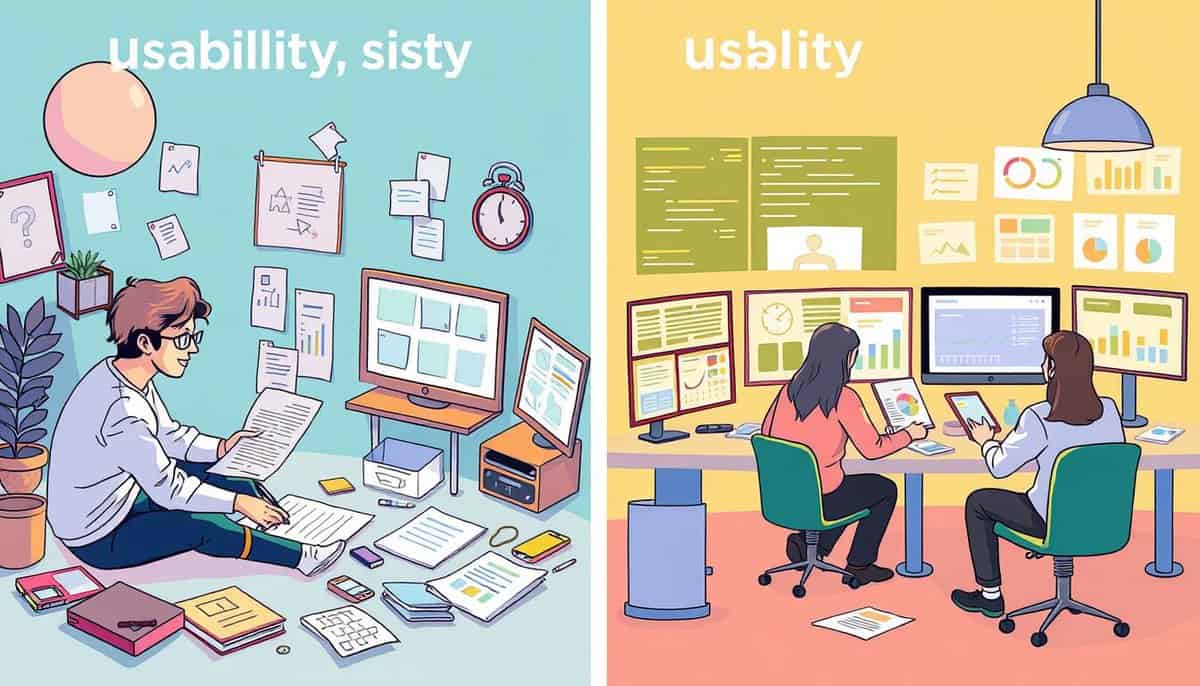
なぜある製品は使うのが楽しいのに、他の製品はそうでないのか、不思議に思ったことはありませんか?それはすべて、 使いやすさ 研究。製品が市場に出る前に、徹底的にテストする必要があります。 ユーザーエクスペリエンスこれにより、高いユーザビリティ基準を満たすことが保証されます。しかし、形成的評価か総括的評価か、適切な評価方法を選択することが重要です。
形成的ユーザビリティテストと総括的ユーザビリティテストは、製品開発においてそれぞれ異なる役割を果たします。形成的テストは、設計の初期段階で製品を改善するのに役立ちます。一方、総括的テストは、ほぼ完成した製品が効果的、効率的、かつ満足のいくものであるかどうかを検証します。これらのテスト方法をいつ、どのように活用するかを知ることは、製品の成功にとって非常に重要です。
主なポイント
- 設計サイクル中は、設計改善に焦点を当てた形成的ユーザビリティテストを少なくとも2回実施すべきである。
- ワイヤーフレームプロトタイプを用いた初期の形成テストには、通常5~8人のユーザーが参加する。
- 開発段階の直前に、5~8人のユーザーを対象に、最小実行可能製品(MVP)を用いた形成的テストを実施することが不可欠です。
- 15~20人のユーザーを対象に実施される総括的なユーザビリティテストは、ユーザビリティ指標に基づいて製品の妥当性を検証するものです。
- 形成評価は継続的に実施され、設計を形成する上で重要な役割を果たし、総括評価は最終的な検証とベンチマークを提供する。
- どちらのタイプの評価も、研究目的に応じて定性的評価または定量的評価のいずれかになり得る。
- 両方の手法を組み合わせることで、長期的な視点と競合他社との比較に基づいた包括的な評価が可能になります。
ユーザビリティ研究入門
ユーザビリティ調査は、ユーザーにとって使いやすい製品を作る上で非常に重要です。ユーザビリティテストの手法と評価方法を用いて、製品が基準を満たし、スムーズに動作することを保証します。これらの調査は、形成段階と総括段階に分かれており、それぞれに独自の目標と実施方法があります。
ユーザビリティテストの理解
ユーザビリティテストでは、ユーザーが製品を使用する様子を観察し、使いづらい箇所を見つけ出します。さまざまなユーザビリティテスト手法を用いることで、研究者は貴重なフィードバックを得ることができます。形成的ユーザビリティテストは、5~7人のユーザーで早い段階で行われます。これは、総括的テストよりも迅速かつ安価です。総括的ユーザビリティテストは、15~20人のユーザーで行われます。これは最終製品をチェックするもので、一般的に費用が高くなります。
製品開発におけるユーザビリティ調査の重要性
製品開発においてユーザビリティ評価手法を用いることは非常に重要です。これらの手法は設計上の問題を早期に発見し、製品をユーザーのニーズに合致させるのに役立ちます。例えば、ヒューマンファクターエンジニアによる評価は客観的な洞察を提供します。これにより、内部的な偏見を排除し、ミスを早期に発見することができます。結果として、製品はより幅広いユーザー層に受け入れられるようになります。両方のタイプのユーザビリティテストに注力することで、ユーザーの信頼を高め、発売後の問題を減らし、市場での存在感を向上させることができます。
次に、形成的ユーザビリティテストと総括的ユーザビリティテストの違いを見ていきましょう。
| 特性 | 形成的ユーザビリティテスト | 総合的なユーザビリティテスト |
|---|---|---|
| ユーザー数 | 5-7 | 15-20 |
| ステージ | 初期設計および開発 | 市場投入後 |
| 料金 | より安価 | より高価 |
| 所要時間 | 時間の節約 | より時間がかかる |
| データ型 | 定性 | 定量的 |
| 評価者 | 内部または外部 | 外部推奨 |
形成的ユーザビリティテストとは何ですか?
形成的ユーザビリティテストは、設計プロセスの初期段階で製品を改善するのに役立ちます。ユーザーからのフィードバックを活用して問題を修正することで、製品がユーザーのニーズをより的確に満たすようになります。

定義と目的
設計段階にある製品を評価する。主な目的は以下のとおりである。
- ユーザビリティの問題を早期に特定し、対処する。
- 定性的なユーザビリティ調査を用いて、詳細な知見を収集する。
- 製品のデザインがユーザーのニーズを満たしていることを確認する。
- ワイヤーフレームプロトタイプまたは最小実行可能製品(MVP)を用いたテスト。
このテストには通常5~8人のユーザーが参加します。
形成的ユーザビリティテストを実施するタイミング
設計段階では2回のテストを実施することが推奨されます。必要なテストは以下のとおりです。
- ワイヤーフレームやMVP(最小実行可能製品)などの初期プロトタイプが利用可能になり次第。
- 重要な設計上の決定が最終決定される前に。
- 繰り返し、継続的なユーザビリティ向上を確実にするために、デザインは進化し続けます。
事例と応用例
以下のような様々な技術やツールが使用されます。
- 低忠実度プロトタイプ: 紙や静的なページを使って初期フィードバックを収集する。
- リアルタイム観測: ユーザーが製品とどのようにインタラクトするかを確認するため。
- パイロットスタディ: 技術的またはワークフロー上の問題を修正するための予備テスト。
以下に、形成的ユーザビリティテストと総括的ユーザビリティテストの比較を示します。
| 側面 | 形成的テスト | 総括的評価 |
|---|---|---|
| 集中 | 定性的な洞察 | 定量的指標 |
| タイミング | 開発の初期段階で | 開発サイクルの終了 |
| サンプルサイズ | 5~8人のユーザー | 15~20人のユーザー |
| プロトタイプ | ワイヤーフレーム、MVP | 完全に機能する製品 |
What is Summative Usability Testing?
Summative Usability Testing is key in ユーザー中心 design. It checks a product’s effectiveness and efficiency after development. Quantitative measures confirm if usability goals are met before the product launch.
定義と目的
It involves assessing the overall design with several users, usually between 15-20. The main goal is to measure how effective, efficient, and satisfying a product is for the users.
When to Conduct Summative Usability Testing
This testing phase is done right before a product’s release. It ensures all usability marks are met. Metrics like task completion rates and satisfaction are key.
Formative versus Summative Studies in Usability
Knowing the difference between formative and summative usability studies is key for product development. Formative and summative usability tests have different goals. They are used at different times in the development process. Formative testing is about exploring early design stages. It aims to find and fix issues early. Common tools for this are heuristic evaluation, interviews, and contextual analysis.
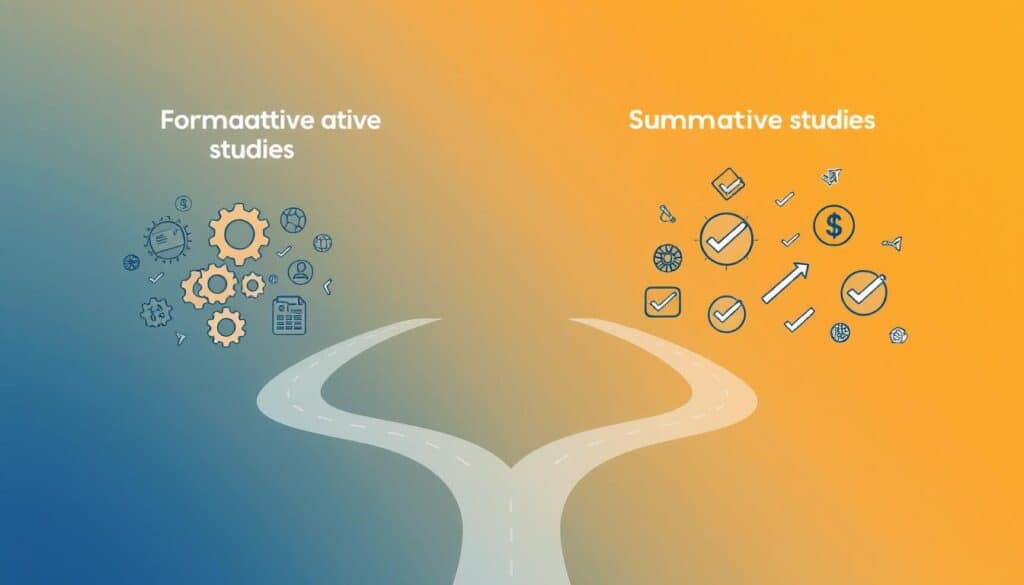
Formative testing usually involves small groups. About 4-5 people per user group work with early designs like wireframes. This phase focuses on qualitative data. It looks at what users do, think, and feel in real-time. The benefits include spotting problems early, making design better over time, improving user experience, and lowering development risks.
In contrast, summative usability testing happens near the end of developing a product. Its goal is to check if the product is easy to use. Usually, 15-20 people per user group take part in this testing. Tests measure things like how long tasks take, completion rates, and overall success. This method involves careful collection of data with specific measurements.
The comparison between these two types of testing shows why both are important. Formative testing helps make designs better early on with feedback. Summative testing checks if the final product meets usability goals before it goes out. Using both types of tests can make a product more user-friendly and successful.
| 側面 | 形成的ユーザビリティテスト | 総合的なユーザビリティテスト |
|---|---|---|
| 目的 | Exploratory, to shape design early | Confirmatory, to validate final product |
| When Conducted | Early stages (concept, prototype testing) | End stages (right before/after redesign) |
| Participants | 4-5 per user group | 15-20 per user group |
| Common Methods |
|
|
| データ型 | Qualitative (observations, thought processes) | Quantitative (task completion time, errors) |
Formative and summative usability studies are both valuable. Formative testing ensures problems are found and fixed early. This makes design better and more efficient. Summative testing, on the other hand, makes sure the final product has been properly checked. It confirms usability before the product goes to market.
Order and Purpose of Usability Studies
Usability studies are essential in the design process integration. They follow a specific order to be most effective.

Role in the Design Process
Design process begins with formative usability testing. It involves a team of 5-7 users. They look for issues by using methods like Think-aloud protocol and prototype testing.
This helps find problems early on. It makes fixing them cheaper and easier.
Once the product is out, summative usability testing takes place. It’s for checking if the design works well with more users. Tools like First click testing see how fast and accurately users perform tasks.
Benefits of Conducting Usability Studies
Usability studies offer key advantages. Early stage testing, or formative testing, spots problems soon. This can save money and improve design quickly.
Summative testing checks if the product meets user needs before launch. It looks at how well redesigns work and compares usability improvements. This puts the product in a stronger position in the market.
Using both testing types improves product making. It boosts user satisfaction and makes the development process smoother.
Industries and Types of Products Benefiting from Usability Studies
Usability studies are key in many sectors to ensure products meet user needs well. They are especially valuable in technology, healthcare, and retail. These sectors use specific tests to make their products better.
- テクノロジー: firms like Apple and Microsoft use usability studies a lot. They do this to improve software and hardware, making them easy to use.
- Healthcare: usability studies are mandatory by regulation in making medical devices and health IT. The Mayo Clinic, for example, uses them to make electronic health records (EHR) systems better.
- Retail: giants like Amazon and Walmart test their e-commerce sites thoroughly. They want to make sure shopping is smooth for all customers.

Many products, from complex software to simple gadgets, undergo usability studies. These studies are vital. They find and fix design problems that might stop users from enjoying the product.
Different kinds of tests are used in various industries. Here’s a brief look at how they work:
| Evaluation Type | 頻度 | Common Methods | Objectives |
|---|---|---|---|
| 形成的ユーザビリティテスト | Multiple times during development | Heuristic evaluation, usability testing, interviews | Find out what users need, like, and want. |
| 総合的なユーザビリティテスト | Less often, after launch | A/B testing, ネットプロモータースコア surveys | See if the product works well, makes users happy. |
Usability studies are super helpful. They give companies important data and insights. With these, businesses can make products that truly connect with people. By using tests that fit their industry, companies can boost user happiness and product success.
Optional or Mandatory: Are Both Usability Studies Needed?
Choosing if you need formative and summative usability studies involves several factors. These include how complex the product is, the goals of your project, and what the industry standards say. It’s vital to look closely at these factors to decide wisely.
Factors to Consider
What kind of usability testing requirements your product needs is key. Let’s say you’re working with early prototypes or wireframes. You should look at how a small group of five to eight users react to them. This step finds problems early, so you can fix them and better the user experience.
You’ll look at things like if users can complete tasks, how long tasks take, mistakes made, and if users are happy with the product. Starting formative testing early can avoid issues, lower risks, and make sure users enjoy the product.
Regulations and Industry Standards
Usability studies might be needed because of industry rules. Some fields, like healthcare, have strict testing rules to follow. This makes sure the product is safe and works well. For example, using ePROs in clinical trials shows how important usability is becoming in healthcare tech.
Authorities now focus more on what patients say about their treatment. This stresses the importance of both formative and summative usability testing. Using both types of testing can really improve your product and make users happy. Formative tests improve design, while summative tests check the product meets all requirements.
| Study Type | ステージ | 指標 | 利点 |
|---|---|---|---|
| 形成的ユーザビリティテスト | Early development | Task completion rates, Time on task, Error rates, User satisfaction, SUS | Early problem identification, Improved user experience, Risk reduction |
| 総合的なユーザビリティテスト | Post-development | Overall usability, Compliance with regulations | Validation, Regulatory compliance |
Duration and Personnel Involved in Usability Studies
Usability studies can take different amounts of time. This is because what you need to test can vary a lot. Knowing how to plan these studies helps decide how much time and people you need.
Timeframe Expectations
Formative usability tests are quick and done over and over. They might just need a few people, which lets you make changes quickly. Jakob Nielsen says five is the best number of people for these tests. They help fix problems early on.
Summative tests take longer and need careful planning. They often involve 20 people per group, as Nielsen recommends, or even up to 50 for everyday items, according to ISO 20282.
Who Should Conduct the Studies?
A good usability test needs a team with UX/UI designers, usability experts, and psychologists. They find design problems and what users like. Each person has important skills for collecting data and analyzing it.
Formative tests often need someone to help participants and use the think-aloud method. Summative tests are different. They use remote, unmoderated methods focused on statistical analysis of how users behave.
A clear distinction exists between the roles for formative and summative usability studies, emphasizing the importance of tailored usability study planning and the strategic composition of the testing team to achieve reliable and actionable results. Data analysis for formative tests is qualitative, concentrating on usability themes and severity ratings, whereas summative tests necessitate statistical evaluations like time on task, success rates, and overall UX scores.
| 側面 | 形成的テスト | 総括的評価 |
|---|---|---|
| Duration | Quick, iterative | Extensive, planned |
| Participants | 5-10 per group | 20-50 per group |
| 集中 | Identifying issues early | Statistical validity, benchmarks |
| Team Composition | UX/UI designers, moderators | Usability specialists, data loggers |
| Data Output | 定性 | 定量的 |
結論
Combining formative and summative usability studies in product development is crucial. It ensures products are technically sound and satisfy users. Designers can find and fix problems early by doing formative testing often. This involves 4-5 users per group using methods like evaluations, testing, interviews, and analysis.
Exploratory testing, A/B testing, and comparing with competitors provide valuable feedback. This guides designers to improve. Summative testing, done later, checks if the design works well with more users, about 15-20 per group. It uses final product tests to confirm usability goals are achieved and provides proof of the design’s effectiveness.
The Human Factors/Usability Engineering process includes steps like making usability tasks, doing validation tests, analyzing data, and identifying risks from use errors. These steps boost product usability and success. Formative evaluations build knowledge while summative evaluations test it, similar to education. Integrating these studies ensures the final product stands out in fulfilling needs and surpassing market standards.
補足資料と方法
- User Experience (UX) design: wireframing, Prototyping, user journey mapping
- Cognitive Psychology: mental models, perception studies, cognitive load analysis
- 人間とコンピュータのインタラクション(HI): interaction design, task analysis, interface evaluation
- Accessibility testing: screen reader testing, keyboard navigation testing, color contrast analysis
- A/Bテスト: split testing, multivariate testing, conversion rate optimization
- 情報アーキテクチャ (IA): card 並べ替え, tree testing, content inventory
- Heuristic evaluation: expert review, usability principles analysis, Nielsen’s heuristics
- Eye tracking studies: heatmaps, gaze plot analysis, fixation patterns
- ペルソナ and user profiles: user interviews, surveys, behavioral segmentation
- Agile and lean UX: rapid iterative testing, Sprint planning, 最小実行可能製品 (MVP) 発達
よくある質問
形成的ユーザビリティ調査とは何ですか?
形成的なユーザビリティ調査は、設計段階の初期に行われます。これらの調査は、問題点を発見し、解決策を検証するのに役立ちます。これらのテストは、ユーザーからのフィードバックに基づいて設計を改善することに重点を置いています。
総括的ユーザビリティ調査とは何ですか?
総括的なユーザビリティ調査は、完全に開発された製品を評価するものです。数値を用いて、製品が効果的かつ効率的であるかどうかを確認し、ユーザビリティの目標を満たしているかどうかを検証します。
形成的ユーザビリティテストはいつ実施すべきか?
製品開発の初期段階で形成的テストを開始するのが最善です。これにより、設計上の問題を早期に発見し、製品がユーザーの求める機能を確実に果たせるようになります。
総括的なユーザビリティテストはいつ実施すべきですか?
総括的テストは製品完成後に行われます。これは、製品が市場投入前にすべてのユーザビリティ要件を満たしていることを確認するための最終段階です。
形成的ユーザビリティ調査と総括的ユーザビリティ調査の主な違いは何ですか?
主な違いは、その目的とタイミングです。形成テストは設計の初期段階で形作るためのものであり、総括テストは製品の発売前に最終製品の使いやすさを確認するためのものです。
ユーザビリティ調査を実施するメリットは何ですか?
ユーザビリティ調査は、ユーザー満足度を高め、再設計コストを削減し、市場での地位を向上させます。デザイン上の問題点を早期に発見し、最終製品がユーザーのニーズを満たすことを保証します。
どの業界がユーザビリティ調査から恩恵を受けるのか?
テクノロジー、ヘルスケア、小売業界は、ユーザビリティ調査から多くの恩恵を受けています。ユーザビリティ調査によって、製品はより使いやすく、より楽しくなり、ユーザーのニーズに的確に応えることができるのです。
形成的ユーザビリティ調査と総括的ユーザビリティ調査は、常に両方とも必要でしょうか?
両方のテストが必要かどうかは、製品、業界の規制、そして目標によって異なります。製品の複雑さやユーザーへの影響を考慮してください。業界によっては、法律で特定のテストが義務付けられている場合もあります。
ユーザビリティ調査は通常どのくらいの期間かかりますか?
調査期間は、何をテストするかによって異なります。形成的調査は通常短く、繰り返し行われます。総括的調査はより詳細なため、時間がかかります。
ユーザビリティ調査は誰が実施すべきか?
UX/UIデザイナー、ユーザビリティスペシャリスト、心理学者といった専門家がこうした調査を行うべきだ。彼らはデザイン上の問題点を見抜くことに長けており、ユーザーが何を好むかを把握しているからだ。
形成的ユーザビリティ調査および総括的ユーザビリティ調査に関する外部リンク
国際規格
(リンクにカーソルを合わせると、コンテンツの説明が表示されます)
用語集
Conversion Rate (CR): ウェブサイトやランディングページへの訪問者のうち、購入やニュースレターへの登録など、目的の行動を完了した人の割合。コンバージョン数を総訪問者数で割って算出する。
Human-Computer Interaction (HCI): 人間が使用するインタラクティブなコンピューティングシステムの設計、評価、実装に焦点を当てた学際的な分野であり、ユーザビリティ、ユーザーエクスペリエンス、およびテクノロジーに関連するユーザーの行動と嗜好の研究を重視している。
International Organization for Standardization (ISO): a non-governmental international body that develops and publishes standards to ensure quality, safety, efficiency, and interoperability across various industries and sectors, facilitating global trade and cooperation. Established in 1947, it comprises national standardization organizations from member countries.
Minimum Viable Product (MVP): 初期ユーザーのニーズを満たし、今後の開発のためのフィードバックを収集するために必要な基本機能のみを搭載した製品の基本バージョン。最小限のリソースと時間投資で顧客ニーズに関する仮説を検証することを目的としている。
User experience (UX): the overall satisfaction and perception of a user when interacting with a product, system, or service, encompassing usability, accessibility, design, and emotional response throughout the entire interaction process.
User Interface (UI): a system that enables interaction between users and software applications, encompassing visual elements, controls, and overall layout to facilitate user tasks and enhance experience.