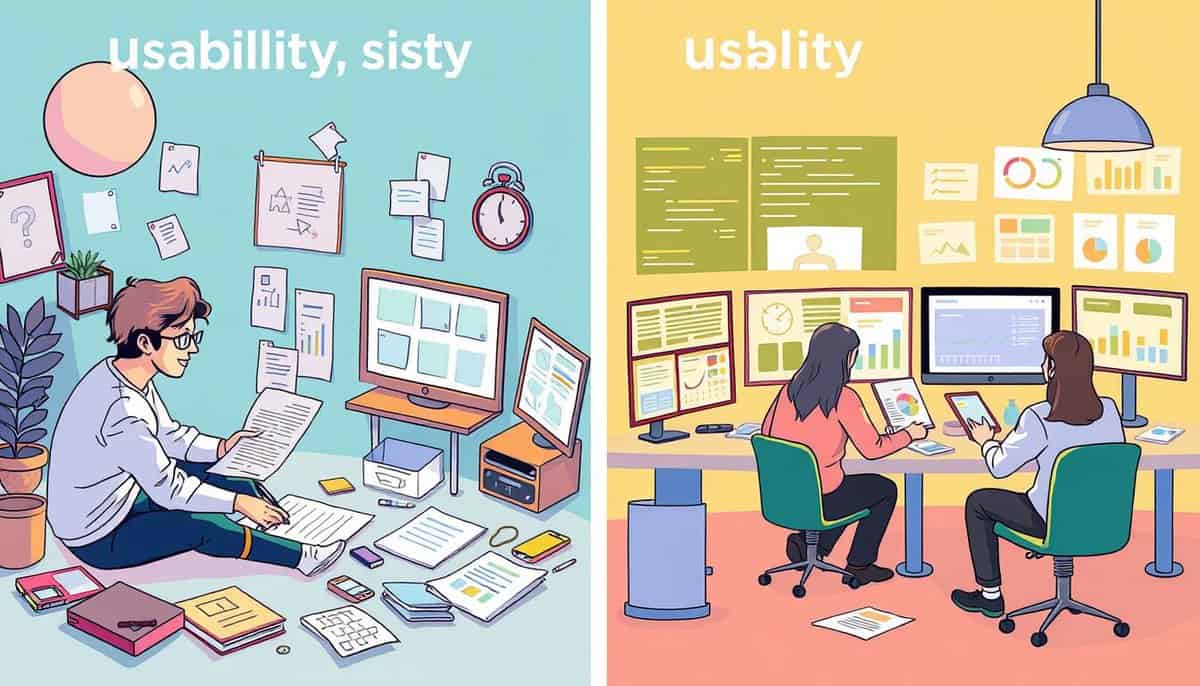
어떤 제품은 사용하기 즐거운 반면, 어떤 제품은 그렇지 않은 이유가 궁금했던 적이 있나요? 그 이유는 바로... 사용성 연구. 제품이 시장에 출시되기 전에 철저한 테스트를 거쳐야 합니다. 사용자 경험이를 통해 높은 사용성 기준을 충족할 수 있습니다. 하지만 형성 평가와 총괄 평가 중 어떤 평가 방법을 선택할지가 핵심입니다.
형성적 사용성 테스트와 총괄적 사용성 테스트는 제품 개발 과정에서 서로 다른 역할을 수행합니다. 형성적 테스트는 초기 설계 단계에서 제품을 개선하는 데 도움을 줍니다. 반면, 총괄적 테스트는 거의 완성 단계에 이른 제품이 효과적이고 효율적이며 만족스러운지 확인하는 데 사용됩니다. 이러한 테스트 방법을 언제 어떻게 활용해야 하는지 아는 것은 제품의 성공에 매우 중요합니다.
핵심 요약
- 형성적 사용성 테스트는 디자인 주기 동안 최소 두 번 이상 실시해야 하며, 디자인 개선에 중점을 두어야 합니다.
- 와이어프레임 프로토타입을 사용한 초기 형성 평가에는 일반적으로 5~8명의 사용자가 참여합니다.
- 최소 기능 제품(MVP)에 대한 형성적 테스트는 개발 단계 직전에 5~8명의 사용자를 대상으로 실시하는 것이 필수적입니다.
- 15~20명의 사용자를 대상으로 실시하는 종합적인 사용성 테스트는 사용성 지표를 기준으로 제품의 유효성을 검증합니다.
- 형성 평가는 지속적으로 이루어지며 설계 방향을 제시하는 반면, 총괄 평가는 최종적인 타당성 검증 및 기준 설정에 활용됩니다.
- 두 가지 유형의 평가 모두 연구 목표에 따라 질적 평가 또는 양적 평가로 진행될 수 있습니다.
- 두 가지 방법론을 결합하면 시간 경과에 따른 종합적인 평가와 경쟁사 대비 평가가 가능해집니다.
사용성 연구 개론
사용성 연구는 사용자가 만족할 만한 제품을 만드는 데 핵심적인 역할을 합니다. 사용성 연구에서는 사용성 테스트 기법과 사용성 평가 방법을 활용하여 제품의 완성도를 높이고 원활한 작동을 보장합니다. 사용성 연구는 형성 평가와 총괄 평가로 나뉘며, 각 단계는 고유한 목표와 수행 방식을 가지고 있습니다.
사용성 테스트 이해하기
사용성 테스트는 사용자가 제품을 사용하는 모습을 관찰하여 불편한 점을 찾아내는 과정입니다. 다양한 사용성 테스트 기법을 통해 연구자들은 귀중한 피드백을 얻습니다. 형성적 사용성 테스트는 제품 개발 초기 단계에 5~7명의 사용자를 대상으로 진행되며, 총괄적 테스트보다 빠르고 비용도 저렴합니다. 총괄적 사용성 테스트는 15~20명의 사용자를 대상으로 최종 제품을 평가하는 것으로, 일반적으로 비용이 더 많이 듭니다.
제품 개발에서 사용성 연구의 중요성
제품 개발에 있어 사용성 평가 방법을 활용하는 것은 매우 중요합니다. 사용성 평가는 디자인 문제를 조기에 발견하고 제품을 사용자 요구에 부합하도록 만들어 줍니다. 예를 들어, 인간공학 전문가의 평가는 객관적인 통찰력을 제공합니다. 이는 내부적인 편견을 방지하고 오류를 찾아내는 데 도움이 됩니다. 결과적으로 제품은 더 넓은 사용자층에게 어필할 수 있게 됩니다. 두 가지 유형의 사용성 테스트 모두에 집중하면 사용자 신뢰도가 높아지고 출시 후 문제 발생률이 감소하며 시장 점유율이 향상됩니다.
다음으로, 형성적 사용성 테스트와 총괄적 사용성 테스트의 차이점을 살펴보겠습니다.
| 특성 | 형성적 사용성 테스트 | 종합적 사용성 테스트 |
|---|---|---|
| 사용자 수 | 5-7 | 15-20 |
| 단계 | 초기 설계 및 개발 | 시장 출시 후 |
| 비용 | 더 저렴한 | 더 비싼 |
| 시간 소모 | 시간이 덜 소요됨 | 시간이 더 많이 소요됨 |
| 데이터 유형 | 질적 | 양적 |
| 평가자 | 내부 또는 외부 | 외부 추천 |
형성적 사용성 테스트란 무엇인가요?
형성적 사용성 테스트는 설계 과정 초기에 제품을 개선하는 데 도움이 됩니다. 사용자 피드백을 활용하여 문제를 해결함으로써 제품이 사용자의 요구를 더 잘 충족하도록 합니다.

정의 및 목표
이는 제품의 설계 단계를 평가하는 것입니다. 주요 목표는 다음과 같습니다.
- 사용성 문제를 조기에 파악하고 해결합니다.
- 심층적인 통찰력을 얻기 위해 정성적 사용성 연구를 활용합니다.
- 제품 디자인이 사용자 요구를 충족하는지 확인합니다.
- 와이어프레임 프로토타입 또는 최소 기능 제품(MVP)을 이용한 테스트.
이 테스트에는 일반적으로 5~8명의 사용자가 참여합니다.
형성적 사용성 테스트는 언제 실시해야 할까요?
설계 단계에서 두 차례의 테스트를 진행하는 것이 좋습니다. 필요한 테스트는 다음과 같습니다.
- 와이어프레임이나 MVP와 같은 초기 프로토타입이 나오는 즉시.
- 중요한 디자인 결정이 최종 확정되기 전에.
- 디자인이 진화함에 따라 사용성 개선이 지속적으로 이루어지도록 반복적으로 수정됩니다.
사례 및 응용
다음과 같은 다양한 기술과 도구가 사용됩니다.
- 저충실도 프로토타입: 종이나 정적인 페이지를 사용하여 초기 피드백을 수집합니다.
- 실시간 관찰: 사용자들이 제품과 어떻게 상호작용하는지 알아보기 위해서입니다.
- 예비 연구: 기술적 또는 업무 흐름상의 문제를 해결하기 위한 예비 테스트.
다음은 형성 평가와 총괄 평가 사용성 테스트를 비교한 내용입니다.
| 측면 | 형성 평가 | 총괄 평가 |
|---|---|---|
| 집중하다 | 질적 통찰 | 정량적 지표 |
| 타이밍 | 개발 초기 단계 | 개발 주기 종료 |
| 표본 크기 | 5~8명 사용자 | 15-20명 사용자 |
| 프로토타입 | 와이어프레임, MVP | 완벽하게 작동하는 제품 |
What is Summative Usability Testing?
Summative Usability Testing is key in 사용자 중심 design. It checks a product’s effectiveness and efficiency after development. Quantitative measures confirm if usability goals are met before the product launch.
정의 및 목표
It involves assessing the overall design with several users, usually between 15-20. The main goal is to measure how effective, efficient, and satisfying a product is for the users.
When to Conduct Summative Usability Testing
This testing phase is done right before a product’s release. It ensures all usability marks are met. Metrics like task completion rates and satisfaction are key.
Formative versus Summative Studies in Usability
Knowing the difference between formative and summative usability studies is key for product development. Formative and summative usability tests have different goals. They are used at different times in the development process. Formative testing is about exploring early design stages. It aims to find and fix issues early. Common tools for this are heuristic evaluation, interviews, and contextual analysis.
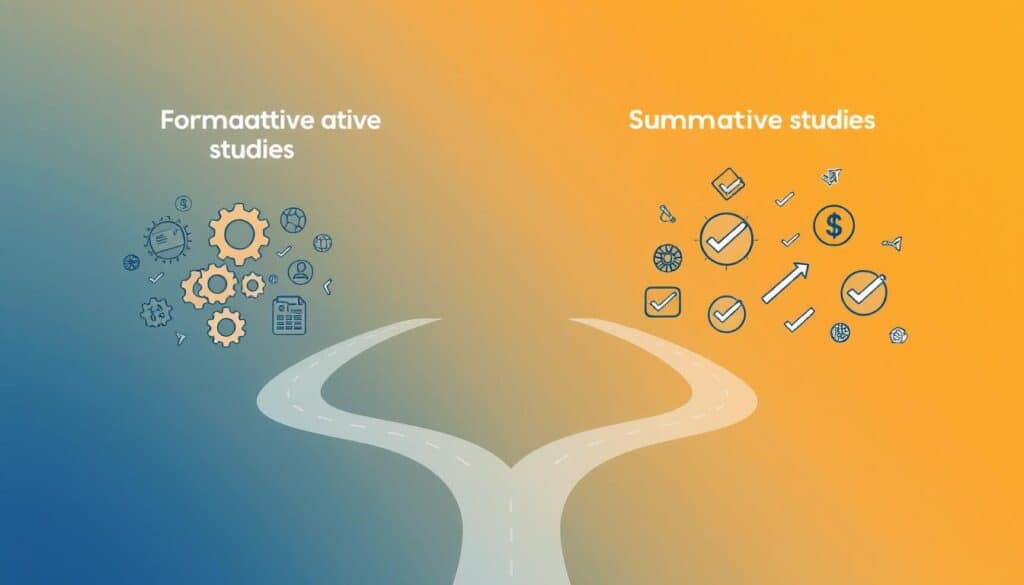
Formative testing usually involves small groups. About 4-5 people per user group work with early designs like wireframes. This phase focuses on qualitative data. It looks at what users do, think, and feel in real-time. The benefits include spotting problems early, making design better over time, improving user experience, and lowering development risks.
In contrast, summative usability testing happens near the end of developing a product. Its goal is to check if the product is easy to use. Usually, 15-20 people per user group take part in this testing. Tests measure things like how long tasks take, completion rates, and overall success. This method involves careful collection of data with specific measurements.
The comparison between these two types of testing shows why both are important. Formative testing helps make designs better early on with feedback. Summative testing checks if the final product meets usability goals before it goes out. Using both types of tests can make a product more user-friendly and successful.
| 측면 | 형성적 사용성 테스트 | 종합적 사용성 테스트 |
|---|---|---|
| 목적 | Exploratory, to shape design early | Confirmatory, to validate final product |
| When Conducted | Early stages (concept, prototype testing) | End stages (right before/after redesign) |
| Participants | 4-5 per user group | 15-20 per user group |
| Common Methods |
|
|
| 데이터 유형 | Qualitative (observations, thought processes) | Quantitative (task completion time, errors) |
Formative and summative usability studies are both valuable. Formative testing ensures problems are found and fixed early. This makes design better and more efficient. Summative testing, on the other hand, makes sure the final product has been properly checked. It confirms usability before the product goes to market.
Order and Purpose of Usability Studies
Usability studies are essential in the design process integration. They follow a specific order to be most effective.

Role in the Design Process
Design process begins with formative usability testing. It involves a team of 5-7 users. They look for issues by using methods like Think-aloud protocol and prototype testing.
This helps find problems early on. It makes fixing them cheaper and easier.
Once the product is out, summative usability testing takes place. It’s for checking if the design works well with more users. Tools like First click testing see how fast and accurately users perform tasks.
Benefits of Conducting Usability Studies
Usability studies offer key advantages. Early stage testing, or formative testing, spots problems soon. This can save money and improve design quickly.
Summative testing checks if the product meets user needs before launch. It looks at how well redesigns work and compares usability improvements. This puts the product in a stronger position in the market.
Using both testing types improves product making. It boosts user satisfaction and makes the development process smoother.
Industries and Types of Products Benefiting from Usability Studies
Usability studies are key in many sectors to ensure products meet user needs well. They are especially valuable in technology, healthcare, and retail. These sectors use specific tests to make their products better.
- 기술: firms like Apple and Microsoft use usability studies a lot. They do this to improve software and hardware, making them easy to use.
- Healthcare: usability studies are mandatory by regulation in making medical devices and health IT. The Mayo Clinic, for example, uses them to make electronic health records (EHR) systems better.
- Retail: giants like Amazon and Walmart test their e-commerce sites thoroughly. They want to make sure shopping is smooth for all customers.

Many products, from complex software to simple gadgets, undergo usability studies. These studies are vital. They find and fix design problems that might stop users from enjoying the product.
Different kinds of tests are used in various industries. Here’s a brief look at how they work:
| Evaluation Type | 빈도 | Common Methods | Objectives |
|---|---|---|---|
| 형성적 사용성 테스트 | Multiple times during development | Heuristic evaluation, usability testing, interviews | Find out what users need, like, and want. |
| 종합적 사용성 테스트 | Less often, after launch | A/B testing, 순추천지수(NPS) surveys | See if the product works well, makes users happy. |
Usability studies are super helpful. They give companies important data and insights. With these, businesses can make products that truly connect with people. By using tests that fit their industry, companies can boost user happiness and product success.
Optional or Mandatory: Are Both Usability Studies Needed?
Choosing if you need formative and summative usability studies involves several factors. These include how complex the product is, the goals of your project, and what the industry standards say. It’s vital to look closely at these factors to decide wisely.
Factors to Consider
What kind of usability testing requirements your product needs is key. Let’s say you’re working with early prototypes or wireframes. You should look at how a small group of five to eight users react to them. This step finds problems early, so you can fix them and better the user experience.
You’ll look at things like if users can complete tasks, how long tasks take, mistakes made, and if users are happy with the product. Starting formative testing early can avoid issues, lower risks, and make sure users enjoy the product.
Regulations and Industry Standards
Usability studies might be needed because of industry rules. Some fields, like healthcare, have strict testing rules to follow. This makes sure the product is safe and works well. For example, using ePROs in clinical trials shows how important usability is becoming in healthcare tech.
Authorities now focus more on what patients say about their treatment. This stresses the importance of both formative and summative usability testing. Using both types of testing can really improve your product and make users happy. Formative tests improve design, while summative tests check the product meets all requirements.
| Study Type | 단계 | 측정 기준 | 이익 |
|---|---|---|---|
| 형성적 사용성 테스트 | Early development | Task completion rates, Time on task, Error rates, User satisfaction, SUS | Early problem identification, Improved user experience, Risk reduction |
| 종합적 사용성 테스트 | Post-development | Overall usability, Compliance with regulations | Validation, Regulatory compliance |
Duration and Personnel Involved in Usability Studies
Usability studies can take different amounts of time. This is because what you need to test can vary a lot. Knowing how to plan these studies helps decide how much time and people you need.
Timeframe Expectations
Formative usability tests are quick and done over and over. They might just need a few people, which lets you make changes quickly. Jakob Nielsen says five is the best number of people for these tests. They help fix problems early on.
Summative tests take longer and need careful planning. They often involve 20 people per group, as Nielsen recommends, or even up to 50 for everyday items, according to ISO 20282.
Who Should Conduct the Studies?
A good usability test needs a team with UX/UI designers, usability experts, and psychologists. They find design problems and what users like. Each person has important skills for collecting data and analyzing it.
Formative tests often need someone to help participants and use the think-aloud method. Summative tests are different. They use remote, unmoderated methods focused on statistical analysis of how users behave.
A clear distinction exists between the roles for formative and summative usability studies, emphasizing the importance of tailored usability study planning and the strategic composition of the testing team to achieve reliable and actionable results. Data analysis for formative tests is qualitative, concentrating on usability themes and severity ratings, whereas summative tests necessitate statistical evaluations like time on task, success rates, and overall UX scores.
| 측면 | 형성 평가 | 총괄 평가 |
|---|---|---|
| Duration | Quick, iterative | Extensive, planned |
| Participants | 5-10 per group | 20-50 per group |
| 집중하다 | Identifying issues early | Statistical validity, benchmarks |
| Team Composition | UX/UI designers, moderators | Usability specialists, data loggers |
| Data Output | 질적 | 양적 |
결론
Combining formative and summative usability studies in product development is crucial. It ensures products are technically sound and satisfy users. Designers can find and fix problems early by doing formative testing often. This involves 4-5 users per group using methods like evaluations, testing, interviews, and analysis.
Exploratory testing, A/B testing, and comparing with competitors provide valuable feedback. This guides designers to improve. Summative testing, done later, checks if the design works well with more users, about 15-20 per group. It uses final product tests to confirm usability goals are achieved and provides proof of the design’s effectiveness.
The Human Factors/Usability Engineering process includes steps like making usability tasks, doing validation tests, analyzing data, and identifying risks from use errors. These steps boost product usability and success. Formative evaluations build knowledge while summative evaluations test it, similar to education. Integrating these studies ensures the final product stands out in fulfilling needs and surpassing market standards.
보충 자료 및 방법
- User Experience (UX) design: wireframing, Prototyping, user journey mapping
- Cognitive Psychology: mental models, perception studies, cognitive load analysis
- 인간-컴퓨터 상호작용 (HCI): interaction design, task analysis, interface evaluation
- Accessibility testing: screen reader testing, keyboard navigation testing, color contrast analysis
- A/B 테스트: split testing, multivariate testing, conversion rate optimization
- 정보 아키텍처 (IA): card 정렬, tree testing, content inventory
- Heuristic evaluation: expert review, usability principles analysis, Nielsen’s heuristics
- Eye tracking studies: heatmaps, gaze plot analysis, fixation patterns
- 페르소나 and user profiles: user interviews, surveys, behavioral segmentation
- Agile and lean UX: rapid iterative testing, Sprint planning, 최소 기능 제품 (MVP) 개발
자주 묻는 질문
형성적 사용성 연구란 무엇인가요?
형성적 사용성 연구는 디자인 단계 초기에 진행됩니다. 이러한 연구는 문제점을 발견하고 해결책을 테스트하는 데 도움이 됩니다. 주요 목표는 사용자 피드백을 바탕으로 디자인을 개선하는 것입니다.
총괄적 사용성 연구란 무엇인가요?
종합적 사용성 연구는 완전히 개발된 제품을 평가합니다. 수치를 사용하여 제품이 사용성 목표를 충족하는지 확인하고, 제품의 효과성과 효율성을 점검합니다.
형성적 사용성 테스트는 언제 실시해야 할까요?
제품 개발 초기에 형성적 테스트를 시작하는 것이 가장 좋습니다. 이를 통해 설계상의 문제를 조기에 발견하고 제품이 사용자가 원하는 기능을 제대로 수행하는지 확인할 수 있습니다.
총괄적 사용성 테스트는 언제 실시해야 할까요?
총괄 테스트는 제품 개발이 완료된 후에 진행됩니다. 이는 제품이 시장에 출시되기 전에 모든 사용성 요구 사항을 충족하는지 확인하는 마지막 단계입니다.
형성적 사용성 조사와 총괄적 사용성 조사의 주요 차이점은 무엇인가요?
주된 차이점은 목적과 시점입니다. 형성 평가는 초기 단계에서 디자인 방향을 설정하는 데 사용되는 반면, 총괄 평가는 최종 제품 출시 전에 사용성을 점검하는 데 사용됩니다.
사용성 연구를 수행하면 어떤 이점이 있나요?
사용성 연구는 사용자 만족도를 높이고, 재설계 비용을 절감하며, 시장 경쟁력을 향상시킵니다. 사용성 연구는 디자인 문제를 조기에 발견하고 최종 제품이 사용자의 요구를 충족하도록 보장합니다.
사용성 연구를 통해 이점을 얻는 산업은 어떤 산업 분야인가요?
기술, 의료, 소매 산업은 사용성 연구를 통해 많은 것을 얻습니다. 사용성 연구는 제품을 더욱 쉽고 즐겁게 사용할 수 있도록 만들어 사용자의 요구에 정확히 부합하도록 합니다.
형성적 사용성 연구와 총괄적 사용성 연구는 항상 모두 필요한가요?
두 가지 테스트가 모두 필요한지는 제품, 업계 규정 및 목표에 따라 다릅니다. 제품의 복잡성과 사용자에게 미치는 영향을 고려해 보세요. 일부 산업에서는 법적으로 특정 테스트를 요구합니다.
일반적으로 사용성 연구는 얼마나 오래 걸리나요?
평가 대상에 따라 연구 기간이 달라집니다. 형성 평가는 일반적으로 짧고 반복적으로 진행됩니다. 총괄 평가는 더 자세한 내용을 다루기 때문에 더 오랜 시간이 걸립니다.
사용성 연구는 누가 수행해야 할까요?
UX/UI 디자이너, 사용성 전문가, 심리학자 같은 전문가들이 이러한 연구를 수행해야 합니다. 그들은 디자인 문제를 파악하고 사용자가 무엇을 좋아하는지 잘 알고 있습니다.
형성평가 및 총괄평가 사용성 연구 관련 외부 링크
국제 표준
(링크 위에 마우스를 올려놓으면 콘텐츠에 대한 설명을 볼 수 있습니다.)
사용된 용어집
Conversion Rate (CR): 웹사이트 또는 랜딩 페이지 방문자 중 구매 또는 뉴스레터 구독과 같은 원하는 행동을 완료한 방문자의 비율로, 전환 수를 전체 방문자 수로 나누어 계산합니다.
Human-Computer Interaction (HCI): 인간이 사용할 수 있는 대화형 컴퓨팅 시스템의 설계, 평가 및 구현에 중점을 둔 다학제 분야로, 사용성, 사용자 경험, 기술과 관련된 사용자 행동 및 선호도 연구를 강조합니다.
International Organization for Standardization (ISO): a non-governmental international body that develops and publishes standards to ensure quality, safety, efficiency, and interoperability across various industries and sectors, facilitating global trade and cooperation. Established in 1947, it comprises national standardization organizations from member countries.
Minimum Viable Product (MVP): 초기 사용자들을 만족시키고 향후 개발을 위한 피드백을 수집하는 데 필요한 핵심 기능만 포함하는 제품의 기본 버전입니다. 최소한의 자원과 시간 투자로 고객 요구에 대한 가설을 검증하는 것을 목표로 합니다.
User experience (UX): the overall satisfaction and perception of a user when interacting with a product, system, or service, encompassing usability, accessibility, design, and emotional response throughout the entire interaction process.
User Interface (UI): a system that enables interaction between users and software applications, encompassing visual elements, controls, and overall layout to facilitate user tasks and enhance experience.