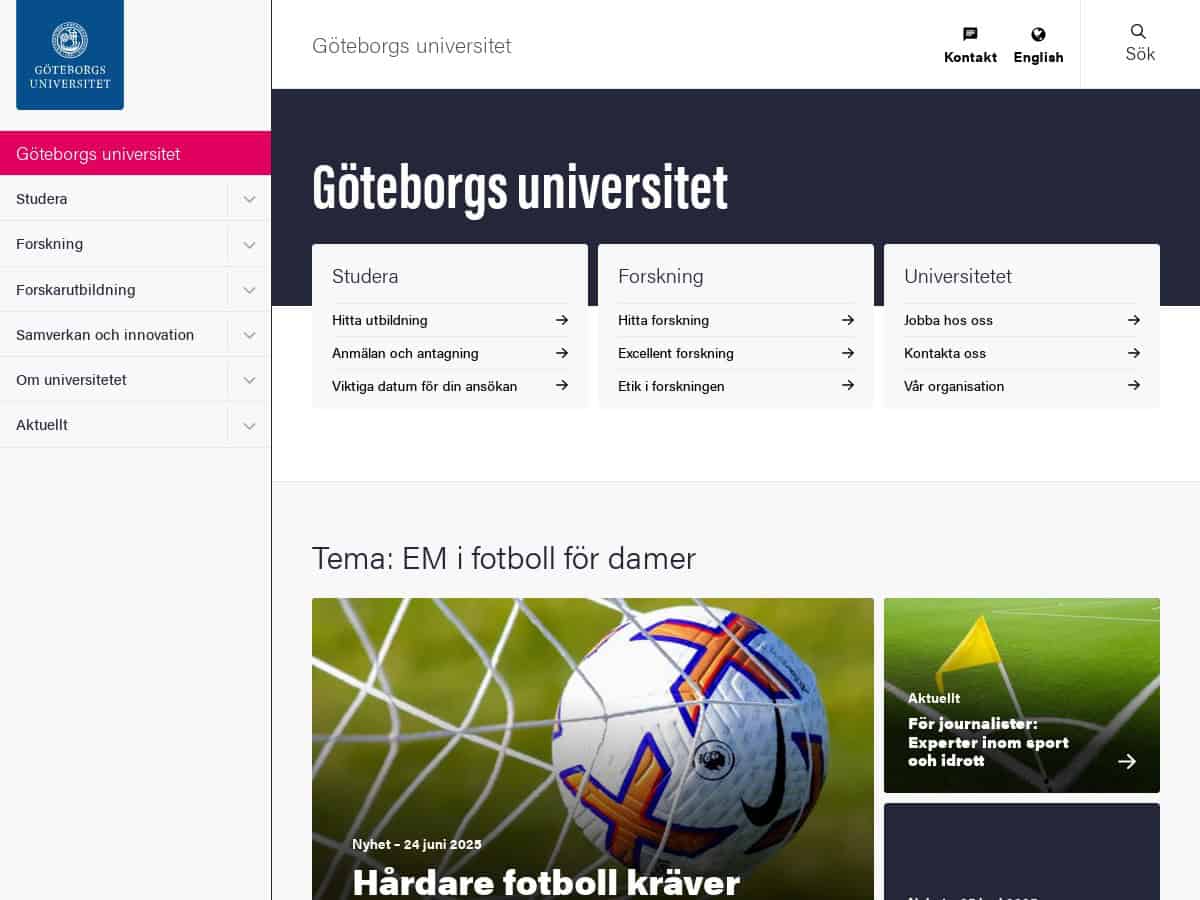
Address: Vasaparken, Universitetsplatsen 1, 405 30 Göteborg, Sweden
Marine Science, Political Science, Business
The University of Gothenburg (GU) is one of the largest universities in the Nordic countries with a wide range of courses and programmes, making it a comprehensive and research-intensive university. The university was founded as Gothenburg University College in 1891 and merged with a number of previously independent higher education institutions in Gothenburg.
The University of Gothenburg, GU, is one of the largest universities in the Nordic countries, with about 53,600 students and 6,000 staff, and around one student in ten from abroad. It began in 1891 as Göteborgs högskola, a college funded by donations from merchants of the port city, and it became a state university in 1954. The main buildings are on Vasaparken and Universitetsplatsen, in the city centre, near the Vasa Park and the theatre district, with the medical campus at Sahlgrenska on the hill.
The university has several faculties: humanities, social sciences, science, education, fine, applied and performing arts, the Sahlgrenska Academy for medicine and health, and the business school. It is broad, with strong research in marine science, medicine, social sciences, languages, philosophy, art and sustainable development. Arvid Carlsson, who received the Nobel Prize in Physiology or Medicine in 2000 for discoveries about dopamine, worked at the university.
Gothenburg’s position on the west coast shapes the research. The Tjärnö marine laboratory and the Sven Lovén Centre for Marine Infrastructure study the sea and its ecosystems, and the Gothenburg Centre for Sustainable Development works on climate and cities. The School of Business, Economics and Law and the Department of Applied Information Technology have strong ties with companies in the region. The Sahlgrenska University Hospital is the largest hospital in Sweden and a major partner.
Tuition is free for citizens of the EU, the EEA and Switzerland, while students from other countries pay tuition fees that vary by programme. Check the current tariff and the scholarships available. Applications for bachelor’s and master’s programmes go through the national portal, and deadlines are in the winter for the autumn intake. Bachelor’s programmes are mostly in Swedish, while most master’s programmes are in English.
Gothenburg has a mild climate by Swedish standards, an archipelago, lower rents than Stockholm and a lively student scene. Housing is still scarce, so students are advised to apply for accommodation early.
Domains taught:
AI and Machine Learning, Bioinformatics, Chemistry, Computer Vision, Data Analytics, Ecology and Sustainability, Life Sciences, Marine Science, Mathematics, Physics, Software Engineering, Statistics
Diplomas*:
Bachelor, Doctor, Master
Status:
Public
Partnerships:
The University of Gothenburg has a large number of international partnerships and is a member of several European and international networks, such as the MIRAI project, a collaboration between Swedish and Japanese universities.
Research:
The University of Gothenburg is a comprehensive research university with eight faculties and 38 departments. Important research areas include marine sciences, political science, and business. The university also has a number of interdisciplinary research centers.
Famous Alumnis:
Arvid Carlsson, Jan Eliasson
International recognition**:
Number of staff***:
6000
Current students***:
53600
Foreign students***:
10%
Cumulative former students***:
100000
Pros
A comprehensive university with a wide range of courses and a central location in Sweden’s second-largest city.
Cons
The university is spread out across the city, which can make it feel less like a unified campus.
Best For
Students looking for a broad, research-based education at a large, comprehensive university in a major city.
Stockholm University overlaps with this university on marine science, chemistry and statistics, so the two are easy to compare, and it covers astroscience and materials as well, and is smaller, enrolling about 33,000 students against roughly 53,600 here.
Umeå University overlaps with this institution on bioinformatics, computer vision and chemistry, so the two are easy to compare, and it is smaller, enrolling about 34,000 students against roughly 53,600 here, and is also a public institution.
Uppsala University is the closest domestic counterpart for statistics, ecology and sustainability and physics; it covers bioengineering and electrical and electronics as well, and has almost the same size, at about 50,000 students.
Linnaeus University offers a comparable education in marine science, ecology and sustainability and mathematics: it is slightly smaller, at about 40,000 students against roughly 53,600 here, and is also a public institution.
Lund University shares the core fields of this university, namely physics, life sciences and data analytics; it teaches at the same levels, namely bachelor's, master's and doctoral, and covers nanotechnologies and industrial design as well.
Most Similar Schools Abroad
Abroad, Masaryk University (the Czech Republic) covers chemistry, statistics and physics in a comparable way, and it runs the same bachelor's, master's and doctoral programmes, and is smaller, enrolling about 35,115 students against roughly 53,600 here.
Seen from abroad, University of Milan (Italy) is a close relative on subject matter, since chemistry, statistics and physics are central to both, and it is also a public institution, and runs the same bachelor's, master's and doctoral programmes.
The closest overseas parallel on bioinformatics, chemistry and statistics is University of Copenhagen, located in Denmark; it is slightly smaller, at about 37,500 students against roughly 53,600 here, and is also a public institution.
On content, Universiteit Utrecht in the Netherlands and this institution are close, as both teach marine science, bioinformatics and computer vision; it covers astroscience and geotechnics as well, and is slightly smaller, at about 37,000 students against roughly 53,600 here.
For chemistry, statistics and physics outside the home country, University of Vienna in Austria is a natural reference; it is also a public institution, and runs the same bachelor's, master's and doctoral programmes.
*our own picks (our criteria: a mix between domains, diploma delivered, reputation and size), but obviously too many criteria for an apple-to-apple ranking.
FAQ
Where is the University of Gothenburg?
The main address is Vasaparken, Universitetsplatsen 1, in Gothenburg, Sweden.
When was it founded?
In 1891 as Göteborgs högskola. It became a state university in 1954.
How large is it?
About 53,600 students and 6,000 staff.
What is it known for?
Marine science, medicine, social sciences, languages, philosophy, art and sustainable development.
What is the Sahlgrenska Academy?
The faculty for medicine and health, linked to the Sahlgrenska University Hospital.
Which Nobel laureate worked there?
Arvid Carlsson, who received the 2000 Nobel Prize in Physiology or Medicine for discoveries about dopamine.
What is the Tjärnö laboratory?
A marine research station on the west coast that studies the sea and its ecosystems.
Is there tuition?
Tuition is free for citizens of the EU, the EEA and Switzerland. Other students pay fees that vary by programme. Check the current tariff and scholarships.
In which language are courses taught?
Bachelor's programmes mostly in Swedish, and most master's programmes in English.
Is Gothenburg cheaper than Stockholm?
Rents are lower than in Stockholm, but housing is still scarce.
Aquaculture, Environmental Engineering, Environmental Impact, Marine Ecosystems, Marine Life Impact, Research and Development, Sustainable Development
*: without any judgment of the quality, readers are strongly encouraged to check the official status of the exact diploma envisioned as many universities have a mix of recognized diplomas, not recognized, “co-delivered,” “equivalent to”, “some pathways” (…), can change over time, and can be named differently from one country to another.
**: international reputation: is based on some criteria that do not mean much in some domains or specialties (number of researchers, of scientific publications, on budget ….). Our approximate 1-4 scale:
known locally
known locally and internationally
is listed in some of the world university’s classifications
is listed among the 20 firsts in some of world university’s classifications
***: estimated numbers, based on online sources and/or feedbacks. The numbers can vary greatly depending on school organisation (ex.: school is part of a group, it employs internal staff or external consultants or has public staff without employing them …). Refer to all the links provided to have accurate and updated numbers.
Innovation.world is not affiliated with this school/university. We recommend to contact them directly on their website for any special request.
To complete or correct any information here or share your opinion, please comment below or > send us a direct message <.