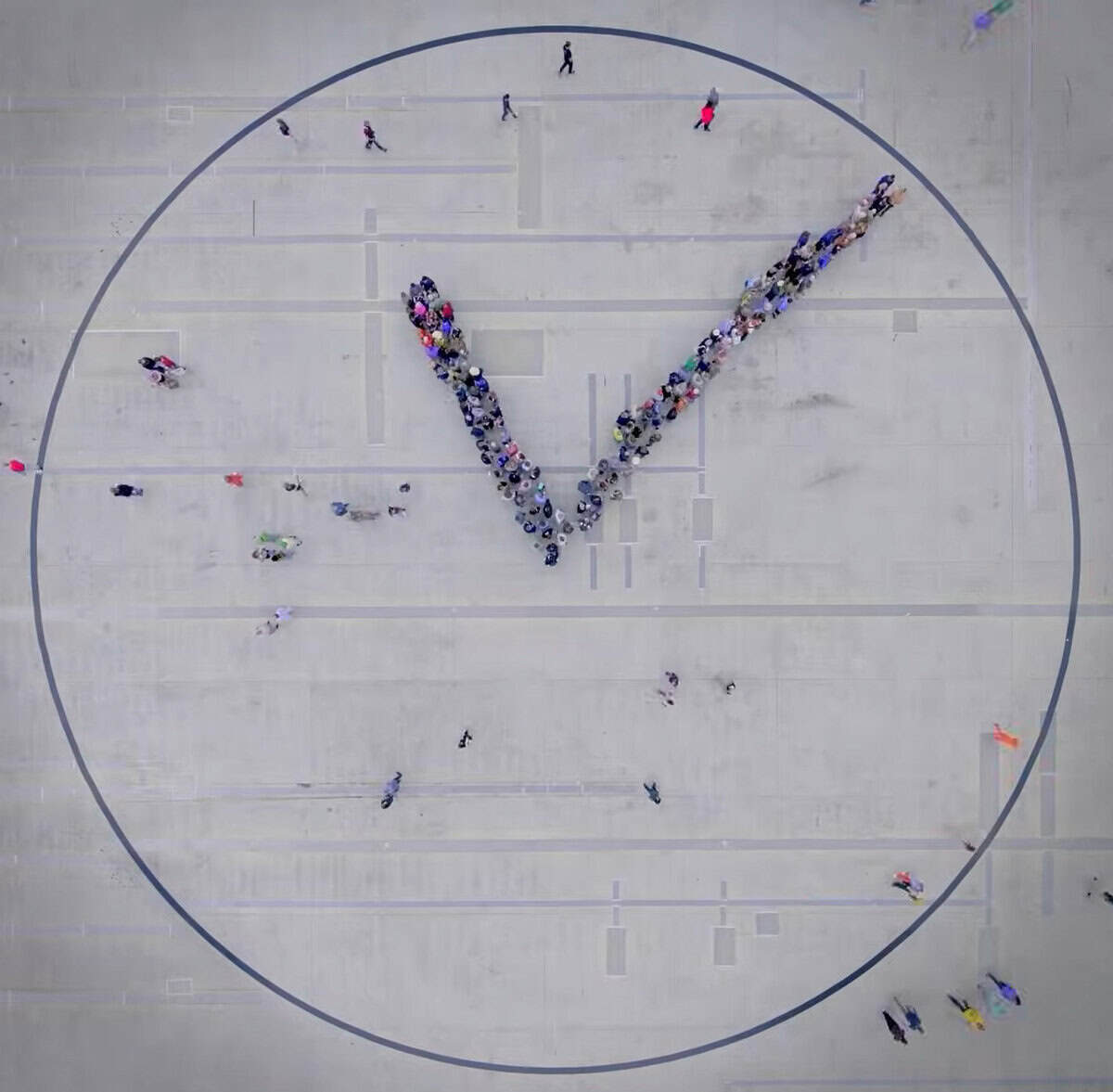
Maarten Baas’s People’s Clock is a permanent art installation unveiled in April 2026 in Lounge 1 of Amsterdam Schiphol Airport, where it greets travelers departing for Schengen destinations. The Dutch designer, known for his “Real Time” series exploring the strangeness of measured time, recruited roughly a thousand volunteers — mostly Schiphol’s own staff, including security officers, baggage handlers, airline personnel and cleaners — to physically form the hour and minute hands of a giant clock with their bodies, while a single runner dressed in orange completes a full lap every minute to trace the second hand.
Over a twelve-hour filming session, an overhead camera recorded the choreographed crowd as it continuously reshaped itself to mark the passing time; that footage now loops and plays back synchronized to the real clock, displayed across four screens mounted on a 250 x 250 x 250 centimetre cube. It follows an earlier, smaller Schiphol clock Baas made a decade ago, in which he alone repeatedly painted and repainted the hands by hand — this new work scales that same idea up from one artist’s labor to an entire community’s.
The video of the “clock”:
What makes the piece technically and humanly compelling is how it inverts the logic of a clock altogether: instead of a mechanism hiding its labor behind a sealed case, Baas exposes the effort — turning something we normally read in an instant, glance-and-go, into a spectacle of sustained collective coordination that took twelve real hours of choreography, patience and goodwill from a thousand ordinary airport workers to produce a single minute-by-minute loop.
Technically, it sits at the intersection of live performance and video engineering: real bodies, filmed once, are stitched into an endlessly repeating digital timepiece that debe stay perfectly synchronized to actual time, so the “human” clock is simultaneously utterly analog in spirit and precisely automated in execution. Humanly, its interest lies in who is doing the performing — not actors or dancers, but the cleaners, baggage handlers and security staff who normally move invisibly through the terminal’s background, now literally embodying the hours for the travelers who rush past them every day, turning a piece about timekeeping into a quiet tribute to the collective labor that keeps an airport, and time itself, running.
And it’s making, really interesting: