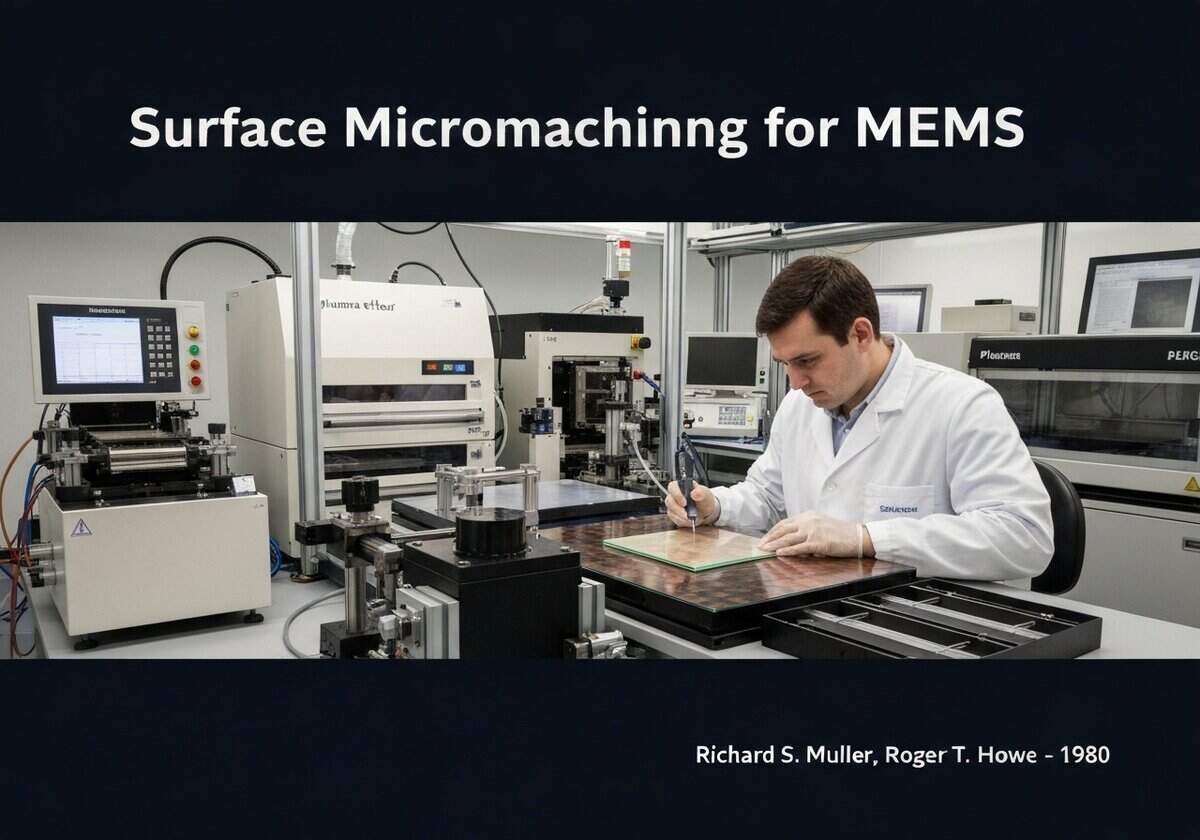
Oberflächenmikrobearbeitung für MEMS
1980
- Richard S. Muller
- Roger T. Howe
Oberflächenmikrobearbeitungsprozesse MEMS Die Herstellung von Bauelementen erfolgt durch Abscheidung und Strukturierung dünner Schichten auf einem Substrat. Dabei wird zunächst eine Opferschicht (z. B. Siliziumdioxid) abgeschieden, strukturiert, anschließend eine Strukturschicht (z. B. Polysilizium) abgeschieden und schließlich die Opferschicht entfernt, um die mechanische Struktur freizulegen. Dieses Verfahren ermöglicht die Erzeugung komplexer, freistehender Mikrostrukturen direkt auf der Waferoberfläche.
Surface micromachining is a cornerstone of MEMS fabrication, enabling the creation of intricate mechanical systems on top of a substrate, typically a silicon wafer. The process is additive, building structures layer by layer, which contrasts with the subtractive nature of bulk micromachining. A typical process flow begins with the deposition of an isolation layer, like silicon nitride, on the substrate. Following this, a sacrificial layer, often a type of silicon dioxide called phosphosilicate glass (PSG), is deposited using Low-Pressure Chemical Vapor Deposition (LPCVD). This layer is then patterned using photolithography and etching, defining the areas where the final structure will be anchored to the substrate and the gaps beneath moving parts.
Next, the structural layer, most commonly polycrystalline silicon (polysilicon), is deposited over the patterned sacrificial layer. This polysilicon layer is then itself patterned to define the geometry of the desired mechanical components, such as beams, gears, or membranes. This sequence of depositing and patterning sacrificial and structural layers can be repeated multiple times to create highly complex, multi-level structures. The final, critical step is the ‘release’ process. The wafer is immersed in a chemical etchant, typically hydrofluoric acid (HF), which selectively removes the sacrificial PSG layers without attacking the polysilicon structural layers or the silicon nitride isolation layer. This leaves the polysilicon structures free to move, suspended above the substrate by their designated anchors.
A major advantage of this technique is its inherent compatibility with standard CMOS integrated circuit manufacturing processes. This allows for the monolithic integration of MEMS devices with their control and signal processing electronics on the same chip, leading to smaller, cheaper, and higher-performance systems. However, surface micromachining is not without its challenges. The primary failure mode during release is ‘stiction,’ where the released structures, once wet, are pulled down to the substrate by capillary forces during drying and become permanently stuck due to intermolecular forces like van der Waals attraction. Various anti-stiction strategies, such as supercritical CO2 drying or special surface coatings, have been developed to mitigate this critical issue.
UNESCO Nomenclature: 3313
- Wirtschaftsingenieurwesen
Verwendung
Weitverbreitete Verwendung
Vorläufer
- photolithography techniques from the semiconductor industry
- chemical vapor deposition (CVD) for thin film growth
- wet and dry etching processes
- integrated circuit (IC) fabrication technology
Anwendungen
- digital micromirror devices (DMDs) in projectors
- inertial sensors (accelerometers and gyroscopes) in smartphones
- pressure sensors
- inkjet printer heads
- RF MEMS switches
Potenzielle Innovationsideen
Aufgrund des hohen Datenverkehrs durch Web-Scraping-Bots, der derzeit mehr als 40.000 Anfragen pro Tag umfasst, ist dieser Inhalt ausschließlich Community-Mitgliedern vorbehalten.
> Anmelden < oder > Registrieren < (100% kostenlos) Zugriff darauf sowie auf alle anderen eingeschränkten Inhalte und Tools.
Related to: surface micromachining, MEMS, fabrication, thin film, polysilicon, sacrificial layer, etching, microfabrication, lithography, stiction.