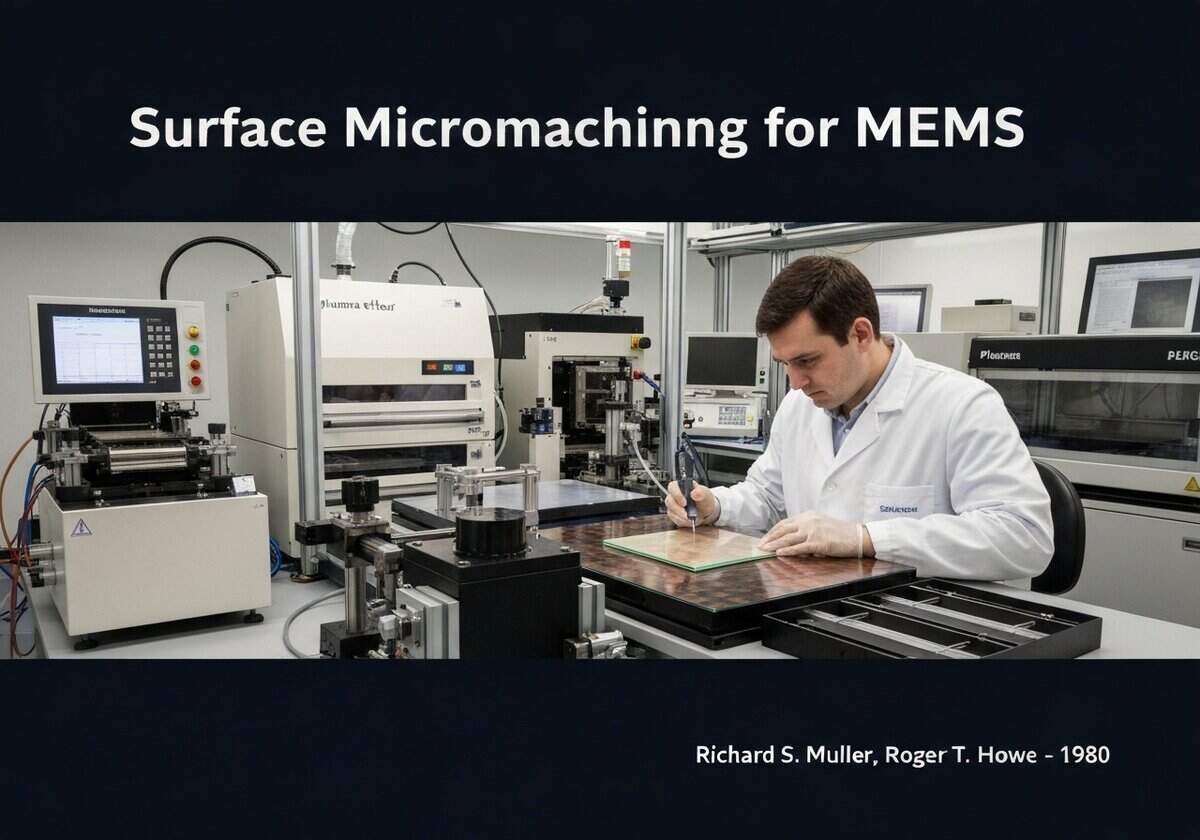
表面微加工是微机电系统(MEMS)制造的基石,它能够在衬底(通常是硅晶片)上构建复杂的机械系统。该工艺属于增材制造,逐层构建结构,这与减材微加工截然不同。典型的工艺流程始于在衬底上沉积一层隔离层,例如氮化硅。随后,采用低压化学气相沉积(LPCVD)法沉积一层牺牲层,通常是一种称为磷硅酸盐玻璃(PSG)的二氧化硅。接下来,利用光刻和蚀刻技术对该牺牲层进行图案化,从而确定最终结构与衬底的连接区域以及运动部件下方的间隙。
Next, the structural layer, most commonly polycrystalline silicon (polysilicon), is deposited over the patterned sacrificial layer. This polysilicon layer is then itself patterned to define the geometry of the desired mechanical components, such as beams, gears, or membranes. This sequence of depositing and patterning sacrificial and structural layers can be repeated multiple times to create highly complex, multi-level structures. The final, critical step is the ‘release’ process. The wafer is immersed in a chemical etchant, typically hydrofluoric acid (HF), which selectively removes the sacrificial PSG layers without attacking the polysilicon structural layers or the silicon nitride isolation layer. This leaves the polysilicon structures free to move, suspended above the substrate by their designated anchors.
A major advantage of this technique is its inherent compatibility with standard CMOS integrated circuit manufacturing processes. This allows for the monolithic integration of MEMS devices with their control and signal processing electronics on the same chip, leading to smaller, cheaper, and higher-performance systems. However, surface micromachining is not without its challenges. The primary failure mode during release is ‘stiction,’ where the released structures, once wet, are pulled down to the substrate by capillary forces during drying and become permanently stuck due to intermolecular forces like van der Waals attraction. Various anti-stiction strategies, such as supercritical CO2 drying or special surface coatings, have been developed to mitigate this critical issue.
Related to: surface micromachining, MEMS, fabrication, thin film, polysilicon, sacrificial layer, etching, microfabrication, lithography, stiction.