Innovation.Welt

(Abbildung dient nur zur Veranschaulichung)
Innovation.Welt
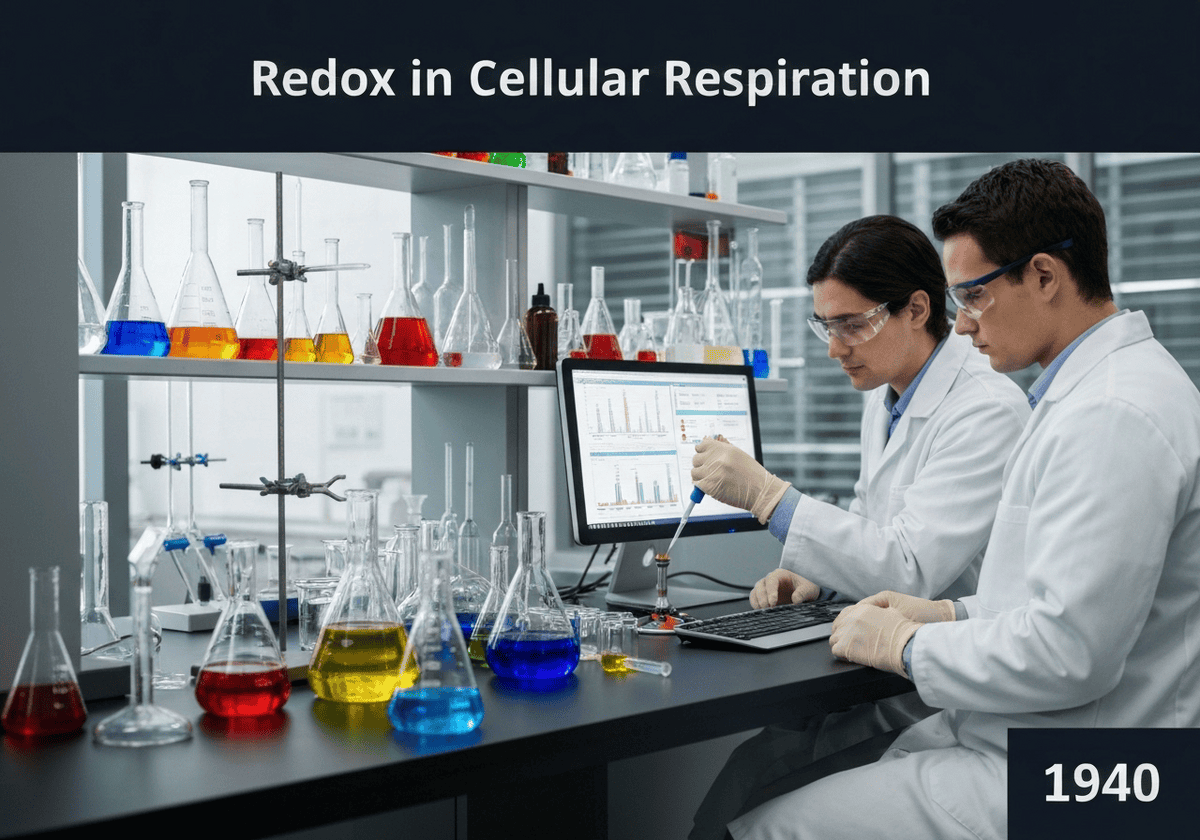
Cellular respiration is a controlled, multi-step oxidation of glucose. Unlike direct combustion, which releases energy explosively as heat, the cell breaks down glucose gradually through glycolysis, the Krebs cycle (citric acid cycle), and oxidative phosphorylation. In this cascade, electrons are stripped from glucose and its intermediates and transferred to electron carriers like [latex]NAD^+[/latex] and [latex]FAD[/latex], reducing them to [latex]NADH[/latex] and [latex]FADH_2[/latex].
These reduced coenzymes then donate their high-energy electrons to the electron transport chain (ETC), a series of protein complexes in the inner mitochondrial membrane. As electrons are passed down the chain, they move to successively lower energy levels. The final electron acceptor is molecular oxygen, which is highly electronegative and is reduced to form water. The energy released during this electron transfer is used to pump protons ([latex]H^+[/latex]) from the mitochondrial matrix into the intermembrane space, establishing an electrochemical gradient. This proton-motive force is a form of stored energy. The flow of protons back into the matrix through an enzyme called ATP synthase powers the synthesis of large amounts of ATP from ADP and inorganic phosphate, a process called chemiosmosis.
Aufgrund des hohen Datenverkehrs durch Web-Scraping-Bots, der derzeit mehr als 40.000 Anfragen pro Tag umfasst, ist dieser Inhalt ausschließlich Community-Mitgliedern vorbehalten.
> Anmelden < oder > Registrieren < (100% kostenlos) Zugriff darauf sowie auf alle anderen eingeschränkten Inhalte und Tools.
Redox in der Zellatmung
(wenn das Datum unbekannt oder nicht relevant ist, z. B. „Strömungsmechanik“, wird eine gerundete Schätzung seines bemerkenswerten Auftretens bereitgestellt)
Bilder in voller Größe und Downloads sind nur für registrierte Mitglieder 100% kostenlos verfügbar.
> Login <