Product Design, Manufacturing & Innovation Resources
Lar » Teorema de Noether e Simetria Translacional

Teorema de Noether e Simetria Translacional

1918
  • Emmy Noether
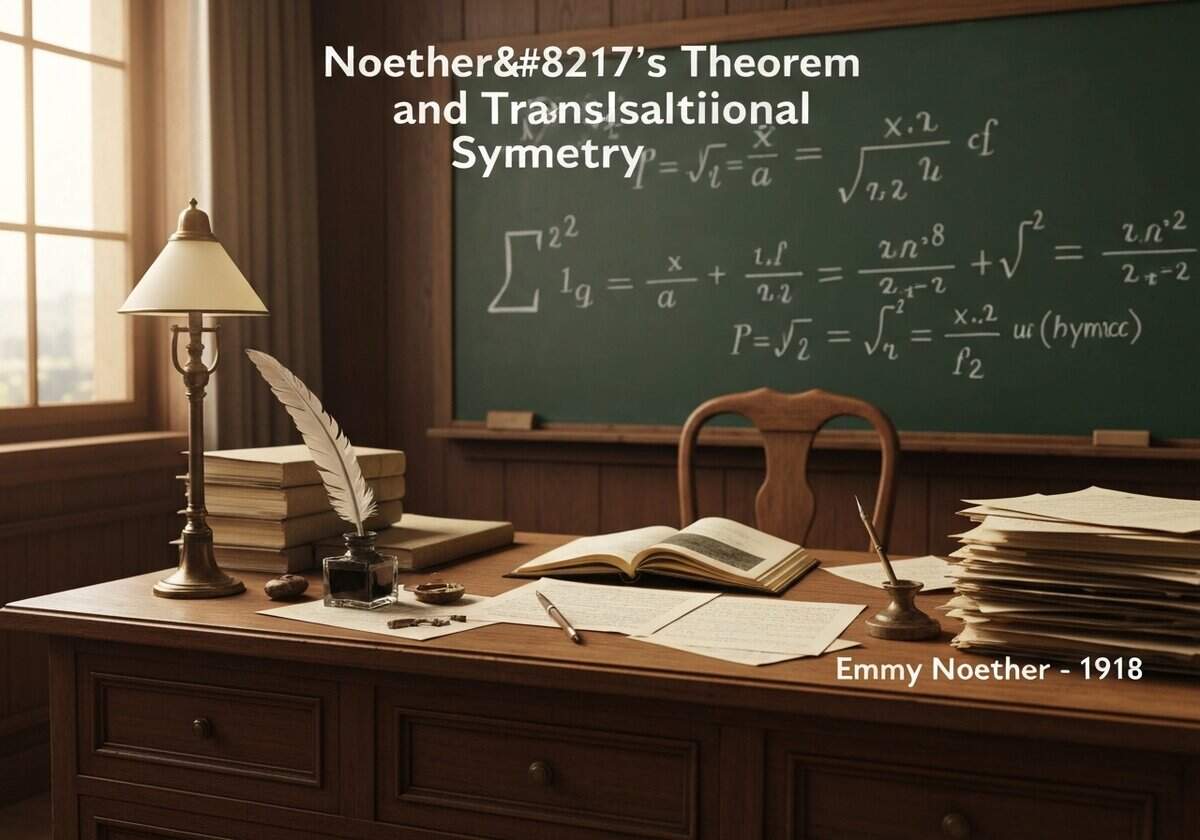
Emmy Noether's workspace illustrating translational symmetry in classical mechanics.

(Imagem gerada apenas para fins ilustrativos)

The conservation of momentum is a direct consequence of the homogeneity of space, meaning the laws of physics are invariant under spatial translation. This profound connection is formalized by Noether’s theorem: for every continuous symmetry of a physical system, there exists a corresponding conserved quantity. Translational symmetry implies that the Lagrangian of the system is unchanged by a shift in coordinates.

O teorema de Emmy Noether de 1918 fornece uma conexão profunda e elegante entre simetrias e leis de conservação na física. É um pilar da física teórica moderna. O teorema afirma que se a ação de um sistema é invariante sob um grupo contínuo de transformações (uma simetria), então existe uma quantidade correspondente que é conservada ao longo do tempo.

In the context of momentum, the relevant symmetry is translational invariance. This means that if you shift the entire physical system by a constant vector, the laws governing its behavior do not change. The Lagrangiano, [latex]L(q, \dot{q})[/latex], which describes the dynamics of the system, remains unchanged under such a transformation. Applying Noether’s theorem to this specific symmetry of spatial translation directly yields the law of conservation of linear momentum.

This perspective elevates the conservação do momento from a mere consequence of Newton’s laws to a fundamental principle rooted in the structure of spacetime itself. Similarly, Noether’s theorem shows that conservação de energia A simetria de translação temporal surge da simetria de rotação, e a conservação do momento angular surge da simetria de translação. Essa estrutura é essencial em campos além da mecânica clássica, incluindo a mecânica quântica e a relatividade geral, onde fornece uma ferramenta poderosa para identificar quantidades conservadas.

UNESCO Nomenclature: 2209
Mecânica

Tipo

Sistema abstrato

Interrupção

Revolucionário

Uso

Uso generalizado

Precursores

  • Princípio da mínima ação
  • Mecânica Lagrangiana (Joseph-Louis Lagrange)
  • Hamiltoniano mecânicos (William Rowan Hamilton)
  • O trabalho de David Hilbert sobre os fundamentos da física

Aplicações

  • fundamental física de partículas (standard model)
  • relatividade geral
  • teoria quântica de campos
  • mecânica lagrangiana e hamiltoniana
  • física do estado sólido (redes cristalinas)

Patentes:

NA

Ideias de Inovação Potencial

  • development of new topological materials with protected surface states
  • formulation of gauge theories in particle physics
  • design of algoritmos for symbolic computation in theoretical physics
  • search for violations of conservation laws to probe new physics
  • construction of consistent theories of quantum gravity
  • analysis of symmetries in complex systems like neural networks
  • development of error-correcting codes based on symmetric principles
  • modeling of crystal defect propagation in materials science
  • creating more robust cosmological models
  • designing stable plasma confinement systems for fusion reactors
Relacionado a: teorema de Noether, simetria, lei da conservação, invariância translacional, mecânica lagrangiana, física teórica, espaço-tempo, homogeneidade, quantidade conservada, princípio da ação.

Contexto histórico

Teorema de Noether e Simetria Translacional

1915
1916
1917
1918
1920
1920
1921
1915
1915-11
1916
1918
1919-05-29
1920
1920
1921

(Caso a data seja desconhecida ou irrelevante, por exemplo, "mecânica dos fluidos", é fornecida uma estimativa aproximada de seu surgimento notável)

10º ano aniversário

Imagens em tamanho real e downloads estão disponíveis apenas, 100% gratuitos, para membros registrados.