Product Design, Manufacturing & Innovation Resources
Heim » Molecular Self-Assembly in Biomaterials

Molecular Self-Assembly in Biomaterials

1990
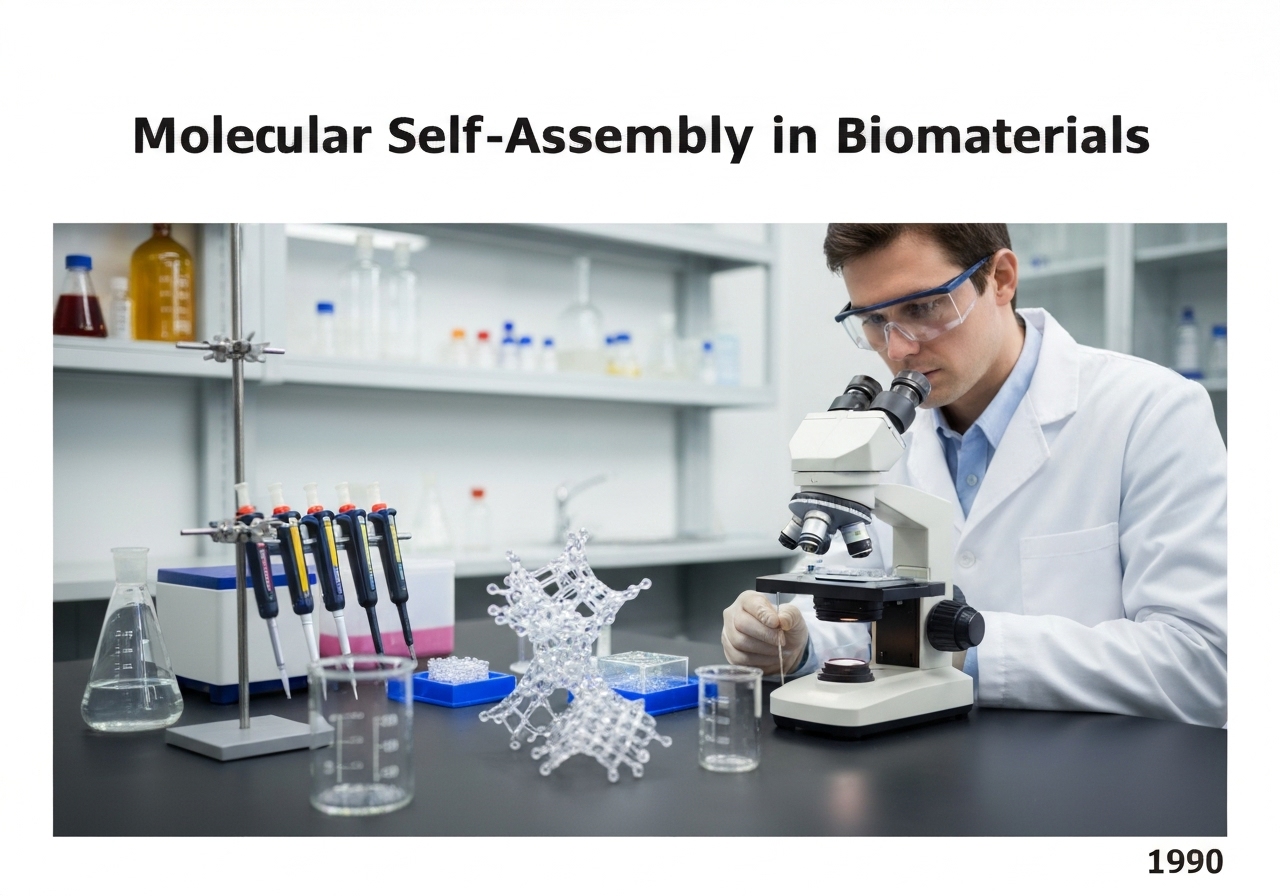
Laborszene zur Demonstration der molekularen Selbstorganisation in Biomaterialien für biomedizinische Anwendungen.

(Abbildung dient nur zur Veranschaulichung)

Die molekulare Selbstorganisation ist ein „Bottom-up“-Prozess, bei dem sich Moleküle spontan und ohne äußere Steuerung zu geordneten Strukturen zusammenfügen. Dieses Phänomen wird durch nicht-kovalente Wechselwirkungen wie Wasserstoffbrückenbindungen und hydrophobe Effekte angetrieben. van der Waals Diese Kräfte sind in der Biologie von grundlegender Bedeutung (z. B. bei der Proteinfaltung und der Bildung von Lipiddoppelschichten). In der Biomaterialforschung werden sie genutzt, um komplexe, nanostrukturierte Materialien wie Hydrogele und Nanofasern für biomedizinische Anwendungen herzustellen.

Self-assembly provides a powerful paradigm for creating biomaterials that mimic the hierarchical complexity of biological tissues. The process is thermodynamically driven, seeking a minimum Gibbs free energy state. The design begins with molecular building blocks, often amphiphilic molecules (containing both hydrophilic and hydrophobic parts) such as block copolymers or peptide amphiphiles (PAs). When placed in an aqueous environment above a critical concentration, these molecules arrange themselves to minimize the unfavorable contact between their hydrophobic segments and water. This can lead to various nanostructures, including spherical micelles, cylindrical nanofibers, or planar bilayers, with the final morphology dictated by molecular geometry and packing parameters. A key advantage is the ability to encode biological function directly into the building blocks. For example, a PA can be designed with a peptide sequence containing the RGD motif, a well-known cell adhesion ligand. Upon self-assembly into nanofibers, this motif is displayed on the fiber surface, creating a scaffold that actively promotes cell attachment. These systems are often dynamic and responsive. A change in pH, temperature, or ionic strength can trigger a structural transition, allowing for the creation of ‘smart’ materials. For instance, a self-assembling peptide solution can be designed to be liquid for easy injection but form a solid hydrogel scaffold at body temperature, entrapping cells and drugs at a target site for regenerative medicine applications.

UNESCO Nomenclature: 2209
Polymerchemie

Typ

Chemischer Prozess

Störung

Grundlegendes

Verwendung

Aufstrebende Technologie

Vorläufer

  • understanding of non-covalent forces (hydrogen bonds, van der waals)
  • discovery of the lipid bilayer structure of cell membranes
  • work on protein folding and quaternary structure
  • development of polymer chemistry, particularly block copolymers
  • nobel prize-winning work in supramolecular chemistry by lehn, pedersen, and cram

Anwendungen

  • fabrication of nanofibrous scaffolds for tissue engineering that mimic the natural extracellular matrix
  • development of injectable hydrogels for drug delivery and cell encapsulation
  • Entwicklung von reaktionsfähigen „intelligenten“ Materialien, die ihre Eigenschaften als Reaktion auf Reize wie pH-Wert oder Temperatur verändern.
  • formation of nanocarriers like micelles and vesicles for targeted therapy
  • surface coatings that prevent biofouling

Patente:

NA

Potenzielle Innovationsideen

Aufgrund des hohen Datenverkehrs durch Web-Scraping-Bots, der derzeit mehr als 40.000 Anfragen pro Tag umfasst, ist dieser Inhalt ausschließlich Community-Mitgliedern vorbehalten.
> Anmelden < oder > Registrieren < (100% kostenlos) Zugriff darauf sowie auf alle anderen eingeschränkten Inhalte und Tools.

Verwandt mit: Selbstorganisation, Bottom-up-Ansatz, supramolekulare Chemie, nicht-kovalente Wechselwirkungen, Hydrogel, Nanofaser, Amphiphil, Blockcopolymer, intelligentes Material, Peptidamphiphil.

Historischer Kontext

Molecular Self-Assembly in Biomaterials

1984
1985
1986
1990
1994
1997
2002
1980
1984
1986
1986
1991
1995
2000
2004

(wenn das Datum unbekannt oder nicht relevant ist, z. B. „Strömungsmechanik“, wird eine gerundete Schätzung seines bemerkenswerten Auftretens bereitgestellt)

Verwandte Erfindungen, Innovationen und technische Prinzipien

Bilder in voller Größe und Downloads sind nur für registrierte Mitglieder 100% kostenlos verfügbar.

> Login <