Product Design, Manufacturing & Innovation Resources
» 생체재료에서의 분자 자가조립

생체재료에서의 분자 자가조립

1990
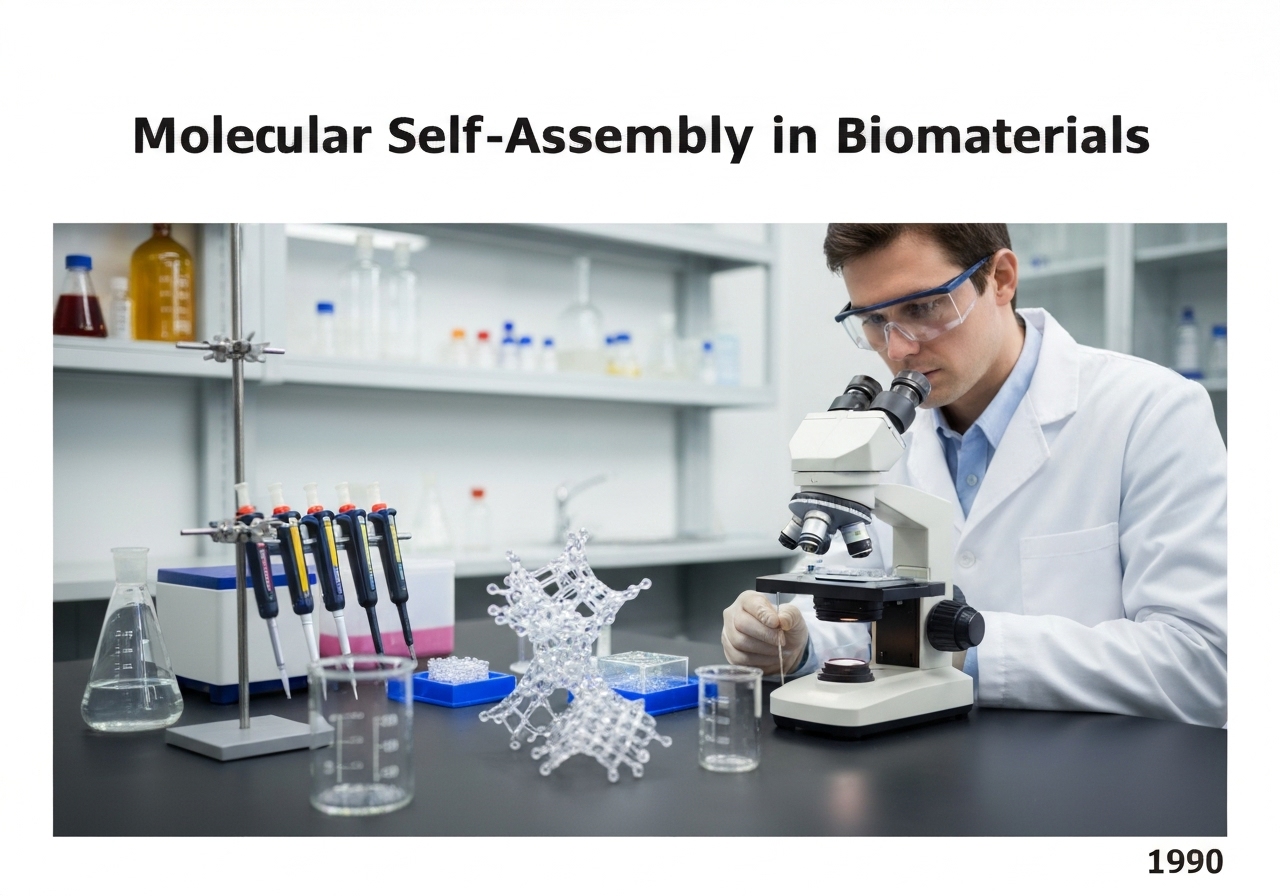
Laboratory scene demonstrating molecular self-assembly in biomaterials for biomedical applications.

(설명을 위한 생성된 이미지입니다)

분자 자가 조립은 외부의 지시 없이 분자들이 자발적으로 질서정연한 구조로 조직화되는 '상향식' 과정입니다. 이 현상은 수소 결합과 같은 비공유 상호작용, 소수성 효과 등에 의해 촉진됩니다. 반 데르 발스 인장력은 생물학에서 근본적인 역할을 합니다(예: 단백질 접힘, 지질 이중막 형성). 생체 재료 분야에서는 인장력을 활용하여 하이드로겔이나 나노섬유와 같은 복잡한 나노 구조 재료를 만들어 생의학 분야에 적용합니다.

Self-assembly provides a powerful paradigm for creating biomaterials that mimic the hierarchical complexity of biological tissues. The process is thermodynamically driven, seeking a minimum Gibbs free energy state. The design begins with molecular building blocks, often amphiphilic molecules (containing both hydrophilic and hydrophobic parts) such as block copolymers or peptide amphiphiles (PAs). When placed in an aqueous environment above a critical concentration, these molecules arrange themselves to minimize the unfavorable contact between their hydrophobic segments and water. This can lead to various nanostructures, including spherical micelles, cylindrical nanofibers, or planar bilayers, with the final morphology dictated by molecular geometry and packing parameters. A key advantage is the ability to encode biological function directly into the building blocks. For example, a PA can be designed with a peptide sequence containing the RGD motif, a well-known cell adhesion ligand. Upon self-assembly into nanofibers, this motif is displayed on the fiber surface, creating a scaffold that actively promotes cell attachment. These systems are often dynamic and responsive. A change in pH, temperature, or ionic strength can trigger a structural transition, allowing for the creation of ‘smart’ materials. For instance, a self-assembling peptide solution can be designed to be liquid for easy injection but form a solid hydrogel scaffold at body temperature, entrapping cells and drugs at a target site for regenerative medicine applications.

UNESCO Nomenclature: 2209
• 고분자 화학

유형

화학 공정

분열

기초적인

용법

신흥 기술

전구체

  • 비공유 힘(수소 결합, 반 데르 발스)에 대한 이해
  • 세포막의 지질 이중층 구조 발견
  • 단백질 접힘 및 4차 구조 연구
  • 고분자 화학, 특히 블록 공중합체의 발전
  • nobel prize-winning work in supramolecular chemistry by lehn, pedersen, and cram

응용 프로그램

  • 천연 세포외 기질을 모방하는 조직 공학용 나노섬유 지지체 제작
  • 약물 전달 및 세포 캡슐화를 위한 주입형 하이드로겔 개발
  • pH나 온도와 같은 자극에 반응하여 특성이 변하는 반응형 '스마트' 소재 개발
  • 표적 치료를 위한 미셀 및 소포체와 같은 나노 운반체 형성
  • 생물막 형성을 방지하는 표면 코팅

특허:

NA

잠재적 혁신 아이디어

현재 하루 4만 건이 넘는 봇 트래픽을 차단하기 위해 이 콘텐츠는 커뮤니티 회원만 이용할 수 있습니다.
> 로그인 < 또는 >등록 < 이 콘텐츠를 비롯한 모든 제한된 콘텐츠와 도구는 (100% 무료로) 이용할 수 있습니다.

관련 키워드: 자가조립, 상향식 접근 방식, 초분자 화학, 비공유 결합, 하이드로겔, 나노섬유, 양친매성 물질, 블록 공중합체, 스마트 소재, 펩타이드 양친매성 물질.

역사적 맥락

생체재료에서의 분자 자가조립

1984
1985
1986
1990
1994
1997
2002
1980
1984
1986
1986
1991
1995
2000
2004

(날짜를 알 수 없거나 관련이 없는 경우, 예를 들어 "유체역학"의 경우, 주목할 만한 등장 시기를 대략적으로 추정하여 제공합니다.)
관련 발명, 혁신 및 기술 원칙

고화질 이미지 및 다운로드는 등록된 회원에게만 100% 무료로 제공됩니다.

> 로그인 <