Product Design, Manufacturing & Innovation Resources
Home » Molecular Self-Assembly in Biomaterials

Molecular Self-Assembly in Biomaterials

1990
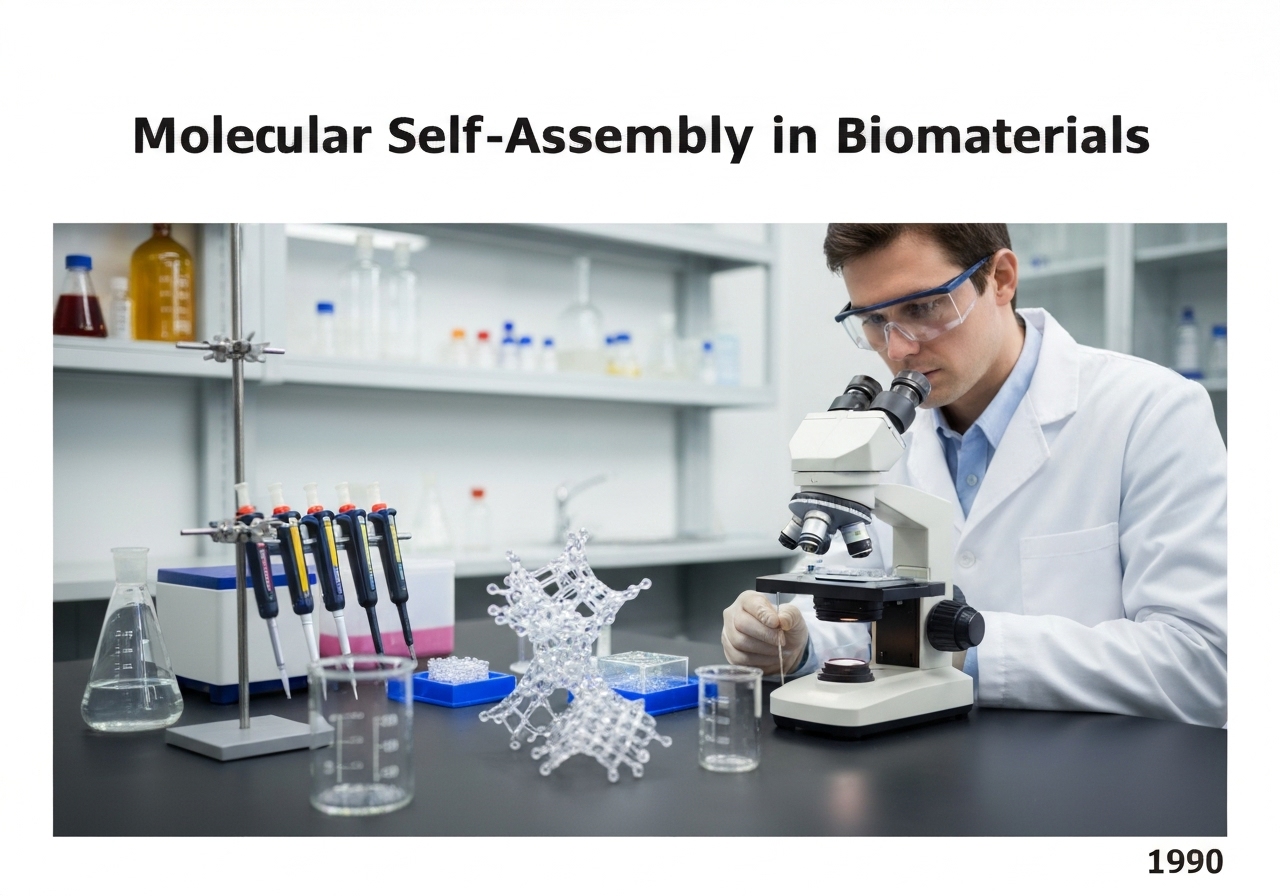
Laboratory scene demonstrating molecular self-assembly in biomaterials for biomedical applications.

(generated image for illustration only)

Molecular self-assembly is a ‘bottom-up’ process where molecules spontaneously organize into ordered structures without external guidance. This phenomenon, driven by non-covalent interactions like hydrogen bonds, hydrophobic effects, and van der Waals forces, is fundamental in biology (e.g., protein folding, lipid bilayer formation). In biomaterials, it is harnessed to create complex, nanostructured materials like hydrogels and nanofibers for biomedical applications.

Self-assembly provides a powerful paradigm for creating biomaterials that mimic the hierarchical complexity of biological tissues. The process is thermodynamically driven, seeking a minimum Gibbs free energy state. The design begins with molecular building blocks, often amphiphilic molecules (containing both hydrophilic and hydrophobic parts) such as block copolymers or peptide amphiphiles (PAs). When placed in an aqueous environment above a critical concentration, these molecules arrange themselves to minimize the unfavorable contact between their hydrophobic segments and water. This can lead to various nanostructures, including spherical micelles, cylindrical nanofibers, or planar bilayers, with the final morphology dictated by molecular geometry and packing parameters. A key advantage is the ability to encode biological function directly into the building blocks. For example, a PA can be designed with a peptide sequence containing the RGD motif, a well-known cell adhesion ligand. Upon self-assembly into nanofibers, this motif is displayed on the fiber surface, creating a scaffold that actively promotes cell attachment. These systems are often dynamic and responsive. A change in pH, temperature, or ionic strength can trigger a structural transition, allowing for the creation of ‘smart’ materials. For instance, a self-assembling peptide solution can be designed to be liquid for easy injection but form a solid hydrogel scaffold at body temperature, entrapping cells and drugs at a target site for regenerative medicine applications.

UNESCO Nomenclature: 2209
– Polymer chemistry

Type

Chemical Process

Disruption

Foundational

Usage

Emerging Technology

Precursors

  • understanding of non-covalent forces (hydrogen bonds, van der waals)
  • discovery of the lipid bilayer structure of cell membranes
  • work on protein folding and quaternary structure
  • development of polymer chemistry, particularly block copolymers
  • nobel prize-winning work in supramolecular chemistry by lehn, pedersen, and cram

Applications

  • fabrication of nanofibrous scaffolds for tissue engineering that mimic the natural extracellular matrix
  • development of injectable hydrogels for drug delivery and cell encapsulation
  • creation of responsive ‘smart’ materials that change properties in response to stimuli like ph or temperature
  • formation of nanocarriers like micelles and vesicles for targeted therapy
  • surface coatings that prevent biofouling

Patents:

NA

Potential Innovations Ideas

Due to scrapping bot traffic, currently more than 40k per day, this content is reserved to community members.
> Login < or > Register < (100% free) to access this, so as all other restricted content and tools.

Related to: self-assembly, bottom-up, supramolecular chemistry, non-covalent interactions, hydrogel, nanofiber, amphiphile, block copolymer, smart material, peptide amphiphile.

Historical Context

Molecular Self-Assembly in Biomaterials

1984
1985
1986
1990
1994
1997
2002
1980
1984
1986
1986
1991
1995
2000
2004

(if date is unknown or not relevant, e.g. "fluid mechanics", a rounded estimation of its notable emergence is provided)

Related Invention, Innovation & Technical Principles

Full size images and downloads are only available, 100% free, for registered members.

> Login <