Product Design, Manufacturing & Innovation Resources
Heim » Mayersche Relation (Thermodynamik)

Mayersche Relation (Thermodynamik)

1842
  • Julius Robert von Mayer
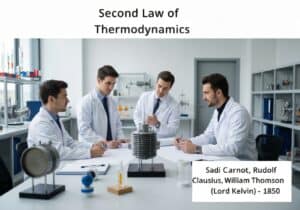
19th century laboratory with thermodynamic instruments and Mayer's relation equations.

(Abbildung dient nur zur Veranschaulichung)

Die Mayer-Gleichung verbindet die spezifischen Wärmekapazitäten eines perfektes Gas zur spezifischen Gaskonstante ([latex]R_s[/latex]). Die Beziehung lautet [latex]c_p – c_v = R_s[/latex]. Für die molaren spezifischen Wärmekapazitäten ([latex]C_p[/latex] und [latex]C_v[/latex]) gilt die Beziehung [latex]C_p – C_v = R[/latex], wobei [latex]R[/latex] die universelle Gaskonstante ist. Daraus folgt, dass [latex]c_p[/latex] stets größer als [latex]c_v[/latex] ist.


Mayer’s relation is a direct consequence of the first law of thermodynamics applied to a perfect gas. It quantifies the difference between the specific heat at constant pressure ([latex]c_p[/latex]) and the specific heat at constant volume ([latex]c_v[/latex]). When a gas is heated at constant volume, all the added heat goes into increasing its internal energy. However, when heated at constant pressure, the gas must expand to keep the pressure constant. This expansion requires work to be done on the surroundings. Therefore, additional heat energy must be supplied to perform this expansion work, in addition to the heat required to raise the internal energy.

The difference, [latex]c_p – c_v[/latex], is precisely the amount of work done by one unit mass of the gas when its temperature is raised by one degree at constant pressure. For a perfect gas, this work is equal to the specific gas constant, [latex]R_s[/latex]. The relation is derived from the definitions of enthalpy ([latex]h = u + Pv[/latex]) and the perfect gas law ([latex]Pv = R_s T[/latex]). Differentiating with respect to temperature gives [latex]dh/dT = du/dT + R_s[/latex], which directly translates to [latex]c_p = c_v + R_s[/latex]. This simple yet elegant relationship is fundamental in thermodynamics.

UNESCO Nomenclature: 2212
- Thermodynamik

Typ

Physikalisches Gesetz

Störung

Wesentliche

Verwendung

Weitverbreitete Verwendung

Vorläufer

  • erster Hauptsatz der Thermodynamik
  • Konzept der spezifischen Wärme (Joseph Black)
  • ideales Gasgesetz (Clapeyron)
  • Definition der Enthalpie
  • Arbeit von Sadi Carnot über Wärmekraftmaschinen

Anwendungen

  • Berechnung unbekannter spezifischer Wärmen aus bekannten Werten
  • Bestimmung des Wärmekapazitätsverhältnisses (Gamma) für gasdynamische Berechnungen
  • Generierung thermodynamischer Eigenschaftstabellen
  • Lehrmittel zur Demonstration des ersten Hauptsatzes der Thermodynamik
  • Grundgleichung bei der Analyse von Gaskraftzyklen

Patente:

NA

Potenzielle Innovationsideen

Aufgrund des hohen Datenverkehrs durch Web-Scraping-Bots, der derzeit mehr als 40.000 Anfragen pro Tag umfasst, ist dieser Inhalt ausschließlich Community-Mitgliedern vorbehalten.
> Anmelden < oder > Registrieren < (100% kostenlos) Zugriff darauf sowie auf alle anderen eingeschränkten Inhalte und Tools.

Verwandt mit: Mayer-Gleichung, spezifische Wärmekapazität, Wärmekapazität, Gaskonstante, Thermodynamik, erster Hauptsatz der Thermodynamik, Enthalpie, innere Energie, ideales Gas, Cp-Cv.

Historischer Kontext

Mayersche Relation (Thermodynamik)

1834
1836
1839-01-01
1842
1847
1850
1850
1834
1835
1838
1841
1845
1850
1850
1850

(wenn das Datum unbekannt oder nicht relevant ist, z. B. „Strömungsmechanik“, wird eine gerundete Schätzung seines bemerkenswerten Auftretens bereitgestellt)

Verwandte Erfindungen, Innovationen und technische Prinzipien

Bilder in voller Größe und Downloads sind nur für registrierte Mitglieder 100% kostenlos verfügbar.

> Login <