Leistungszahl (Wärmepumpen)
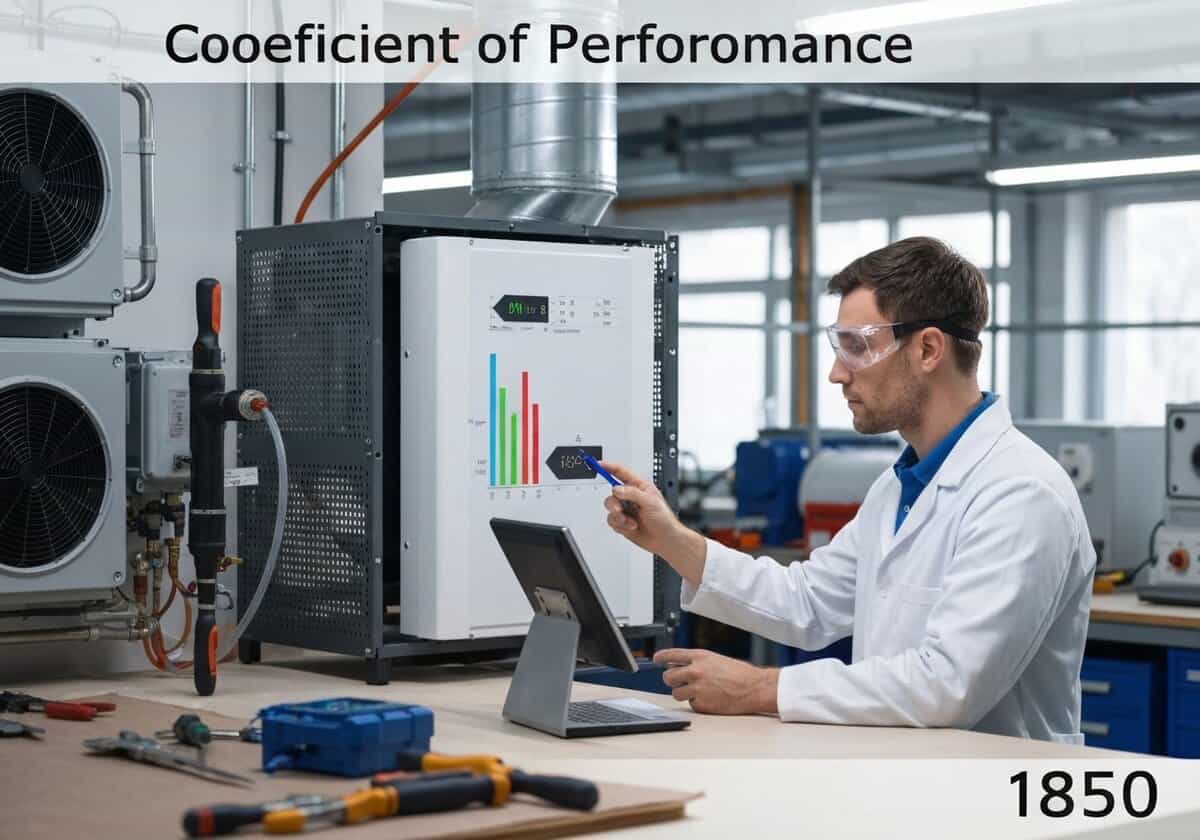
Die Leistungszahl (Coefficient of Performance, COP) ist eine dimensionslose Kennzahl, die die Effizienz einer Wärmepumpe misst. Sie ist das Verhältnis zwischen der bereitgestellten Nutzwärme oder -kühlung und der erforderlichen Arbeit. Beim Heizen ist [latex]COP_{Heizung} = \frac{|Q_H|}{W}[/latex] und beim Kühlen [latex]COP_{Kühlung} = \frac{|Q_C|}{W}[/latex], wobei Q die übertragene Wärme und W die zugeführte Arbeit ist. Höhere COP-Werte bedeuten eine größere Effizienz.
The Coefficient of Performance (COP) is a fundamental metric in thermodynamics that quantifies the effectiveness of a heat Pumpe, refrigerator, or air conditioning system. Unlike the ‘thermal efficiency’ of a heat engine, which is always less than one, the COP of a heat pump is typically greater than one. This is because a heat pump does not convert work into heat; it uses work to move existing heat from a colder location to a warmer one. The work input, W, is usually the electrical energy consumed by the compressor.
The two primary COP values are for heating and cooling. The heating COP, [latex]COP_{heating}[/latex], is the ratio of the heat delivered to the hot reservoir ([latex]Q_H[/latex]) to the input work (W). The cooling COP, [latex]COP_{cooling}[/latex], is the ratio of the heat removed from the cold reservoir ([latex]Q_C[/latex]) to the input work (W). By the erstes Gesetz Nach den Gesetzen der Thermodynamik gilt: [latex]|Q_H| = |Q_C| + W[/latex]. Dies bedeutet, dass für dasselbe Gerät gilt: [latex]COP_{heating} = COP_{cooling} + 1[/latex].
The COP is not a constant value; it is highly dependent on the operating conditions, specifically the temperature difference between the heat source and the heat sink. As the temperature difference increases, the heat pump must work harder to move the heat, and its COP decreases. For this reason, manufacturers often provide COP data at standardized temperature conditions to allow for fair comparisons. However, for a more realistic measure of performance over a season, metrics like the Seasonal Performance Factor (Lichtschutzfaktor) are used.
UNESCO Nomenclature: 3322
- Maschinenbau
Verwendung
Weitverbreitete Verwendung
Vorläufer
- Sadi Carnots Arbeit über den Wirkungsgrad von Wärmekraftmaschinen
- die Formulierung des ersten und zweiten Hauptsatzes der Thermodynamik
- James Prescott Joules Experimente über das mechanische Wärmeäquivalent
- Rudolf Clausius' Entropiekonzept
Anwendungen
- Energieeffizienzkennzahlen für HLK-Systeme (SEER, EER, HSPF)
- Leistungsvergleich verschiedener Wärmepumpenmodelle
- Designoptimierung of refrigeration cycles
- Berechnung der Energieeinsparungen und Amortisationszeiten für hocheffiziente Geräte
- Regierung informieren Energieeinsparung Richtlinien und Standards
Potenzielle Innovationsideen
- dynamic cop optimization Algorithmen in smart thermostats that adjust operation based on real-time electricity pricing and weather forecasts
- Mehrstufige Kompressoren mit drehzahlvariablen Antrieben, die einen hohen durchschnittlichen COP-Wert über einen weiten Bereich thermischer Lasten aufrechterhalten.
- KI-gestützte, vorausschauende Wartungssysteme überwachen die Komponentenleistung, um Leistungseinbrüche zu verhindern.
- Integration von Wärmepumpen mit Wärmespeichersystemen, um die Pumpe mit ihrer maximalen Leistung zu betreiben und die Energie zu speichern
- development of novel refrigerants with thermodynamisch properties that maximize cop for specific temperature ranges
- cop-based Steuerungssysteme for hybrid heating systems that switch between a heat pump and a furnace based on which is more efficient at the current outdoor temperature
- Mikro-Wärmepumpen zur Elektronikkühlung, bei denen die lokale Wärmeableitung für einzelne Hotspots auf dem Chip optimiert ist.
- transkritische CO2-Wärmepumpen, die für die Erzeugung von hygienischem Warmwasser hohe CO2-Werte erreichen sollen
- self-learning heat pump systems that adapt their cycle parameters over time to maximize the cop in a specific building’s thermal environment
- a universal ‘live cop’ display for consumers, showing real-time efficiency to encourage energy-saving behavior
Bezogen auf: COP, Leistungszahl, Wärmepumpenwirkungsgrad, Heizung, Lüftung, Klimatechnik (HLK), Thermodynamik, Energieverhältnis, Heizung, Kühlung, Arbeitsaufwand, Energieeffizienz.