Coeficiente de desempenho (bombas de calor)
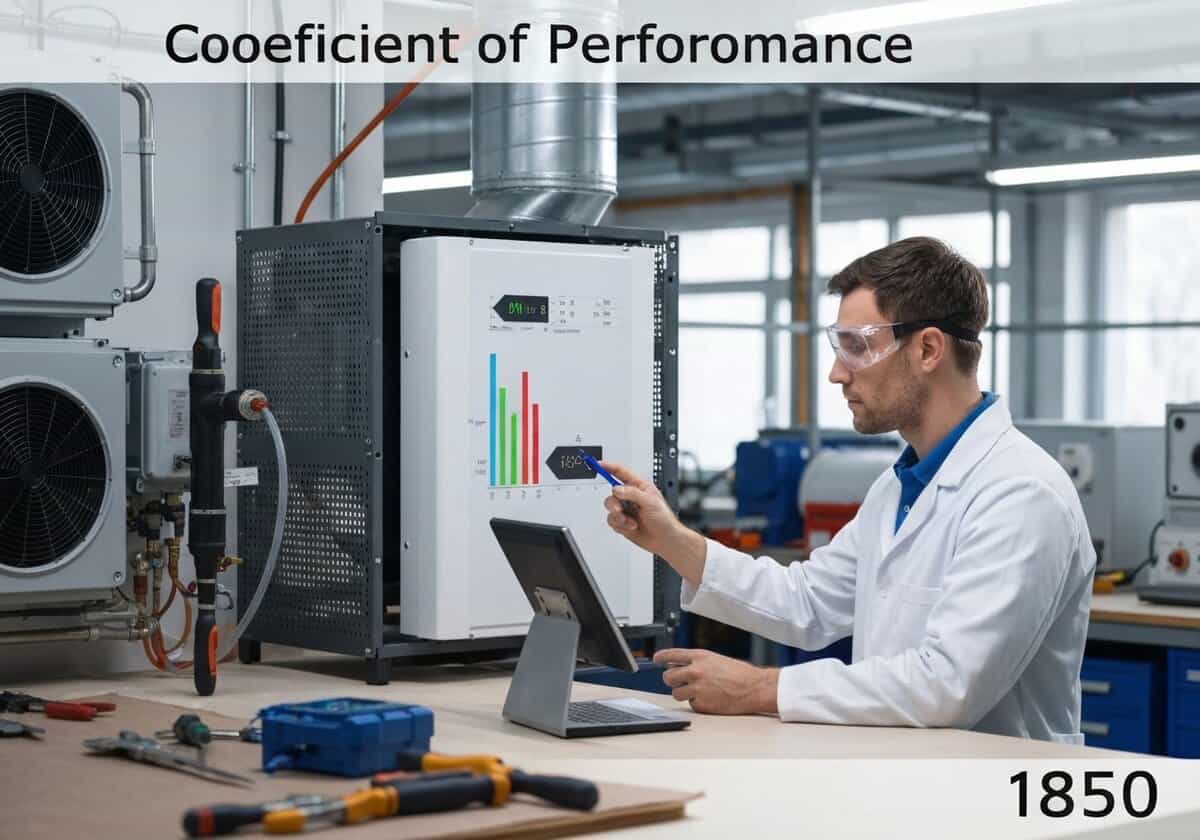
O Coeficiente de Desempenho (COP) é uma razão adimensional que mede a eficiência de uma bomba de calor. É a razão entre o aquecimento ou resfriamento útil fornecido e o trabalho necessário. Para aquecimento, [latex]COP_{aquecimento} = frac{|Q_H|}{W}[/latex], e para resfriamento, [latex]COP_{resfriamento} = frac{|Q_C|}{W}[/latex], onde Q é o calor transferido e W é o trabalho necessário. Valores de COP mais altos indicam maior eficiência.
The Coefficient of Performance (COP) is a fundamental metric in thermodynamics that quantifies the effectiveness of a heat bombear, refrigerator, or air conditioning system. Unlike the ‘thermal efficiency’ of a heat engine, which is always less than one, the COP of a heat pump is typically greater than one. This is because a heat pump does not convert work into heat; it uses work to move existing heat from a colder location to a warmer one. The work input, W, is usually the electrical energy consumed by the compressor.
The two primary COP values are for heating and cooling. The heating COP, [latex]COP_{heating}[/latex], is the ratio of the heat delivered to the hot reservoir ([latex]Q_H[/latex]) to the input work (W). The cooling COP, [latex]COP_{cooling}[/latex], is the ratio of the heat removed from the cold reservoir ([latex]Q_C[/latex]) to the input work (W). By the primeira lei de termodinâmica, [latex]|Q_H| = |Q_C| + W[/latex], o que significa que para o mesmo dispositivo, [latex]COP_{aquecimento} = COP_{resfriamento} + 1[/latex].
The COP is not a constant value; it is highly dependent on the operating conditions, specifically the temperature difference between the heat source and the heat sink. As the temperature difference increases, the heat pump must work harder to move the heat, and its COP decreases. For this reason, manufacturers often provide COP data at standardized temperature conditions to allow for fair comparisons. However, for a more realistic measure of performance over a season, metrics like the Seasonal Performance Factor (FPS) are used.
UNESCO Nomenclature: 3322
Engenharia mecânica
Tipo
Métrica de desempenho
Precursores
- O trabalho de Sadi Carnot sobre a eficiência dos motores térmicos.
- a formulação da primeira e da segunda leis da termodinâmica
- Os experimentos de James Prescott Joule sobre o equivalente mecânico do calor
- O conceito de entropia de Rudolf Clausius
Aplicações
- Classificações de eficiência energética para sistemas HVAC (SEER, EER, HSPF)
- Comparação de desempenho entre diferentes modelos de bombas de calor
- otimização do projeto of refrigeration cycles
- Cálculo da economia de energia e dos períodos de retorno do investimento para eletrodomésticos de alta eficiência.
- informando o governo conservação de energia políticas e padrões
Ideias de Inovação Potencial
- dynamic cop optimization algoritmos in smart thermostats that adjust operation based on real-time electricity pricing and weather forecasts
- multi-stage compressors with variable speed drives that maintain a high average cop across a wide range of thermal loads
- ai-powered predictive maintenance systems that monitor component performance to prevent drops in cop
- integration of heat pumps with thermal storage systems to run the pump at its peak cop and store the energy
- development of novel refrigerants with termodinâmica properties that maximize cop for specific temperature ranges
- cop-based sistemas de controle for hybrid heating systems that switch between a heat pump and a furnace based on which is more efficient at the current outdoor temperature
- micro-heat pumps for electronics cooling, where local cop is optimized for individual chip hotspots
- transcritical co2 heat pumps designed to achieve high cop values for sanitary hot water production
- self-learning heat pump systems that adapt their cycle parameters over time to maximize the cop in a specific building’s thermal environment
- a universal ‘live cop’ display for consumers, showing real-time efficiency to encourage energy-saving behavior
Relacionado a: COP, coeficiente de desempenho, eficiência da bomba de calor, HVAC, termodinâmica, relação de energia, aquecimento, resfriamento, entrada de trabalho, eficiência energética.