Dreifache modulare Redundanz (TMR)
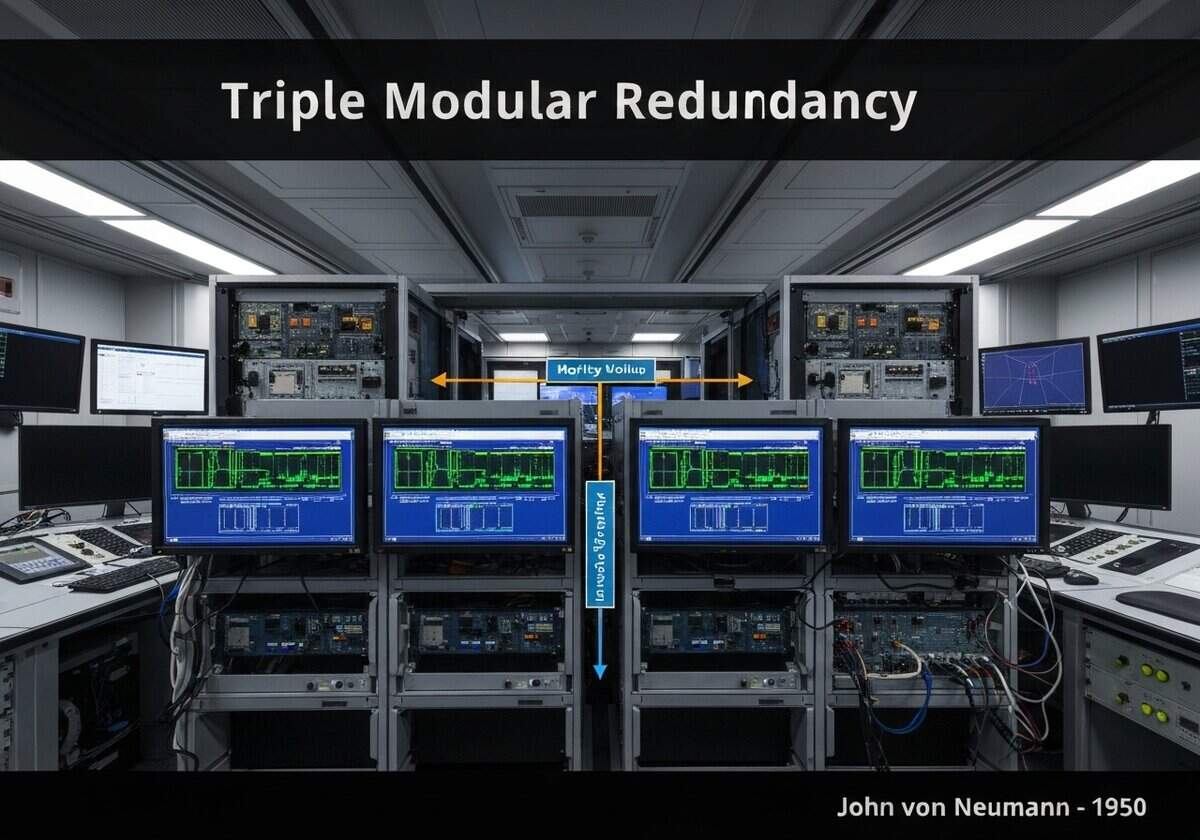
TMR (Triple Modular Redundancy) is a hardware fault-tolerance technique that uses three identical modules performing the same operation in parallel. Their outputs are fed into a majority-voting circuit. If one module fails and produces an incorrect output, the voter is still able to determine the correct output based on the other two modules, thus masking the fault and ensuring continuous operation.
Triple Modular Redundancy (TMR) is a classic example of N-modular redundancy, where N=3. The core idea is to replicate a critical component three times and have them all process the same input simultaneously. The results from these three modules are then passed to a voter. The voter implements a majority function; if at least two of the three inputs are identical, that value is selected as the final output. This mechanism effectively masks a single fault in any one of the modules. For instance, if Module A, B, and C produce outputs 1, 1, and 0 respectively, the majority voter will output 1.
Die Zuverlässigkeit des TMR-Systems hängt nicht nur von den Modulen, sondern auch vom Wähler selbst ab. Fällt der Wähler aus, fällt das gesamte System aus. Daher muss der Wähler deutlich zuverlässiger sein als die einzelnen Module, die er überwacht. In der Praxis sind Wähler oft einfacher aufgebaut als die von ihnen gesteuerten Module, was zu dieser höheren Zuverlässigkeit beiträgt. Die Gesamtzuverlässigkeit des Systems lässt sich mathematisch modellieren. Ist die Zuverlässigkeit eines einzelnen Moduls [latex]R_m[/latex], so ergibt sich die Zuverlässigkeit des TMR-Systems (bei einem perfekten Wähler) aus der Wahrscheinlichkeit, dass mindestens zwei Module korrekt funktionieren: [latex]R_{TMR} = R_m^3 + 3R_m^2(1-R_m) = 3R_m^2 ± 2R_m^3[/latex]. Diese Formel zeigt, dass TMR die Zuverlässigkeit nur dann verbessert, wenn die Zuverlässigkeit [latex]R_m[/latex] der einzelnen Module größer als 0,5 ist.
Historically, John von Neumann’s work in the 1950s laid the theoretical groundwork for building reliable systems from unreliable components, which directly led to concepts like TMR. It was first implemented in practice in systems where failure was not an option, such as the Saturn V launch vehicle’s digital computer and early fly-by-wire Flugsteuerung systems. While TMR increases hardware cost, power consumption, and weight by a factor of more than three (due to the voter), its simplicity and effectiveness in handling single random hardware faults make it a cornerstone of high-availability and safety-critical system design.
UNESCO Nomenclature: 1203
- Computerwissenschaften
Verwendung
Weitverbreitete Verwendung
Vorläufer
- Claude Shannons Informationstheorie und seine Arbeiten über Relaisschaltungen
- John von Neumanns Vorlesungen über zuverlässiges Rechnen mit unzuverlässigen Komponenten
- Early concepts of redundancy in biological systems
- Basic principles of voting and majority logic
Anwendungen
- aerospace systems (e.g., flight control computers)
- Satelliten
- nuclear power plant safety systems
- fault-tolerant computer architectures
Potenzielle Innovationsideen
- quadruple modular redundancy for handling two simultaneous faults
- self-healing integrated circuits with reconfigurable TMR cells
- adaptive TMR systems that can power down redundant modules to save energy when fault risk is low
- TMR implementation in software for critical process validation
- distributed TMR across networked microcontrollers for IoT device clusters
- TMR for securing quantum computing qubits against decoherence errors
- dynamic TMR where spare modules are activated only upon failure detection
- hybrid TMR-ECC memory systems for enhanced data integrity
- TMR-based neuronales Netzwerk architectures for robust AI decision-making
- verifiable TMR systems using formal methods for certified safety applications
Verwandt mit: dreifacher modularer Redundanz, TMR, Fehlermaskierung, Hardware-Redundanz, N-modularer Redundanz, Mehrheitsentscheidung, sicherheitskritischen Systemen, Luft- und Raumfahrt, von Neumann, Zuverlässigkeitstechnik.