Product Design, Manufacturing & Innovation Resources
Heim » CubeSat

CubeSat

1999
  • Jordi Puig-Suari (California Polytechnic State University)
  • Bob Twiggs (Stanford University)
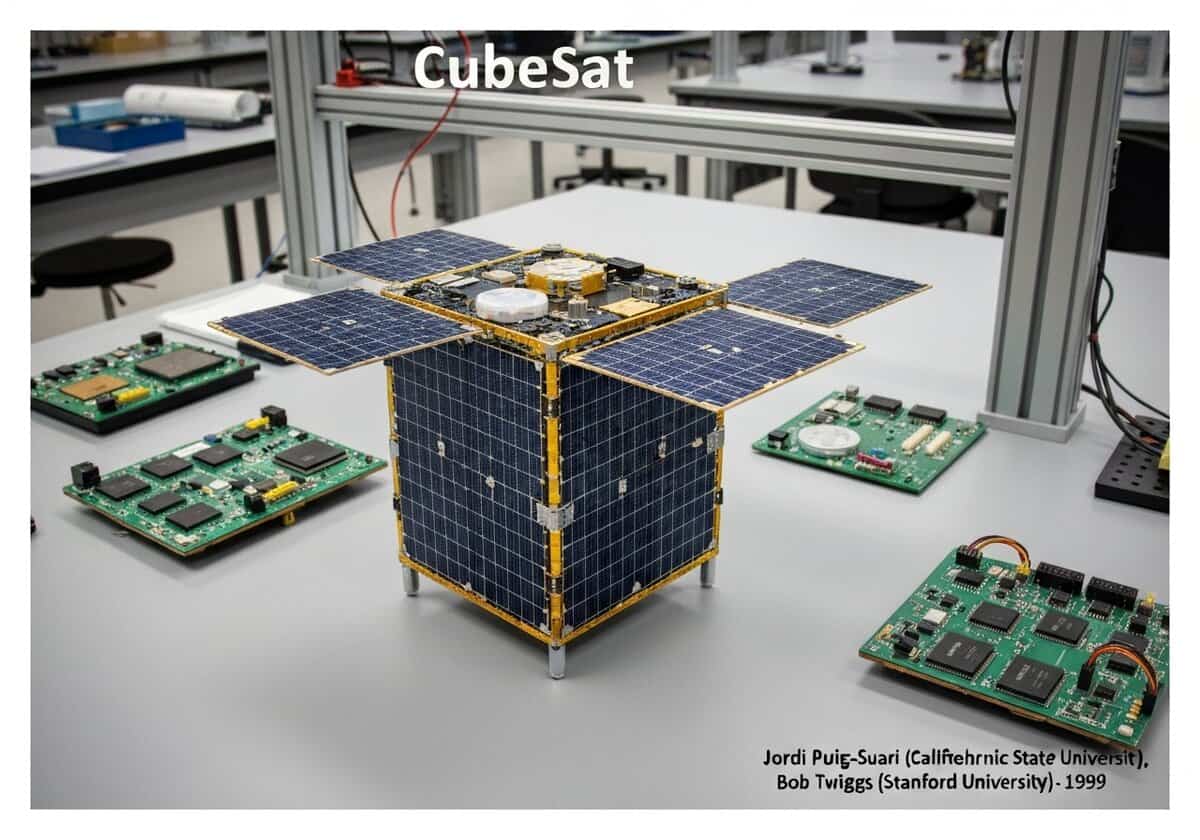
Entwurf eines CubeSat-Nanosatelliten im Labor für Luft- und Raumfahrttechnik.

(Abbildung dient nur zur Veranschaulichung)

Eine Spezifikation für eine Klasse von Nanosatelliten mit einer Standardgröße von 10 × 10 × 10 cm, bekannt als 1U, und einer Masse von bis zu 2 kg. CubeSats können auf Größen von 1,5U, 2U, 3U, 6U oder 12U+ skaliert werden. Diese Standardisierung senkte die Einstiegshürden für Weltraummissionen erheblich, indem sie die gemeinsame Nutzung von Startrampen und einen Markt für handelsübliche Komponenten ermöglichte.


The CubeSat standard was conceived in 1999 as an educational tool to give graduate students hands-on experience in designing, building, testing, and operating a satellite. The core innovation was not just the small size, but the standardization of the form factor and its interface with the launch vehicle. This was achieved through the Poly-Picosatellite Orbital Deployer (P-POD), a box-like mechanism that holds the CubeSats securely during launch and ejects them into orbit using a spring-loaded system.

By standardizing the external dimensions and providing a simple, reliable deployment method, the CubeSat specification decoupled the satellite’s design from the specifics of the launch vehicle. This allowed launch providers to treat CubeSats as a uniform type of secondary payload, simplifying integration and safety reviews. This predictability fueled the creation of a vibrant ecosystem of commercial-off-the-shelf (COTS) components. Companies began mass-producing CubeSat-compatible subsystems like power systems, on-board computers, radios, and attitude control systems. This COTS market drastically reduced the cost and development time for new missions, transforming the CubeSat from a purely educational tool into a viable platform for commercial ventures, government science, and even interplanetary exploration.

UNESCO Nomenclature: 3302
Luft- und Raumfahrttechnik

Typ

Designstandard

Störung

Revolutionär

Verwendung

Weitverbreitete Verwendung

Vorläufer

  • Frühere Pikosatellitenprojekte im Weltraumsystementwicklungslabor der Stanford University
  • die Notwendigkeit einer standardisierten, kostengünstigen Plattform für die Ausbildung von Doktoranden
  • Fortschritte bei handelsüblicher Elektronik (Kinderbetten)
  • Entwicklung standardisierter Trägerraketenadapter für Sekundärnutzlasten wie den ASAP-Ring

Anwendungen

  • von Universitäten geleitete Weltraumforschungsmissionen
  • kommerzielle Erdbeobachtungskonstellationen (z. B. Planet Labs)
  • in-orbit technology demonstration for new hardware and software
  • interplanetare Missionen (z. B. Marcopolo-A und Marcopolo-B)
  • amateur radio communication satellites

Patente:

NA

Potenzielle Innovationsideen

Aufgrund des hohen Datenverkehrs durch Web-Scraping-Bots, der derzeit mehr als 40.000 Anfragen pro Tag umfasst, ist dieser Inhalt ausschließlich Community-Mitgliedern vorbehalten.
> Anmelden < oder > Registrieren < (100% kostenlos) Zugriff darauf sowie auf alle anderen eingeschränkten Inhalte und Tools.

Verwandt mit: CubeSat, Nanosatellit, Satellitenstandard, 1U, P-Pod, Bob Twiggs, Jordi Puig-Suari, Newspace, Cots, standardisiertes Design.

Historischer Kontext

CubeSat

1993-07-22
1996
1998
1999
2000
2000
2000
1993
1994
1997
1998
1999-05-01
2000
2000
2000

(wenn das Datum unbekannt oder nicht relevant ist, z. B. „Strömungsmechanik“, wird eine gerundete Schätzung seines bemerkenswerten Auftretens bereitgestellt)

Verwandte Erfindungen, Innovationen und technische Prinzipien

Bilder in voller Größe und Downloads sind nur für registrierte Mitglieder 100% kostenlos verfügbar.

> Login <