Product Design, Manufacturing & Innovation Resources
Heim » Feuerlöschung durch Kühlung

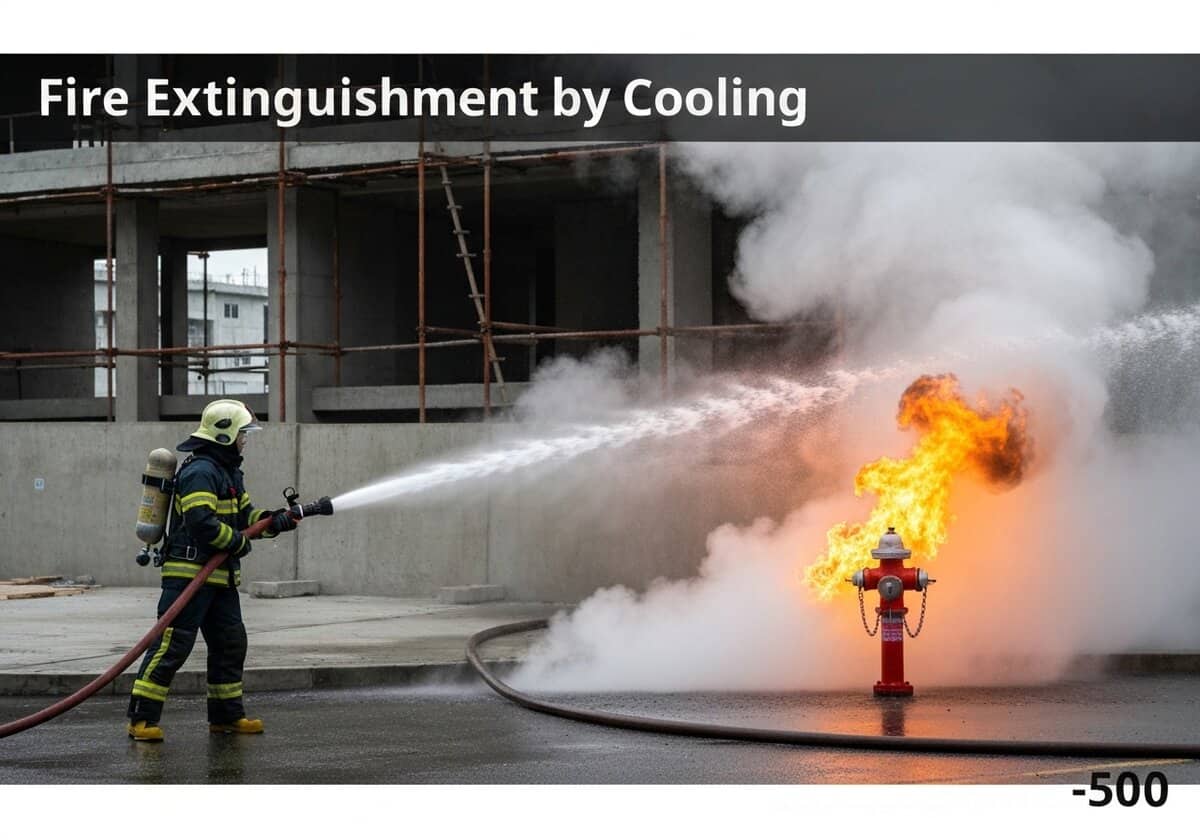
Feuerlöschung durch Kühlung

-500
Feuerwehrmann beim Löschen von Flammen mit einem Wasserschlauch in einer kontrollierten Umgebung, Anwendung in der Verfahrenstechnik.

(Abbildung dient nur zur Veranschaulichung)

A primary method of fire extinguishment involves removing the ‘heat’ component of the fire triangle. This is most commonly achieved by applying a substance that absorbs a large amount of heat, such as water (despite water also have other effects in the fire triangle -refer to dedicated post-). Water’s high specific heat and latent heat of vaporization make it highly effective at cooling a fire below its self-sustaining temperature.

Extinguishment by cooling is a fundamental firefighting tactic that directly targets the ‘heat’ side of the Feuerdreieck. The goal is to reduce the temperature of the burning material to a point where it no longer produces sufficient flammable vapor to sustain combustion. This point is known as the fire point. Water is the most common cooling agent due to its unique thermal properties. It has a high specific heat capacity, meaning it can absorb a significant amount of thermal energy before its own temperature rises substantially. More importantly, it has a very high latente Wärme of vaporization. When liquid water turns into steam at 100°C, it absorbs a massive amount of energy from the fire without any change in temperature. This phase change is extremely efficient at drawing heat away from the fuel. The resulting steam also helps to displace oxygen, contributing to extinguishment by smothering. However, using water is not always appropriate. It can be ineffective or dangerous on grease fires (it can spread the burning grease) and electrical fires (due to conductivity), and it can react violently with certain metal fires.

UNESCO Nomenclature: 3305
- Chemieingenieurwesen

Typ

Physikalischer Prozess

Störung

Inkremental

Verwendung

Weitverbreitete Verwendung

Vorläufer

  • Beobachtung der Wirkung von Wasser auf Feuer
  • Verständnis von Wärme und Temperatur
  • Entwicklung der Thermodynamik, insbesondere Konzepte der spezifischen Wärme und der latenten Wärme
  • Erfindung von Pumpen und Schläuchen zur Wasserversorgung

Anwendungen

  • Hydranten und Schläuche
  • Sprinkleranlagen in Gebäuden
  • Wasserabwurfflugzeuge für Waldbrände
  • persönliche Wasserfeuerlöscher
  • Dampfinertisierungssysteme

Patente:

NA

Potenzielle Innovationsideen

  • Ultraschall- water mist systems with smaller droplets for more efficient heat absorption
  • Feuerlöschgele, die an Oberflächen haften und für anhaltende Kühlung sorgen
  • Drohnen, die Kühlmittel gezielt und mit hoher Präzision einsetzen
  • Phasenwechselmaterialschlämme für die spezielle industrielle Brandbekämpfung
  • self-activating cooling systems embedded in Lithium-Ionen-Batterie packs
  • Akustik extinguishers that use sound waves to create pressure changes and cool the flame front
  • Feuerlöscher mit kryogenem Flüssigstickstoff für empfindliche elektronische Umgebungen
  • intelligente Sprinkleranlagen, die den Wasserfluss und die Tropfengröße je nach Brandintensität anpassen
  • biologisch abbaubare Kühlschäume, die auch als Dampfsperre wirken
  • thermoelektrische Kühlpaneele zur lokalen Brandverhütung in Hightech-Geräten
Verwandt mit: Kühlung, Löschung, Wasser, Verdampfungswärme, spezifische Wärme, Brandbekämpfung, Sprinkleranlage, Brandbekämpfung, Wärmeabfuhr, Feuerdreieck.

Historischer Kontext

Feuerlöschung durch Kühlung

-500
1700
1761
1807-01-01
1850
1850
1850
-250
-500
1750
1788
1834
1850
1850
1850

(wenn das Datum unbekannt oder nicht relevant ist, z. B. „Strömungsmechanik“, wird eine gerundete Schätzung seines bemerkenswerten Auftretens bereitgestellt)

10. Jahr Jubiläum

Bilder in voller Größe und Downloads sind ausschließlich für registrierte Mitglieder kostenlos verfügbar.

> Login <