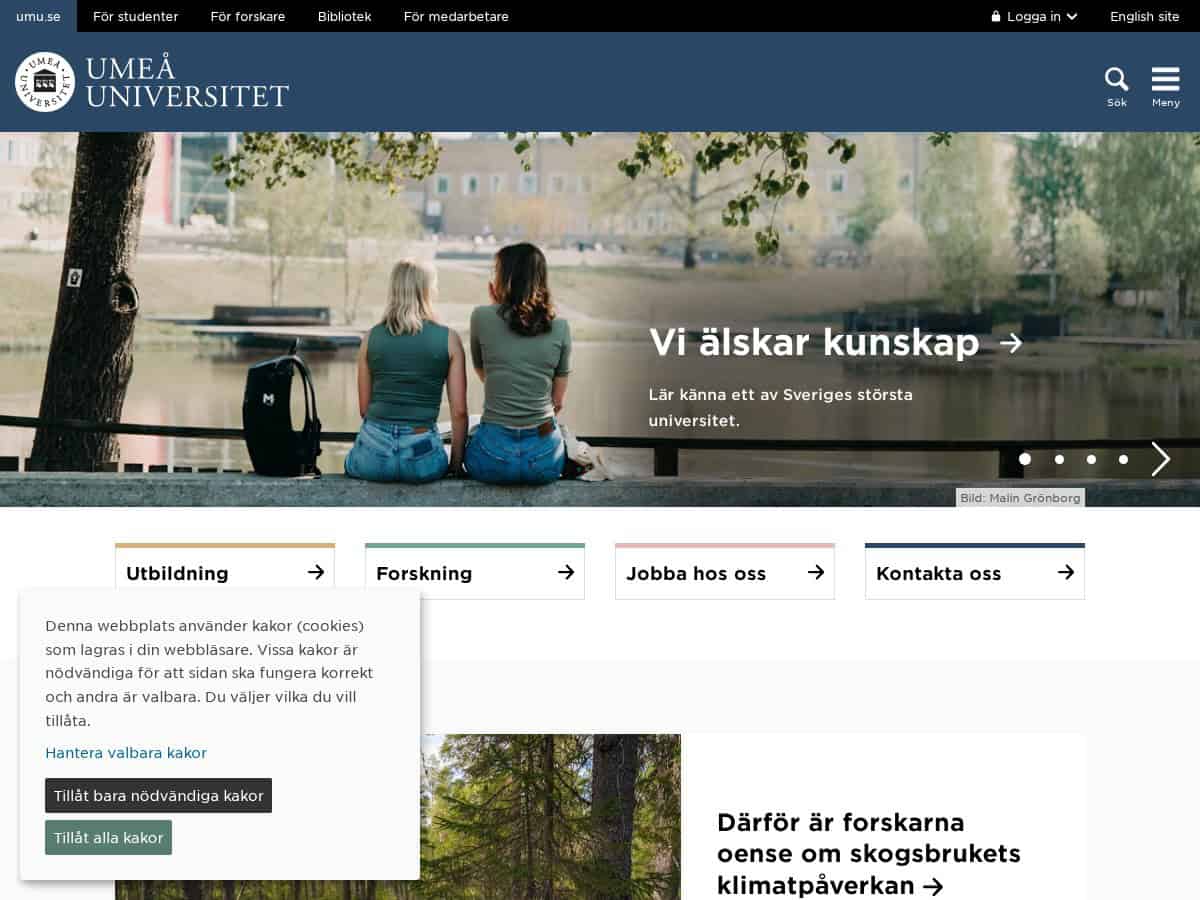
Umeå University, established in 1965, is a comprehensive public research university in northern Sweden. It is known for its strong research in life sciences, social sciences, and humanities, and for its vibrant campus life. The university has a strong international profile and a commitment to sustainability.
Umeå University was established in 1965 and is one of the largest universities in northern Sweden, with about 34,000 students and 4,200 staff. Around one student in ten comes from abroad. The campus lies on a hill in the city of Umeå, in the province of Västerbotten, around 600 kilometres north of Stockholm, near the Gulf of Bothnia. The medical faculty works with the Norrland University Hospital, and the Arts Campus on the river hosts design, architecture and fine arts.
The university offers programmes in humanities, social sciences, medicine, science and technology, teaching, and the arts. The Umeå Institute of Design is regularly ranked among the best design schools in Europe, and the School of Architecture attracts students from around the world. Research is strong in molecular biology, plant science, medicine, Arctic research, environmental science and forestry.
Umeå has a major role in molecular infection research. Emmanuelle Charpentier worked at the Laboratory for Molecular Infection Medicine Sweden, MIMS, and published her key work on the CRISPR-Cas9 system in 2011 while in Umeå, which later brought her the 2020 Nobel Prize in Chemistry. The Umeå Plant Science Centre, together with the Swedish University of Agricultural Sciences, is a leading centre for trees and forest biotechnology. The Arctic Research Centre studies climate change in northern regions.
Tuition is free for citizens of the EU, the EEA and Switzerland, while students from other countries pay tuition fees that vary by programme. Check the current tariff and the scholarships available. Applications for bachelor’s and master’s programmes go through the national portal, and deadlines are in the winter for the autumn intake. Bachelor’s programmes are mostly in Swedish, while most master’s programmes are in English.
Umeå was a European Capital of Culture in 2014, and it has a young population, many cyclists and cold, snowy winters. Rents are lower than in the south, and student housing is relatively available compared with Stockholm or Lund.
Domains taught:
AI and Machine Learning, Bioinformatics, Chemistry, Computer Vision, Data Analytics, Ecology and Sustainability, Life Sciences, Microbiology and Genetics, Physics, Statistics, Structural Engineering
Diplomas*:
Bachelor, Doctor, Master
Status:
Public
Partnerships:
Umeå University has a wide network of international partners and is a member of the University of the Arctic, a cooperative network of universities, colleges, and other organizations committed to higher education and research in the North.
Research:
Umeå University has a strong research profile with a focus on interdisciplinary research. Key research areas include life sciences, Arctic research, and public health. The university is home to several world-class research centers, including the Umeå Plant Science Centre and the Arctic Research Centre at Umeå University (Arcum).
Famous Alumnis:
Emmanuelle Charpentier
International recognition**:
Number of staff***:
4200
Current students***:
34000
Foreign students***:
10%
Cumulative former students***:
60000
Pros
A young and dynamic university with a strong research profile and a vibrant campus life. A beautiful natural environment and a commitment to sustainability.
Cons
The university’s location in northern Sweden can be a disadvantage for some students. The winters are long and cold, which may not be suitable for everyone.
Best For
Students who are looking for a comprehensive university with a strong research profile, a vibrant campus life, and a commitment to sustainability.
On content, University of Gothenburg and this institution are close, as both teach bioinformatics, computer vision and chemistry; it teaches at the same levels, namely bachelor's, master's and doctoral, and covers marine science and mathematics as well.
Uppsala University offers a comparable education in statistics, ecology and sustainability and physics: it is slightly larger, at about 50,000 students against roughly 34,000 here, and is also a public institution.
Stockholm University works in much the same fields, chiefly chemistry, statistics and ecology and sustainability, and it has almost the same size, at about 33,000 students, and is also a public institution.
The comparison with Linnaeus University is straightforward on subjects, since both focus on ecology and sustainability, life sciences and data analytics, and it covers marine science and bioengineering as well, and is slightly larger, at about 40,000 students against roughly 34,000 here.
Another national school that puts computer vision, data analytics and AI and machine learning at the centre is Linköping University, and it runs the same bachelor's, master's and doctoral programmes, and covers logistics and industrial design as well.
Most Similar Schools Abroad
For a study option in Finland with a comparable spread of chemistry, statistics and ecology and sustainability, University of Helsinki is the reference point: it is also a public institution, and teaches at the same levels, namely bachelor's, master's and doctoral.
A foreign alternative with a similar emphasis on bioinformatics, chemistry and statistics is University of Copenhagen in Denmark, and it covers nanotechnologies and mathematics as well, and has almost the same size, at about 37,500 students.
On content, Masaryk University in the Czech Republic and this university are close, as both teach chemistry, statistics and physics; it is also a public institution, and teaches at the same levels, namely bachelor's, master's and doctoral.
Seen from abroad, Heinrich Heine University Düsseldorf (Germany) is a close relative on subject matter, since microbiology and genetics, chemistry and statistics are central to both, and it is also a public institution, and teaches at the same levels, namely bachelor's, master's and doctoral.
In France, Université Paris Cité teaches much the same core subjects, microbiology and genetics, chemistry and statistics, and it runs the same bachelor's, master's and doctoral programmes, and covers mathematics as well.
*our own picks (our criteria: a mix between domains, diploma delivered, reputation and size), but obviously too many criteria for an apple-to-apple ranking.
FAQ
Where is Umeå University?
The campus is in Umeå, Sweden, in the province of Västerbotten, about 600 kilometres north of Stockholm.
When was it established?
In 1965.
How large is it?
About 34,000 students and 4,200 staff.
What is it known for?
Molecular biology, plant science, medicine, Arctic research, design and architecture.
Which Nobel laureate worked there?
Emmanuelle Charpentier, who published key work on the CRISPR-Cas9 system in 2011 while at Umeå. She received the 2020 Nobel Prize in Chemistry.
What is MIMS?
The Laboratory for Molecular Infection Medicine Sweden at Umeå University.
What is the Umeå Institute of Design?
A design school that is regularly ranked among the best in Europe.
Is there tuition?
Tuition is free for citizens of the EU, the EEA and Switzerland. Other students pay fees that vary by programme. Check the current tariff and scholarships.
In which language are courses taught?
Bachelor's programmes mostly in Swedish, and most master's programmes in English.
Is housing easier than in Stockholm?
Student housing is relatively available compared with Stockholm or Lund.
Agriculture, Climate Change, Environmental Impact, Environmental Technologies, Health Sciences, Innovation, Research and Development
*: without any judgment of the quality, readers are strongly encouraged to check the official status of the exact diploma envisioned as many universities have a mix of recognized diplomas, not recognized, “co-delivered,” “equivalent to”, “some pathways” (…), can change over time, and can be named differently from one country to another.
**: international reputation: is based on some criteria that do not mean much in some domains or specialties (number of researchers, of scientific publications, on budget ….). Our approximate 1-4 scale:
known locally
known locally and internationally
is listed in some of the world university’s classifications
is listed among the 20 firsts in some of world university’s classifications
***: estimated numbers, based on online sources and/or feedbacks. The numbers can vary greatly depending on school organisation (ex.: school is part of a group, it employs internal staff or external consultants or has public staff without employing them …). Refer to all the links provided to have accurate and updated numbers.
Innovation.world is not affiliated with this school/university. We recommend to contact them directly on their website for any special request.
To complete or correct any information here or share your opinion, please comment below or > send us a direct message <.