Product Design, Manufacturing & Innovation Resources
Casa » Stress and Strain

Stress and Strain

1820
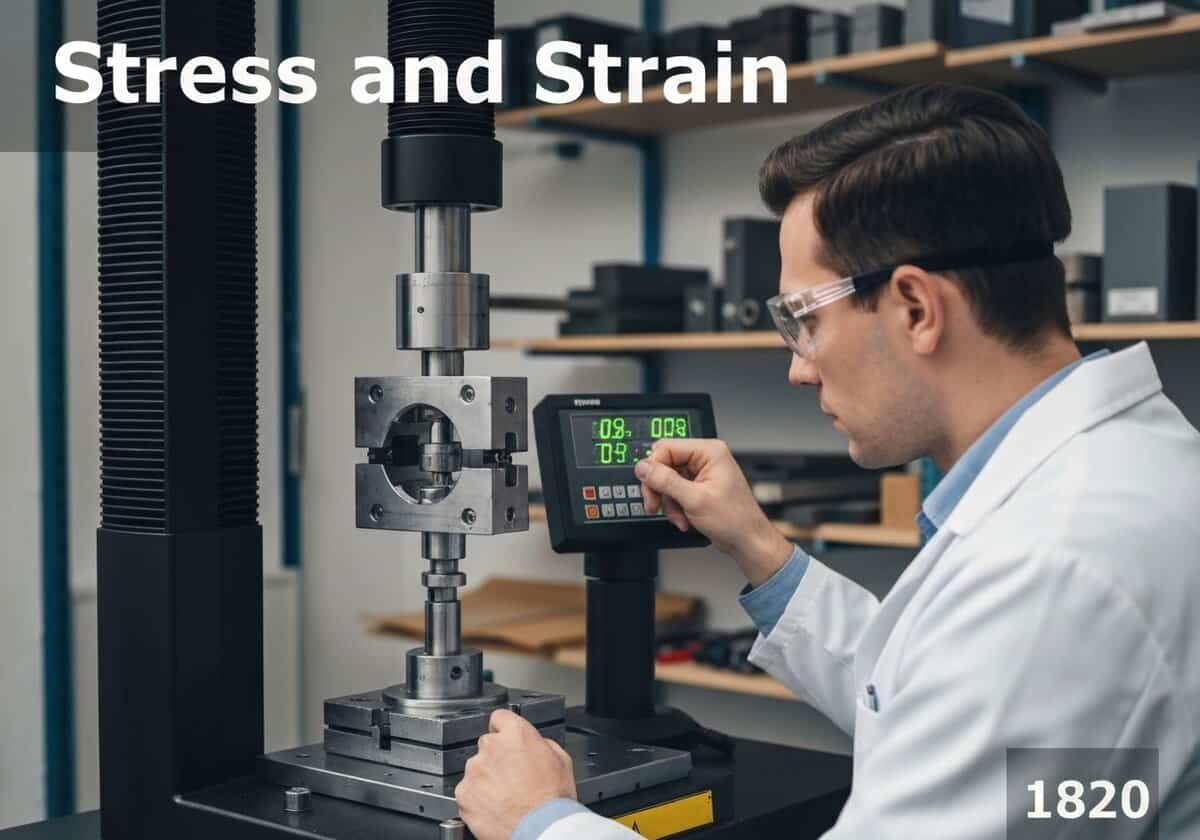
Macchina per prove di trazione che misura lo stress e la deformazione nella fisica dello stato solido.

(Immagine generata a solo scopo illustrativo)

Engineering stress ([latex]sigma[/latex]) is the applied load divided by the original cross-sectional area ([latex]A_0[/latex]), while engineering strain ([latex]epsilon[/latex]) is the change in length ([latex]Delta L[/latex]) divided by the original length ([latex]L_0[/latex]). These definitions, [latex]sigma = frac{F}{A_0}[/latex] and [latex]epsilon = frac{Delta L}{L_0}[/latex], are fundamental for plotting stress-strain curves but assume the specimen’s dimensions remain constant during the test.


Engineering stress and strain are foundational concepts in materials science and mechanics, providing a simplified yet powerful way to characterize a material’s response to external forces. The assumption that the cross-sectional area remains constant ([latex]A_0[/latex]) is valid for small deformations, particularly within the elastic region. However, as a material undergoes significant plastic deformation, its cross-sectional area changes—a phenomenon known as necking in tensile tests. This change means engineering stress no longer represents the true stress experienced by the material at its narrowest point. Similarly, engineering strain is based on the original length, which can be less accurate for large deformations compared to an instantaneous strain measure.

Despite these limitations, the engineering stress-strain curve is widely used in industry and academia. Its key features, such as the limite di snervamento and ultimate tensile strength (UTS), are standard parameters for material specification and design. The curve is relatively easy to generate from a standard tensile test, where a specimen is pulled apart at a constant rate while force and elongation are measured. The initial linear portion of this curve is particularly important as it defines the material’s elastic behavior, governed by Hooke’s Law.

UNESCO Nomenclature: 2211
- Fisica dello stato solido

Tipo

Sistema astratto

Interruzione

Fondamento

Utilizzo

Uso diffuso

Precursori

  • Galileo Galilei’s studies on the strength of materials (17th century)
  • Legge dell’elasticità di Robert Hooke (1678)
  • Thomas Young’s definition of the modulo di elasticità (1807)
  • development of the concept of stress by Cauchy (early 19th century)

Applicazioni

  • structural analysis of buildings and bridges
  • design of mechanical components like gears and shafts
  • quality control in manufacturing
  • material selection for various engineering applications

Brevetti:

NA

Idee e potenziali innovazioni

  • development of standardized material testing protocols (e.g., astm e8)
  • creazione di elemento finito analysis (FEA) software using simplified material models
  • design of lightweight composite materials with predictable failure modes
  • automated quality control systems in manufacturing lines using tensile data
  • predictive maintenance algorithms for structural components based on strain monitoring
  • 3d printing parameter optimization based on mechanical property testing
  • biomaterial design for impianti medici with specific stress-strain requirements
  • development of self-healing materials with monitored mechanical integrity
  • smart textiles that measure and respond to applied strain
  • virtual reality simulators for material failure analysis
Related to: engineering stress, engineering strain, tensile test, material properties, mechanics of materials, deformation, load, cross-sectional area, elongation, meccanica solida.

Contesto storico

Stress and Strain

1810
1816
1816-11-16
1820
1820
1822
1824
1808
1811
1816-11-16
1820
1820
1821
1822
1827

(se la data è sconosciuta o non rilevante, ad esempio "meccanica dei fluidi", viene fornita una stima approssimativa della sua notevole comparsa)

decimo anno anniversario

Le immagini a grandezza naturale e i download sono disponibili, gratuitamente al 100%, solo per gli utenti registrati.

> Login <