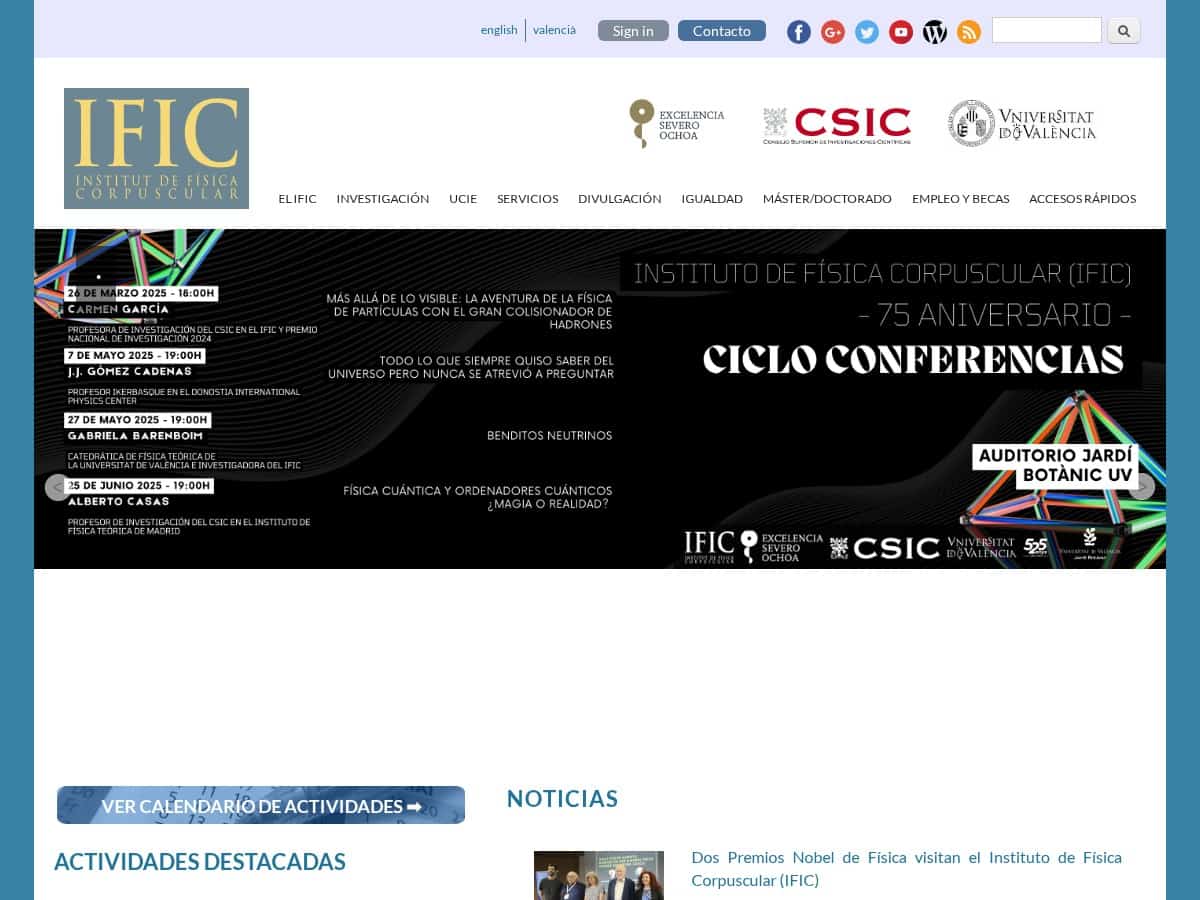
In autumn 1950 the physicist Joaquín Catalá gathered a group in Valencia to study atomic nuclei and elementary particles with nuclear emulsions, and that group grew into the Instituto de Física Corpuscular (IFIC). It first worked as a local division of the Instituto de Óptica Daza de Valdés, a CSIC institute, and received its present name at the beginning of 1960. Today IFIC is a joint centre of the Spanish National Research Council (CSIC) and the University of Valencia.
The institute is located in the Science Park of the University of Valencia at Paterna. Its research covers particle physics, astroparticle physics, nuclear physics, cosmology and medical physics, with both experimental and theoretical groups. IFIC scientists take part in international collaborations that include experiments at the Large Hadron Collider at CERN and the KM3NeT neutrino telescope on the Mediterranean seabed.
In 2015 IFIC received the Severo Ochoa accreditation as a centre of excellence, a Spanish distinction for research centres. In 2025 the institute marked 75 years since the start of the Valencia group. Information on current research lines, seminars and vacancies is available on the institute’s website and through the University of Valencia.
Domains taught:
Astroscience, Data Analytics, Engineering, Mathematics, Physics
Diplomas*:
Doctor, Master
Status:
Public
Partnerships:
Joint CSIC-UV center. Major participation in international experiments at CERN (ATLAS, LHCb), neutrino observatories (KM3NeT, DUNE), and astroparticle projects. Offers Master and PhD programs with UV.
Research:
Experimental and theoretical research in high-energy physics, neutrino physics, nuclear structure, medical physics applications, and cosmology.
Famous Alumnis:
Juan Fuster
International recognition**:
Number of staff***:
200
Current students***:
100
Foreign students***:
30%
Cumulative former students***:
300
Pros
Leading international center for research in fundamental physics, with significant involvement in global experiments. Excellent for postgraduate training in these fields.
Cons
Very specialized research focus.
Best For
PhD students and researchers specializing in particle, astroparticle, or nuclear physics, aiming to participate in major international collaborations.
University of Valencia is IFIC's partner and the university whose Science Park hosts the institute; it is a public university in Valencia with sciences, medicine, law and economics.
Instituto de Física de Altas Energías at Bellaterra, a public centre near Barcelona, shares the focus on particle physics and also covers astrophysics and cosmology.
Donostia International Physics Center, based in Donostia-San Sebastián, is a public centre working on condensed matter physics, materials science and nanoscience.
Instituto de Astrofísica de Andalucía in Granada is a public institute dedicated to astrophysics, planetary sciences and space instrumentation.
Centro de Investigaciones Energéticas, Medioambientales y Tecnológicas in Madrid, a public research centre, deals with energy technologies and environmental science.
Most Similar Schools Abroad
Gran Sasso Science Institute in L'Aquila, Italy, is a public institute whose list of subjects includes astroparticle physics.
Scuola Internazionale Superiore di Studi Avanzati, a public school in Trieste, Italy, specialises in theoretical particle physics and condensed matter physics.
Switzerland offers Université de Genève, a public university in Geneva with physics, chemistry, biology and computer science.
The Graduate University for Advanced Studies in Hayama, Japan, is a public institution covering particle and nuclear physics and fusion science.
In Germany, Ruprecht-Karls-Universität Heidelberg is a public university in Heidelberg where physics and astronomy sit beside chemistry and geosciences.
*our own picks (our criteria: a mix between domains, diploma delivered, reputation and size), but obviously too many criteria for an apple-to-apple ranking.
FAQ
Who founded IFIC and when did it begin?
The Valencian physicist Joaquín Catalá formed the founding group in 1950 to study atomic nuclei and elementary particles. The group was first attached to the Instituto de Óptica Daza de Valdés of CSIC.
How is the institute linked to the University of Valencia?
IFIC is a joint centre of CSIC and the University of Valencia. Its home is the university's Science Park in Paterna.
When did it take the name Instituto de Física Corpuscular?
The present name dates from the beginning of 1960, about ten years after the first group was formed in autumn 1950.
What does IFIC research?
The institute works on particle physics, astroparticle physics, nuclear physics and cosmology, and it also applies physics to medicine. Both experimental teams and theoretical groups are part of the centre.
Which large experiments involve its researchers?
IFIC takes part in collaborations at the Large Hadron Collider at CERN and in the KM3NeT neutrino telescope in the Mediterranean. Other detector and accelerator projects are listed on the institute's website.
Is IFIC recognised as a centre of excellence?
Yes. It received the Severo Ochoa accreditation in 2015, an award given by the Spanish government to leading research centres.
Where can I find information on studying or working at IFIC?
The institute's website lists research groups, seminars and job offers. Students interested in doctoral work can also ask the University of Valencia, since the centre is a joint one.
Astrophysics, Innovation, Medical, Nuclear Physics, Research and Development, User experience (UX)
*: without any judgment of the quality, readers are strongly encouraged to check the official status of the exact diploma envisioned as many universities have a mix of recognized diplomas, not recognized, “co-delivered,” “equivalent to”, “some pathways” (…), can change over time, and can be named differently from one country to another.
**: international reputation: is based on some criteria that do not mean much in some domains or specialties (number of researchers, of scientific publications, on budget ….). Our approximate 1-4 scale:
known locally
known locally and internationally
is listed in some of the world university’s classifications
is listed among the 20 firsts in some of world university’s classifications
***: estimated numbers, based on online sources and/or feedbacks. The numbers can vary greatly depending on school organisation (ex.: school is part of a group, it employs internal staff or external consultants or has public staff without employing them …). Refer to all the links provided to have accurate and updated numbers.
Innovation.world is not affiliated with this school/university. We recommend to contact them directly on their website for any special request.
To complete or correct any information here or share your opinion, please comment below or > send us a direct message <.