Address: Avenida 7 Nro. 776, B1900 La Plata, Buenos Aires, Argentina
Engineering, Computer Science, Natural Sciences
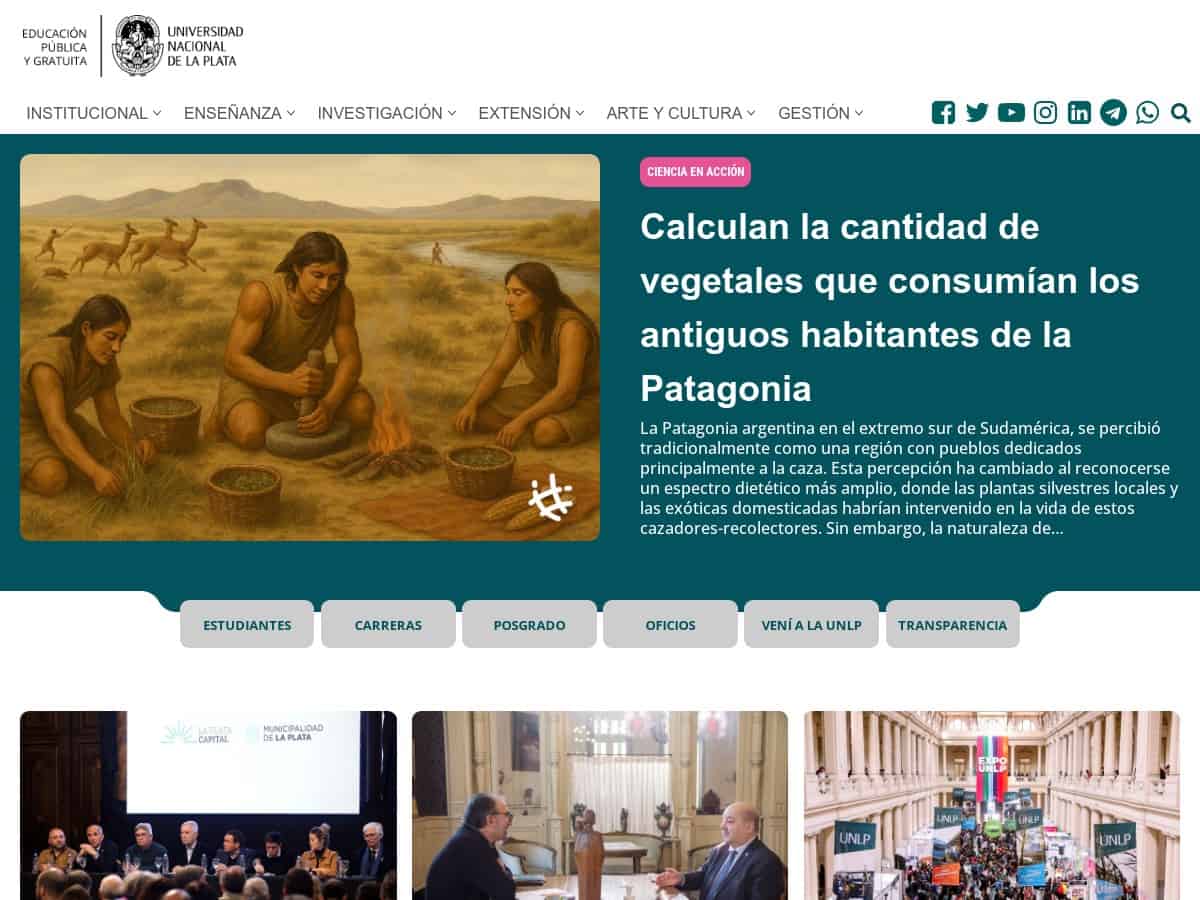
Established in 1905, the National University of La Plata is a major public university in Argentina, located in the city of La Plata. It was the third university founded in the country and is known for its strong focus on scientific research and its complex of faculties, museums, and an observatory.
La Plata was planned as a provincial capital in 1882, and the university grew into that grid of diagonal avenues and tree-lined squares. With about 115,000 students and 12,000 staff it works at nearly ten students per employee, and its faculties are scattered through the city instead of gathered on one campus.
Two institutions give it a scientific identity. The La Plata Museum, a natural history museum opened in 1888, belongs to the Faculty of Natural Sciences, and the Astronomical Observatory stands in the Paseo del Bosque park. Engineering, informatics, exact sciences and astronomy are all taught inside the city, and the large Faculty of Informatics trains a steady flow of software developers. The heart surgeon René Favaloro and Julio Palmaz, inventor of the vascular stent, are among the alumni.
More than 150 research centres and laboratories are attached to the university, with biotechnology, engineering and environmental science as the leading areas. Many groups are shared with CONICET and other national agencies. The university reports over 500 international agreements, which cover student and teacher exchange, joint projects and technical assistance.
Education is free of tuition for undergraduates and taught in Spanish. Admission procedures and any introductory courses are set by each faculty, so applicants should check the requirements for the specific degree. Buenos Aires is about an hour away by train or road, which lets students use both cities, and rents in La Plata are generally lower than in the capital.
Figures give a sense of the weight of the institution. About 600,000 people have graduated from the university, and its network of faculties, museum, observatory and research centres occupies a large share of the city centre. Visiting students often notice how much of daily life in La Plata is tied to the university: bookshops, cafes, rented rooms and cultural events follow the academic calendar closely.
Domains taught:
Astroscience, Chemistry, Computer Vision, Engineering, Life Sciences, Physics, Software Engineering
Diplomas*:
Bachelor, Doctor, Master
Status:
Public
Partnerships:
Maintains over 500 international agreements with universities globally for student and faculty exchange, joint research projects, and technical assistance.
Research:
A leading institution for scientific research in Argentina, with over 150 research centers and laboratories. Key areas include biotechnology, engineering, and environmental sciences. It has strong collaborations with CONICET, Argentina’s national research council.
Famous Alumnis:
René Favaloro, Adolfo Pérez Esquivel, Cristina Fernández de Kirchner, Néstor Kirchner, Julio Palmaz
International recognition**:
Number of staff***:
12000
Current students***:
115000
Foreign students***:
10%
Cumulative former students***:
600000
Pros
Strong research focus, comprehensive campus with a renowned natural history museum, high academic quality, free education.
Cons
Bureaucratic processes can be slow, some facilities require modernization, large class sizes in introductory courses.
Best For
Individuals passionate about scientific research and a traditional university environment in a well-planned city.
National University of Córdoba shares the core fields of this university, namely astroscience, chemistry and physics; it is also a public institution, and teaches at the same levels, namely bachelor's, master's and doctoral.
National University of Rosario works in much the same fields, chiefly chemistry, physics and engineering, and it covers agriculture and bioengineering as well, and is slightly smaller, at about 80,000 students against roughly 115,000 here.
National University of the South shares the core fields of this institution, namely computer vision, chemistry and life sciences; it covers marine science and agriculture as well, and is far smaller, with about 22,000 students against roughly 115,000 here.
National University of Cuyo sits close to this university on chemistry, physics and engineering; it teaches at the same levels, namely bachelor's, master's and doctoral, and covers agriculture and food science as well.
Both schools build their programmes around chemistry, physics and software engineering, and National University of Buenos Aires is the one to compare first within the country, since it is larger, enrolling about 310,000 students against roughly 115,000 here, and is also a public institution.
Most Similar Schools Abroad
University of Granada in Spain shares the astroscience, chemistry and physics orientation of this university, and it covers mathematics and data analytics as well, and is smaller, enrolling about 60,000 students against roughly 115,000 here.
Abroad, University of São Paulo (Brazil) covers computer vision, life sciences and engineering in a comparable way, and it is also a public institution, and runs the same bachelor's, master's and doctoral programmes.
University of Belgrade brings a Serbia setting to the same core fields, chemistry, physics and life sciences, and it covers civil engineering and mathematics as well, and is slightly smaller, at about 94,425 students against roughly 115,000 here.
National Autonomous University of Mexico brings a Mexico setting to the same core fields, astroscience, chemistry and physics, and it is also a public institution, and runs the same bachelor's, master's and doctoral programmes.
The closest overseas parallel on astroscience, chemistry and physics is University of Oslo, located in Norway; it is also a public institution, and teaches at the same levels, namely bachelor's, master's and doctoral.
*our own picks (our criteria: a mix between domains, diploma delivered, reputation and size), but obviously too many criteria for an apple-to-apple ranking.
FAQ
Where is the National University of La Plata?
It is in La Plata, the capital of Buenos Aires province, about 60 km south-east of the city of Buenos Aires.
How large is the university?
It has about 115,000 students, 12,000 staff and a broad range of faculties, museums and an observatory.
Is tuition charged?
Undergraduate study at Argentine national universities has traditionally been free. Confirm current rules if you are a non-resident foreign student.
Which engineering and technical faculties exist?
The university has faculties of engineering, informatics, exact sciences and astronomy and geophysical sciences, among others.
What is the La Plata Museum?
It is a natural history museum opened in 1888 and run by the university's Faculty of Natural Sciences. It holds large palaeontology and anthropology collections.
Which research areas stand out?
Biotechnology, engineering, environmental sciences, astronomy and geophysics, with more than 150 research centres and laboratories.
How many international agreements does it have?
The university reports more than 500 agreements with universities worldwide for exchange, joint research and technical assistance.
In which language are courses taught?
Courses are taught in Spanish. A good working level is necessary for lectures and exams.
Who are some famous alumni?
René Favaloro, a pioneer of coronary bypass surgery, Julio Palmaz, inventor of the vascular stent, and the former presidents Néstor Kirchner and Cristina Fernández de Kirchner studied here.
How far is La Plata from Buenos Aires?
It is roughly an hour away by train or road, so many students and staff commute between the two cities.
Engineering, Environmental Engineering, Innovation, Research and Development
*: without any judgment of the quality, readers are strongly encouraged to check the official status of the exact diploma envisioned as many universities have a mix of recognized diplomas, not recognized, “co-delivered,” “equivalent to”, “some pathways” (…), can change over time, and can be named differently from one country to another.
**: international reputation: is based on some criteria that do not mean much in some domains or specialties (number of researchers, of scientific publications, on budget ….). Our approximate 1-4 scale:
known locally
known locally and internationally
is listed in some of the world university’s classifications
is listed among the 20 firsts in some of world university’s classifications
***: estimated numbers, based on online sources and/or feedbacks. The numbers can vary greatly depending on school organisation (ex.: school is part of a group, it employs internal staff or external consultants or has public staff without employing them …). Refer to all the links provided to have accurate and updated numbers.
Innovation.world is not affiliated with this school/university. We recommend to contact them directly on their website for any special request.
To complete or correct any information here or share your opinion, please comment below or > send us a direct message <.