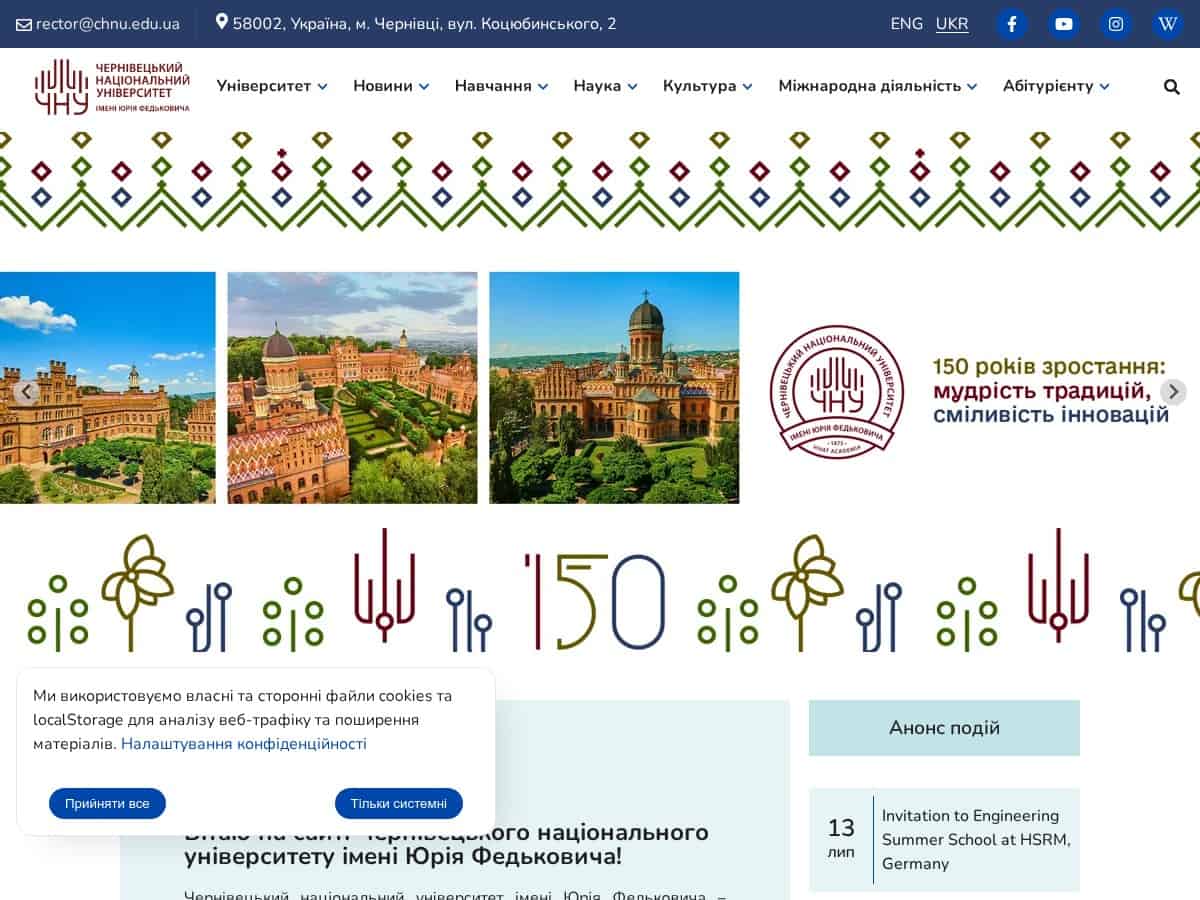
In October 1875 the Franz-Josephs-Universität opened in Czernowitz, then the capital of Bukovina in Austria-Hungary, and Constantin Tomashchuk served as its first rector. The institution is today Yuriy Fedkovych Chernivtsi National University, in Chernivtsi, western Ukraine. It started with three faculties: Greek Orthodox theology, law and philosophy.
Its history follows the changing rule over Bukovina. German was the main language of instruction until 1918. Between 1918 and 1940 it operated as a Romanian university named after King Carol I. After northern Bukovina joined the Ukrainian SSR in 1940, Ukrainian became the language of instruction. The name Yuriy Fedkovych was adopted in 1989, and national university status followed in 2000.
The main campus is the former Residence of Bukovinian and Dalmatian Metropolitans, a building complex inscribed on the UNESCO World Heritage List in 2011. Today the university has eleven faculties and two institutes, with mathematics and informatics among them. The directory profile points to computer science, optics and photonics, and physics.
Domains taught:
Chemistry, Electrical and Electronics, Materials, Mathematics, Optics, Physics, Software Engineering
Diplomas*:
Bachelor, Doctor, Master
Status:
Public
Partnerships:
International collaborations, particularly with Romanian and Austrian universities; member of international university networks.
Research:
Research in optics and photonics, semiconductor physics, materials science, theoretical physics, computer modeling, and organic chemistry.
Famous Alumnis:
Joseph Schumpeter (taught here)
International recognition**:
Number of staff***:
1500
Current students***:
12000
Foreign students***:
0%
Cumulative former students***:
100000
Pros
Historic university with unique architectural ensemble, strong in optics and material sciences.
Shanxi University in China is a public university with physics and optoelectronics and chemistry.
Université de Fribourg in Switzerland is a public university with materials science, biology and computer science.
*our own picks (our criteria: a mix between domains, diploma delivered, reputation and size), but obviously too many criteria for an apple-to-apple ranking.
FAQ
How was the university founded?
It opened in October 1875 as the Franz-Josephs-Universität in Czernowitz, in the Austrian crown land of Bukovina.
Who was the first rector?
Constantin Tomashchuk.
Why does the building have a UNESCO connection?
The main campus is the former residence of the Orthodox metropolitans of Bukovina and Dalmatia, which was added to the UNESCO World Heritage List in 2011.
How many faculties are there?
Eleven faculties and two institutes are listed in current descriptions.
When did it take its present name?
It was named after Yuriy Fedkovych in 1989 and received national university status in 2000.
What changes did the language of teaching see?
German was used under Austrian rule, Romanian in the interwar period, and Ukrainian from 1940.
Where can applicants look up admissions?
Entrance rules and programmes are published on the official website of the university.
Biology, Chemistry, Engineering, Materials Science, Mathematics, Optics, Photonics, Physics, Research and Development
*: without any judgment of the quality, readers are strongly encouraged to check the official status of the exact diploma envisioned as many universities have a mix of recognized diplomas, not recognized, “co-delivered,” “equivalent to”, “some pathways” (…), can change over time, and can be named differently from one country to another.
**: international reputation: is based on some criteria that do not mean much in some domains or specialties (number of researchers, of scientific publications, on budget ….). Our approximate 1-4 scale:
known locally
known locally and internationally
is listed in some of the world university’s classifications
is listed among the 20 firsts in some of world university’s classifications
***: estimated numbers, based on online sources and/or feedbacks. The numbers can vary greatly depending on school organisation (ex.: school is part of a group, it employs internal staff or external consultants or has public staff without employing them …). Refer to all the links provided to have accurate and updated numbers.
Innovation.world is not affiliated with this school/university. We recommend to contact them directly on their website for any special request.
To complete or correct any information here or share your opinion, please comment below or > send us a direct message <.