Metallurgy, Materials Science, Chemical Technology
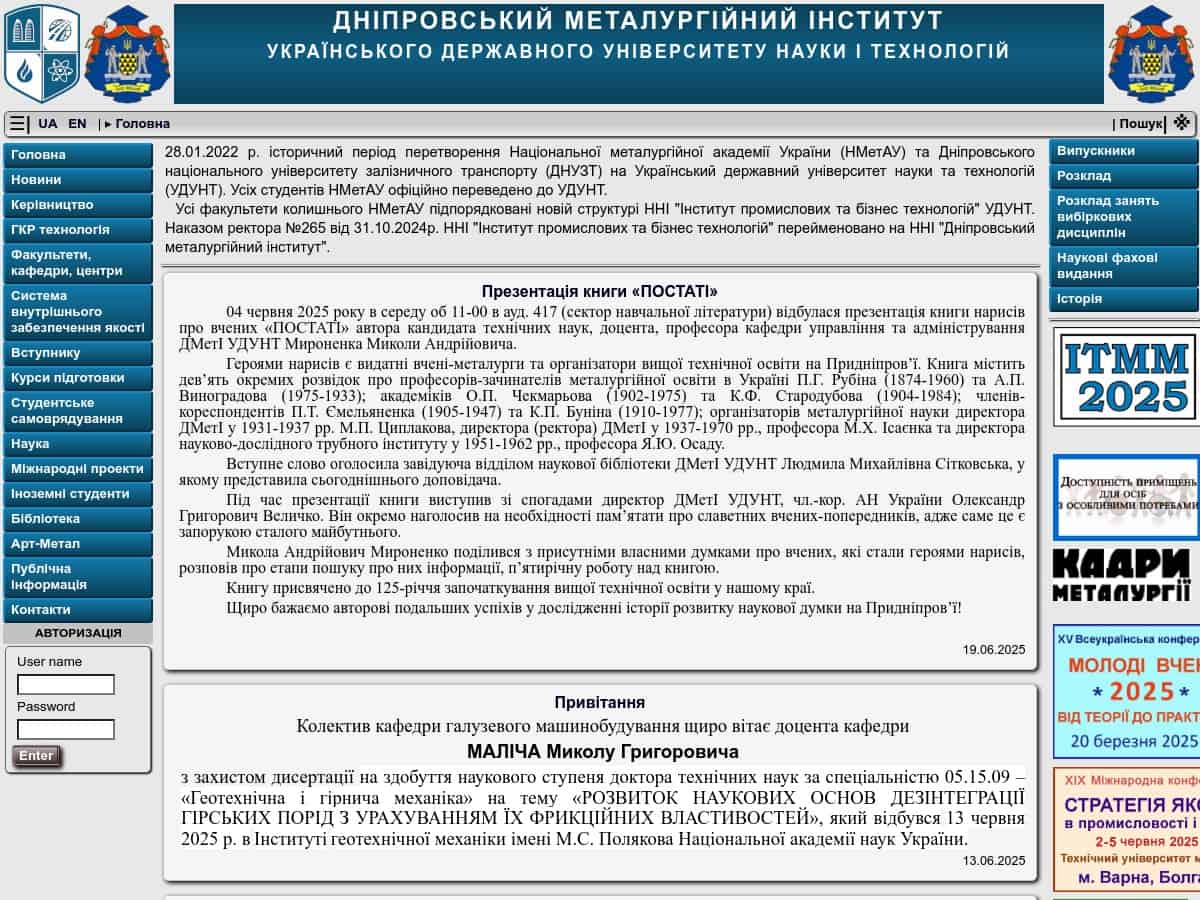
The National Metallurgical Academy of Ukraine, abbreviated NMetAU, is a metallurgical higher-education institution in Dnipro, Ukraine. Its origins lie in October 1899, when it opened as a department of the Katerynoslav Higher Mining School.
In 1912 it became the metallurgical faculty of the Katerynoslav Mining Institute, and in 1930 it was reorganised as an independent institution, the Dnipropetrovsk Metallurgical Institute. The title National Metallurgical Academy of Ukraine was adopted in 1999. The academy has since become part of the Ukrainian State University of Science and Technologies, where its former faculties form the Dnipro Metallurgical Institute, a name introduced in 2024.
Its faculties covered metallurgy, electrometallurgy, mechanical engineering, materials science and metal forming, computer systems and automation, and economics and management. For present admissions and study options, the Dnipro Metallurgical Institute pages of the successor university are the place to check.
Domains taught:
Automation, Chemical Engineering, Engineering, Manufacturing, Materials, Mechanical Engineering, Physics
Diplomas*:
Bachelor, Doctor, Master
Status:
Public
Partnerships:
Strong partnerships with major metallurgical plants in Ukraine (e.g., Metinvest, ArcelorMittal Kryvyi Rih).
Research:
Research in ferrous and non-ferrous metallurgy, metal casting and forming, powder metallurgy, new materials, and industrial ecology in metallurgy.
Famous Alumnis:
N/A
International recognition**:
Number of staff***:
900
Current students***:
7000
Foreign students***:
0%
Cumulative former students***:
60000
Pros
Historic and premier university for metallurgy.
Cons
Specialized focus, city affected by proximity to conflict.
As the successor institution, Ukrainian State University of Science and Technologies in Dnipro lists railway engineering, metallurgy and materials science.
In the same city, Dnipro University of Technology teaches mining engineering, mechanical engineering and information technology.
*our own picks (our criteria: a mix between domains, diploma delivered, reputation and size), but obviously too many criteria for an apple-to-apple ranking.
FAQ
When did the academy's story begin?
It started in October 1899 as a department of the Katerynoslav Higher Mining School.
What were its earlier names?
In 1912 it became a metallurgical faculty of the Katerynoslav Mining Institute, and in 1930 the Dnipropetrovsk Metallurgical Institute. The academy name followed in 1999.
Which subjects form its core?
Metallurgy, materials science and metal forming and mechanical engineering are central. Electrometallurgy and economics and management were also taught as separate faculties.
What is its status now?
It has become part of the Ukrainian State University of Science and Technologies. The former academy faculties are grouped there as the Dnipro Metallurgical Institute.
Which city hosts the institution?
Dnipro, Ukraine. The successor university pages carry current contact details.
How can applicants get current information?
Admissions and international sections of the successor university website describe programmes and deadlines. Direct contact with the institute confirms current requirements.
*: without any judgment of the quality, readers are strongly encouraged to check the official status of the exact diploma envisioned as many universities have a mix of recognized diplomas, not recognized, “co-delivered,” “equivalent to”, “some pathways” (…), can change over time, and can be named differently from one country to another.
**: international reputation: is based on some criteria that do not mean much in some domains or specialties (number of researchers, of scientific publications, on budget ….). Our approximate 1-4 scale:
known locally
known locally and internationally
is listed in some of the world university’s classifications
is listed among the 20 firsts in some of world university’s classifications
***: estimated numbers, based on online sources and/or feedbacks. The numbers can vary greatly depending on school organisation (ex.: school is part of a group, it employs internal staff or external consultants or has public staff without employing them …). Refer to all the links provided to have accurate and updated numbers.
Innovation.world is not affiliated with this school/university. We recommend to contact them directly on their website for any special request.
To complete or correct any information here or share your opinion, please comment below or > send us a direct message <.