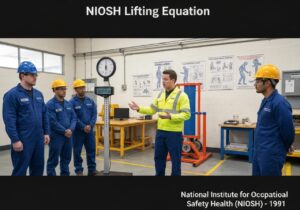
The NIOSH Lifting Equation (NLE) is particularly effective in environments where manual lifting is prevalent, such as warehouses, manufacturing plants, and medical settings. It is most commonly applied during the ergonomics phase of product design and workplace assessments, allowing engineers and safety specialists to collaborate on lifting task evaluations and modifications. Participants in the implementation of the NLE typically include safety engineers, ergonomists, occupational health professionals, human factors specialists, and employees who perform lifting tasks. The methodology can be integrated during various project phases, including the initial design development and during post-implementation reviews to ensure continuous improvement in ergonomics. A systematic approach using the equation can lead to redesigning jobs in a way that minimizes lifting risks and enhances worker safety. For instance, in an assembly line, modifying the positioning of components to align with the ideal lifting zones identified by the NLE can significantly lower the risk of injury. Industries like construction, logistics, and healthcare frequently utilize the NLE to analyze and adjust manual handling tasks. Furthermore, leveraging this methodology promotes a safety culture within organizations, encouraging ongoing risk assessments and fostering employee involvement in ergonomics initiatives, ultimately contributing to long-term injury reduction and enhanced operational efficiency.
该方法的关键步骤
计算负载在两脚中点处的水平位置(H)。
确定负载从地面到负载把手的垂直位置(V)。
将负载垂直移动的距离(D)测量为提升距离。
评估不对称角(A),即提拉与身体中线的角度。
通过每分钟的升降次数来估算升降频率(F)。
根据负载上使用的夹持方式评价耦合质量(C)。
使用上述参数,利用 NIOSH 起重方程计算推荐重量限制 (RWL)。
用负载重量除以RWL计算起重指数(LI)。
解读 LI 值,确定相关的腰背部损伤风险。
专业提示
Regularly update the parameters based on ergonomic research to adapt the NIOSH equation to evolving workplace conditions.