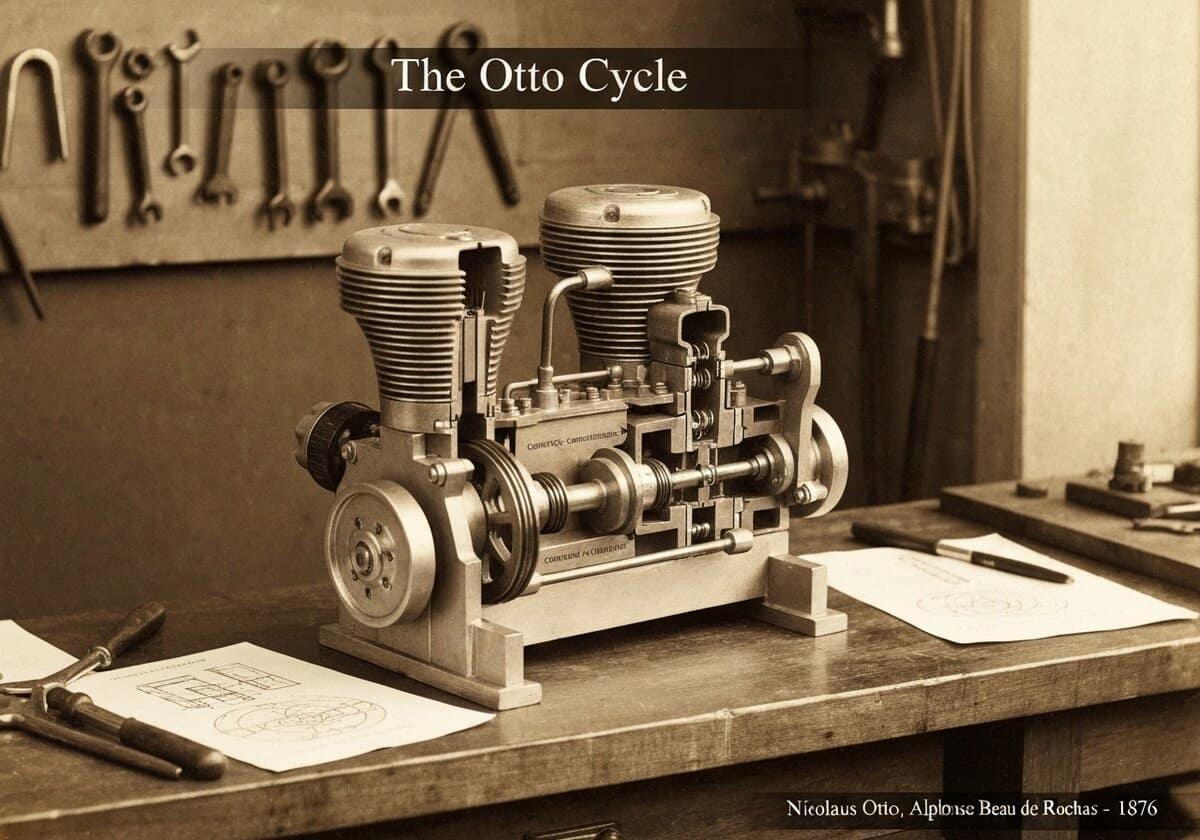
The ideal Otto cycle is a termodinámica model for spark-ignition engines. It consists of four internally reversible processes: isentropic compression (1-2), constant volume (isochoric) heat addition (2-3), isentropic expansion (3-4), and constant volume (isochoric) heat rejection (4-1). This cycle forms the theoretical basis for analyzing the performance of gasoline engines, assuming an ideal gas as the working fluid.
The Otto cycle is visualized on a Pressure-Volume (P-V) diagram, forming a bucle cerrado. The analysis begins at state 1, at the start of the compression stroke, with the piston at bottom dead center (BDC).
Proceso 1–2: Compresión isentrópica. El pistón se desplaza desde el punto muerto inferior (PMI) hasta el punto muerto superior (PMS), comprimiendo la mezcla aire-combustible. En este proceso adiabático idealizado, no hay transferencia de calor hacia ni desde el sistema, por lo que la entropía permanece constante. Se realiza trabajo sobre el gas, aumentando su energía interna, lo cual se manifiesta como un incremento tanto de la presión como de la temperatura.
Proceso 2–3: Adición de calor a volumen constante. At TDC, the spark plug ignites the mixture. The combustion is assumed to be instantaneous, occurring while the volume does not change (an isochoric process). This adds heat ([latex]Q_{in}[/latex]) to the working fluid, causing a sharp increase in temperature and pressure to state 3, the point of maximum cycle pressure and temperature.
Proceso 3–4: Expansión isentrópica (Golpe de potencia). El gas a alta presión proveniente de la combustión se expande, empujando el pistón desde el PMS (Punto Muerto Superior) hasta el PMI (Punto Muerto Inferior). Esta expansión se idealiza como adiabática y reversible (isentrópica). El gas en expansión realiza trabajo sobre el pistón, que constituye el trabajo útil del ciclo. A medida que el gas se expande, su presión y temperatura disminuyen.
Proceso 4–1: Rechazo de calor a volumen constante. At BDC, the exhaust valve is assumed to open, and the pressure instantly drops back to the initial pressure of state 1. This is modeled as an isochoric process where heat ([latex]Q_{out}[/latex]) is rejected from the working fluid to the surroundings, completing the cycle and returning the fluid to its initial state.
Related to: Otto cycle, thermodynamics, isentropic, isochoric, internal combustion engine,
four-stroke, p-v diagram, spark-ignition, ideal gas, heat engine.