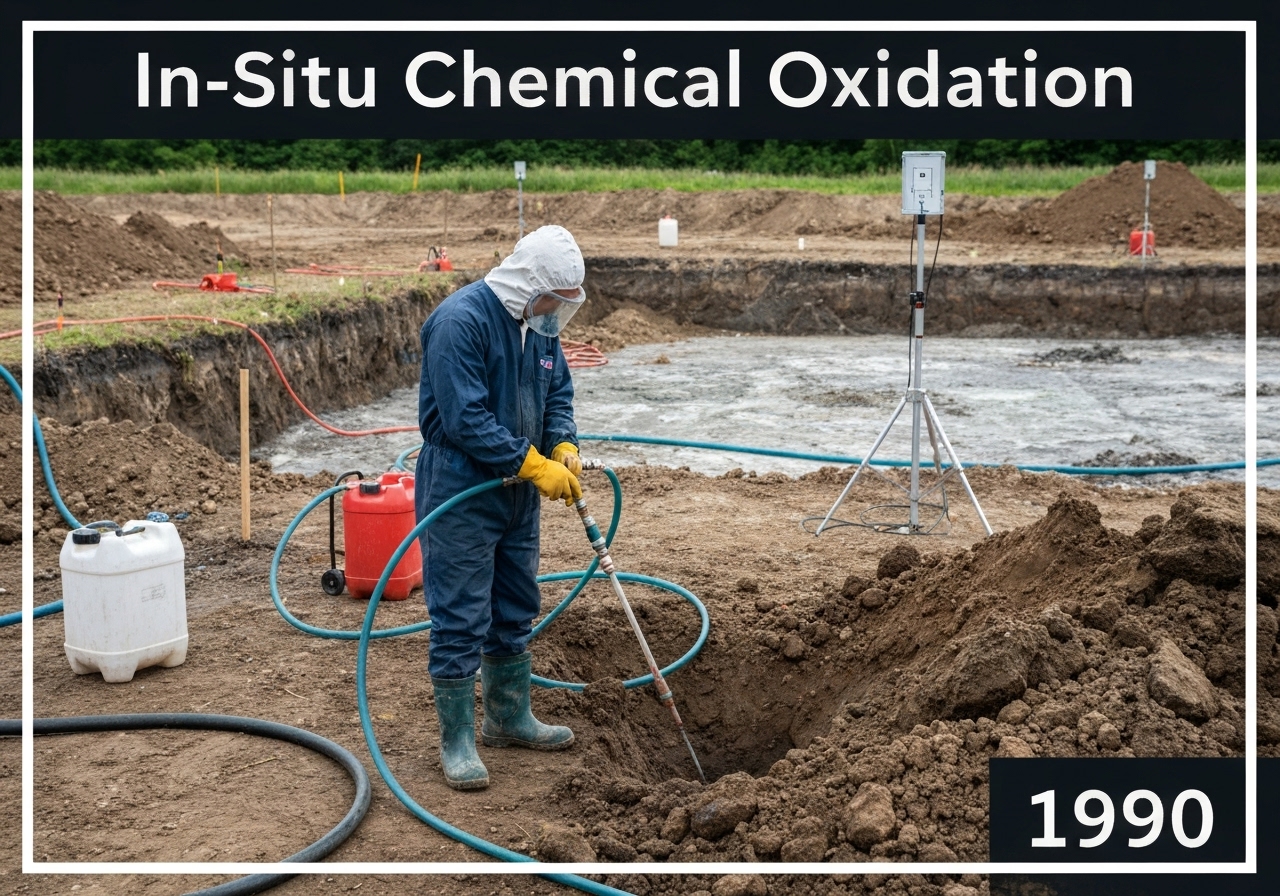
原位化学氧化(ISCO)是一种强力修复技术,它将强氧化剂直接注入受污染的地下介质中,以破坏污染物。常用的氧化剂包括高锰酸盐、过硫酸盐、过氧化氢(芬顿试剂)和臭氧。这些化学物质与污染物发生反应,将其转化为毒性较低的物质,例如二氧化碳、水和无机盐,而无需挖掘受污染的土体。

(图片仅供参考)
原位化学氧化(ISCO)是一种强力修复技术,它将强氧化剂直接注入受污染的地下介质中,以破坏污染物。常用的氧化剂包括高锰酸盐、过硫酸盐、过氧化氢(芬顿试剂)和臭氧。这些化学物质与污染物发生反应,将其转化为毒性较低的物质,例如二氧化碳、水和无机盐,而无需挖掘受污染的土体。
ISCO is a powerful method for rapidly degrading a wide range of organic contaminants in both soil and groundwater. The selection of the oxidant is crucial and depends on the target contaminant, geochemistry of the site, and safety considerations. Potassium permanganate ([latex]KMnO_4[/latex]) is effective against chlorinated ethenes like PCE and TCE but is less effective for petroleum hydrocarbons. Fenton’s reagent, a mixture of hydrogen peroxide ([latex]H_2O_2[/latex]) and an iron 催化剂, generates highly reactive hydroxyl radicals ([latex]\bullet OH[/latex]) that can non-selectively destroy most organic compounds. Persulfate ([latex]S_2O_8^{2-}[/latex]), activated by heat, high pH, or iron, is more stable than Fenton’s reagent and can travel further in the subsurface. Ozone ([latex]O_3[/latex]) is a gas that is typically sparged into the subsurface to treat both saturated and unsaturated zones.
原位化学氧化(ISCO)面临的一个主要挑战是如何有效地将氧化剂输送并分配到目标污染区。地下水通常具有异质性,氧化剂可能会与土壤中的天然有机物或矿物质发生非目标反应而被消耗,这种现象被称为天然氧化剂需求(NOD)。这会显著增加所需的化学品用量。此外,原位化学氧化反应可能放热剧烈,可能造成危险情况,并可能通过改变含水层的氧化还原条件来迁移铬等有毒金属。尽管存在这些挑战,原位化学氧化(ISCO)仍因其在降低污染源区高浓度污染物方面的速度而经常被采用。
原位化学氧化(ISCO)
(如果日期未知或不相关,例如“流体力学”,则提供其显著出现的近似估计)
只有注册会员才能免费获取完整尺寸的图片和下载内容。
> 登录 <