Product Design, Manufacturing & Innovation Resources
家 » 比尔-兰伯特定律

比尔-兰伯特定律

1852
  • Pierre Bouguer
  • Johann Heinrich Lambert
  • August Beer
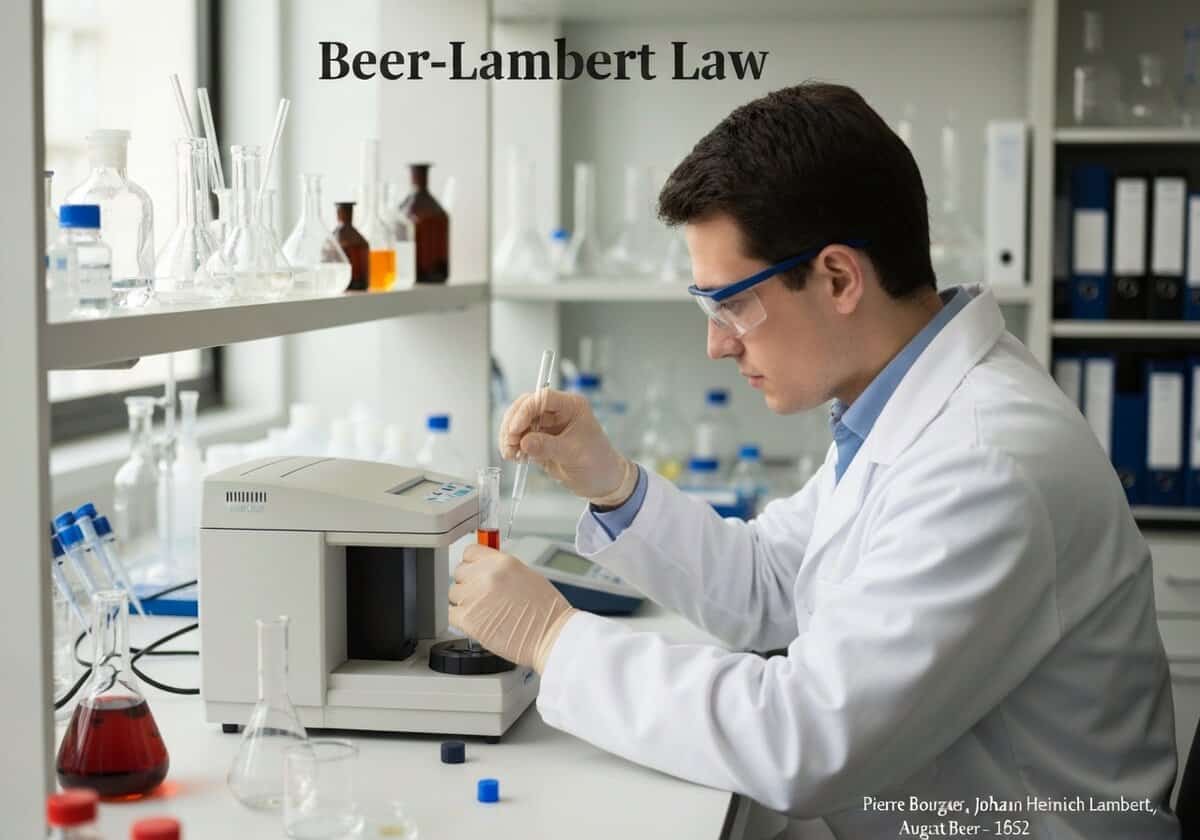
Laboratory analysis of absorbance using UV-Vis spectroscopy in analytical chemistry.

(图片仅供参考)

The Beer-Lambert law relates the attenuation of light to the properties of the material through which it is traveling. It states that the absorbance ([latex]A[/latex]) of a solution is directly proportional to the concentration ([latex]c[/latex]) of the absorbing species and the path length ([latex]l[/latex]) of the light through the solution. The relationship is expressed as [latex]A = \epsilon c l[/latex], where [latex]\epsilon[/latex] is the molar absorptivity.

The Beer-Lambert law, also known as the Beer–Lambert–Bouguer law, is the cornerstone of quantitative absorption 光谱学. It combines the findings of several scientists over more than a century. Pierre Bouguer (1729) and Johann Lambert (1760) established that the fraction of light absorbed is proportional to the thickness of the absorbing medium. August Beer (1852) then discovered that the absorbance is also proportional to the concentration of the absorbing substance in a solution. The law is typically written as [latex]A = \log_{10}(I_0/I) = \epsilon c l[/latex], where [latex]I_0[/latex] is the intensity of the incident light and [latex]I[/latex] is the intensity of the transmitted light. The molar absorptivity, [latex]\epsilon[/latex], is a constant that is characteristic of the absorbing substance at a specific wavelength. This means that for a given substance and path length, a plot of absorbance versus concentration will be a straight line, allowing for the creation of a calibration curve. By measuring the absorbance of an unknown sample, its concentration can be determined from this curve. The law holds true for monochromatic light and for dilute solutions where interactions between solute molecules are negligible. Deviations can occur at high concentrations due to chemical and instrumental effects.

UNESCO Nomenclature: 2501
分析化学

类型

Physical Law

中断

重大的

用法

广泛使用

前体

  • Pierre Bouguer’s work on light attenuation in the atmosphere (1729)
  • Johann Heinrich Lambert’s publication “Photometria” formalizing the relationship between absorption and path length (1760)
  • 早期光度计和色度计的发展

应用程序

  • 利用紫外-可见光谱法进行定量化学分析
  • 测定溶液中溶质的浓度
  • 大气科学用来描述太阳辐射吸收
  • 饮料和制药行业的质量控制
  • 临床化学:测量血液样本中的成分

专利:

NA

潜在创新理念

  • 利用光纤探头对化学反应器进行在线过程监测
  • 脉搏血氧仪通过在两个波长下对血红蛋白应用该定律来测量血氧饱和度。
  • 用于现场的便携式水质检测套件
  • 在药物发现中利用高通量筛选来测量微孔板中的化合物浓度
  • 用于血液和尿液检测的自动化临床分析仪
  • 通过测量太阳吸收率来遥感大气气体(如臭氧)
  • 半导体制造中的薄膜厚度测量
  • 用于检测污染物或掺杂物的食品安全传感器
  • dna and rna quantification in molecular biology labs (e.g., nanodrop)
  • 通过测量溶液颜色和浊度的变化来监测啤酒厂和葡萄酒厂的发酵过程
Related to: Beer-Lambert law, absorbance, concentration, quantitative analysis, spectrophotometry, molar absorptivity, path length, transmittance, analytical chemistry, UV-vis.

历史背景

比尔-兰伯特定律

1650
1800
1852
1900
1912
1940
1940
1950
1800
1838
1872
1910
1940
1940
1946

(如果日期未知或不相关,例如“流体力学”,则提供其显著出现的近似估计)

第十年 周年纪念日

只有注册会员才能免费获取完整尺寸的图片和下载内容。

> 登录 <