Product Design, Manufacturing & Innovation Resources
بيت » قانون بير لامبرت

قانون بير لامبرت

1852
  • Pierre Bouguer
  • Johann Heinrich Lambert
  • August Beer
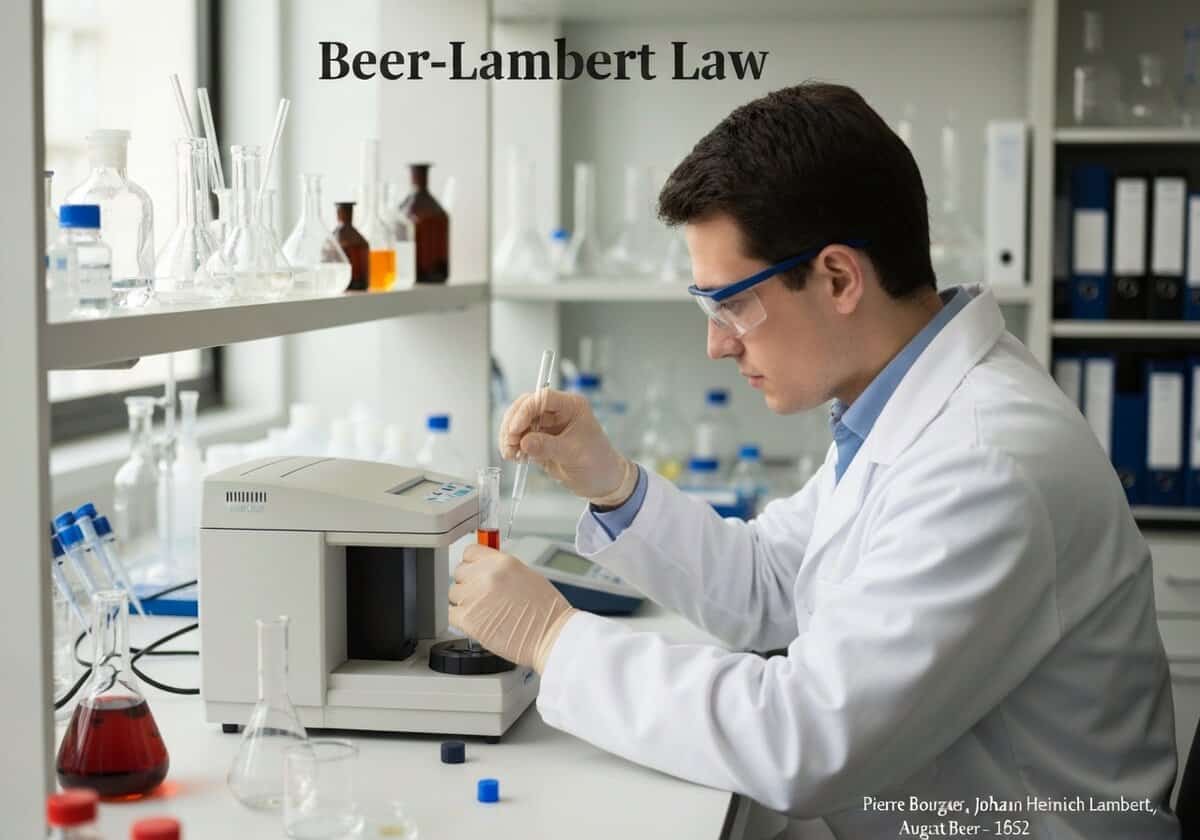
Laboratory analysis of absorbance using UV-Vis spectroscopy in analytical chemistry.

(صورة توضيحية فقط)

The Beer-Lambert law relates the attenuation of light to the properties of the material through which it is traveling. It states that the absorbance ([latex]A[/latex]) of a solution is directly proportional to the concentration ([latex]c[/latex]) of the absorbing species and the path length ([latex]l[/latex]) of the light through the solution. The relationship is expressed as [latex]A = \epsilon c l[/latex], where [latex]\epsilon[/latex] is the molar absorptivity.
يُعد قانون بير-لامبرت، المعروف أيضًا باسم قانون بير-لامبرت-بوغيه، حجر الزاوية في الامتصاص الكمي التحليل الطيفي. It combines the findings of several scientists over more than a century. Pierre Bouguer (1729) and Johann Lambert (1760) established that the fraction of light absorbed is proportional to the thickness of the absorbing medium. August Beer (1852) then discovered that the absorbance is also proportional to the concentration of the absorbing substance in a solution. The law is typically written as [latex]A = \log_{10}(I_0/I) = \epsilon c l[/latex], where [latex]I_0[/latex] is the intensity of the incident light and [latex]I[/latex] is the intensity of the transmitted light. The molar absorptivity, [latex]\epsilon[/latex], is a constant that is characteristic of the absorbing substance at a specific wavelength. This means that for a given substance and path length, a plot of absorbance versus concentration will be a straight line, allowing for the creation of a calibration curve. By measuring the absorbance of an unknown sample, its concentration can be determined from this curve. The law holds true for monochromatic light and for dilute solutions where interactions between solute molecules are negligible. Deviations can occur at high concentrations due to chemical and instrumental effects.

UNESCO Nomenclature: 2501
– Analytical chemistry

يكتب

Physical Law

خلل

Substantial

الاستخدام

استخدام واسع النطاق

مقدمات

  • عمل بيير بوجيه حول توهين الضوء في الغلاف الجوي (1729)
  • Johann Heinrich Lambert’s publication “Photometria” formalizing the relationship between absorption and path length (1760)
  • تطوير أجهزة قياس الضوء وأجهزة قياس اللون المبكرة

التطبيقات

  • التحليل الكيميائي الكمي باستخدام مطيافية الأشعة فوق البنفسجية والمرئية
  • تحديد تركيزات المواد المذابة في المحاليل
  • علم الغلاف الجوي لوصف امتصاص الإشعاع الشمسي
  • مراقبة الجودة في صناعات المشروبات والأدوية
  • الكيمياء السريرية لقياس المكونات في عينات الدم

براءات الاختراع:

NA

أفكار ابتكارية محتملة

  • مراقبة العمليات عبر الإنترنت في المفاعلات الكيميائية باستخدام مجسات الألياف البصرية
  • أجهزة قياس التأكسج النبضي التي تقيس تشبع الأكسجين في الدم من خلال تطبيق القانون على الهيموجلوبين عند طولين موجيين
  • مجموعات اختبار جودة المياه المحمولة للاستخدام الميداني
  • الفحص عالي الإنتاجية في اكتشاف الأدوية لقياس تركيزات المركبات في الصفائح الدقيقة
  • أجهزة تحليل سريرية آلية لتحاليل الدم والبول
  • الاستشعار عن بعد للغازات الجوية مثل الأوزون عن طريق قياس امتصاص الطاقة الشمسية
  • قياس سمك الأغشية الرقيقة في تصنيع أشباه الموصلات
  • أجهزة استشعار سلامة الغذاء للكشف عن الملوثات أو المواد المغشوشة
  • dna and rna quantification in molecular biology labs (e.g., nanodrop)
  • مراقبة التخمير في مصانع الجعة ومصانع النبيذ عن طريق قياس التغيرات في لون المحلول والعكارة
ذات صلة بـ: قانون بير-لامبرت، الامتصاص، التركيز، التحليل الكمي، قياس الطيف الضوئي، الامتصاصية المولية، طول المسار، النفاذية، الكيمياء التحليلية، الأشعة فوق البنفسجية المرئية.

السياق التاريخي

قانون بير لامبرت

1650
1800
1852
1900
1912
1940
1940
1950
1800
1838
1872
1910
1940
1940
1946

(إذا كان التاريخ غير معروف أو غير ذي صلة، على سبيل المثال "ميكانيكا الموائع"، يتم توفير تقدير تقريبي لظهوره الملحوظ)

أحدث الإضافات

أهم المنشورات والمقالات

أفضل الأدوات الأصلية

السنة العاشرة عيد

الصور والتنزيلات بالحجم الكامل متاحة فقط، ومجانية تمامًا، للأعضاء المسجلين.