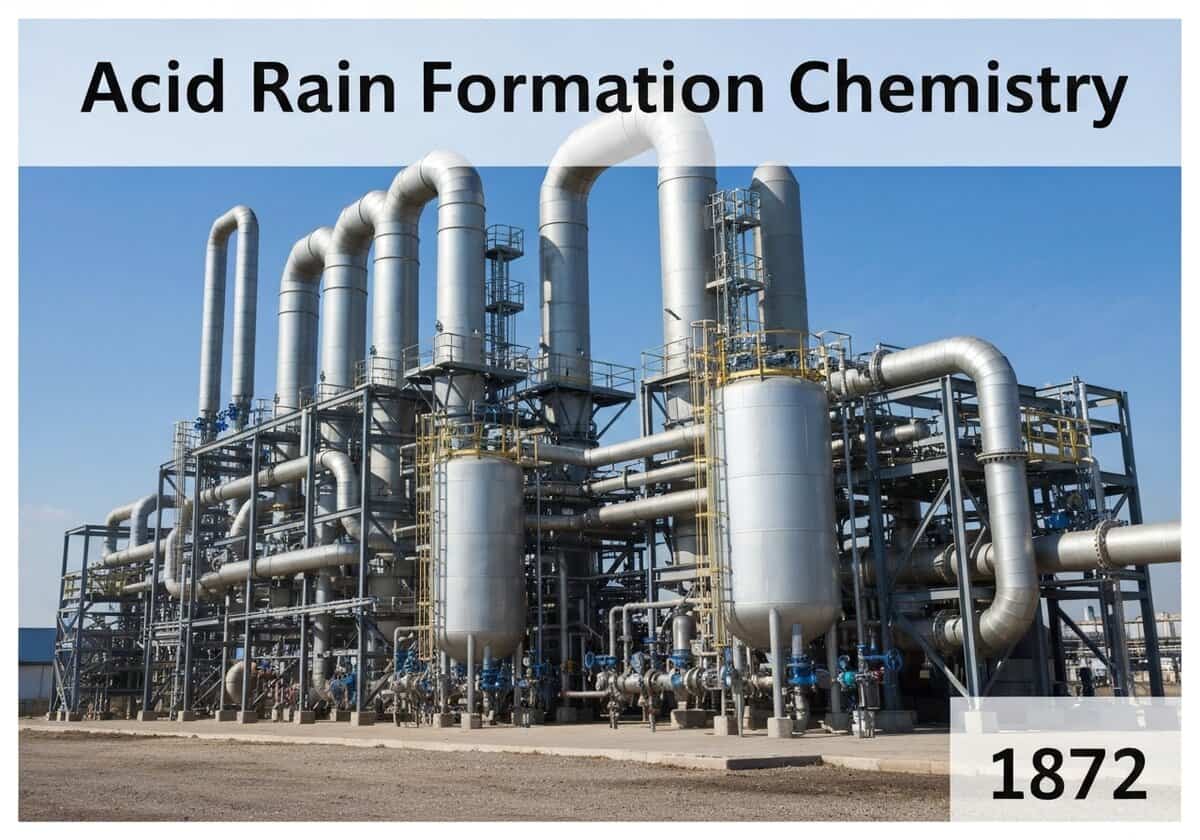
The primary precursors to acid rain are sulfur dioxide (SO2) and nitrogen oxides (NOx), which are released into the atmosphere primarily from the burning of fossil fuels in power plants and vehicles. Once in the atmosphere, these gases undergo complex chemical transformations. For sulfur dioxide, the process can be summarized in two main steps. First, SO2 is oxidized to sulfur trioxide (SO3): [latex]2SO_2(g) + O_2(g) \\rightarrow 2SO_3(g)[/latex]. This reaction can be slow in the gas phase but is significantly accelerated on the surface of atmospheric particles or in water droplets, where 催化剂 like iron and manganese are present. Subsequently, sulfur trioxide reacts rapidly with water to form sulfuric acid: [latex]SO_3(g) + H_2O(l) \\rightarrow H_2SO_4(aq)[/latex].
Similarly, nitrogen oxides, primarily nitric oxide (NO) and nitrogen dioxide (NO2), contribute to acid rain formation. NO is typically emitted and is then oxidized in the atmosphere to NO2: [latex]2NO(g) + O_2(g) \\rightarrow 2NO_2(g)[/latex]. Nitrogen dioxide then reacts with hydroxyl radicals (OH) to form nitric acid: [latex]NO_2(g) + OH(g) \\rightarrow HNO_3(g)[/latex]. These strong acids, sulfuric and nitric, dissolve in atmospheric water droplets (clouds, fog, rain, snow) and lower the pH of the precipitation, often to levels between 4.2 and 4.4, which is significantly more acidic than natural rain (pH ~5.6). This acidified precipitation has widespread environmental impacts, including the acidification of lakes and streams, damage to forests and crops, and the 腐蚀性 of buildings and statues.