Product Design, Manufacturing & Innovation Resources
Hogar » Ley de Beer-Lambert

Ley de Beer-Lambert

1852
  • Pierre Bouguer
  • Johann Heinrich Lambert
  • August Beer
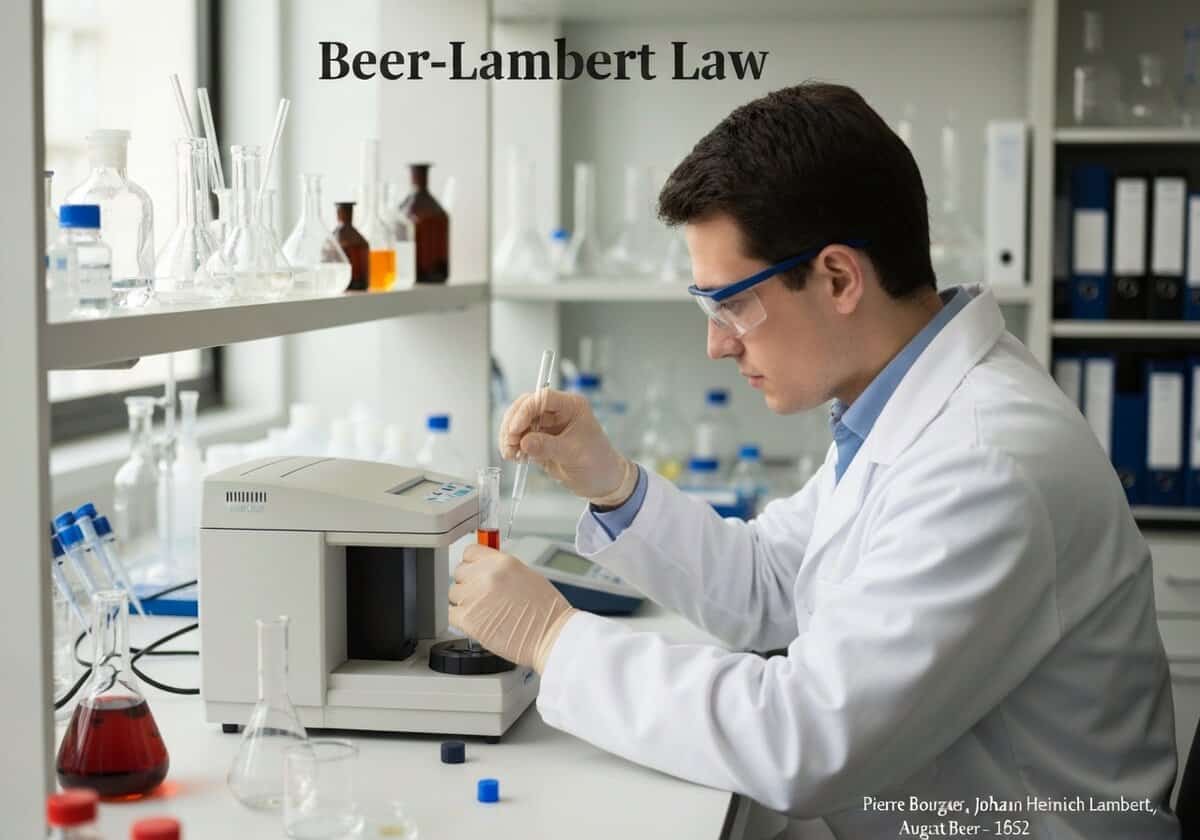
Análisis de laboratorio de la absorbancia mediante espectroscopia UV-Vis en química analítica.

(Imagen generada únicamente con fines ilustrativos)

La ley de Beer-Lambert relaciona la atenuación de la luz con las propiedades del material a través del cual viaja. Establece que la absorbancia ([latex]A[/latex]) de una solución es directamente proporcional a la concentración ([latex]c[/latex]) de las especies absorbentes y a la longitud del recorrido ([latex]l[/latex]) de la luz a través de la solución. La relación se expresa como [latex]A = \epsilon c l[/latex], donde [latex]\epsilon[/latex] es la absorbancia molar.
La ley de Beer-Lambert, también conocida como ley de Beer-Lambert-Bouguer, es la piedra angular de la absorción cuantitativa. espectroscopia. It combines the findings of several scientists over more than a century. Pierre Bouguer (1729) and Johann Lambert (1760) established that the fraction of light absorbed is proportional to the thickness of the absorbing medium. August Beer (1852) then discovered that the absorbance is also proportional to the concentration of the absorbing substance in a solution. The law is typically written as [latex]A = \log_{10}(I_0/I) = \epsilon c l[/latex], where [latex]I_0[/latex] is the intensity of the incident light and [latex]I[/latex] is the intensity of the transmitted light. The molar absorptivity, [latex]\epsilon[/latex], is a constant that is characteristic of the absorbing substance at a specific wavelength. This means that for a given substance and path length, a plot of absorbance versus concentration will be a straight line, allowing for the creation of a calibration curve. By measuring the absorbance of an unknown sample, its concentration can be determined from this curve. The law holds true for monochromatic light and for dilute solutions where interactions between solute molecules are negligible. Deviations can occur at high concentrations due to chemical and instrumental effects.

UNESCO Nomenclature: 2501
– Química analítica

Tipo

Derecho físico

Ruptura

Sustancial

Uso

Uso generalizado

Precursores

  • La obra de Pierre Bouguer sobre la atenuación de la luz en la atmósfera (1729)
  • Johann Heinrich Lambert’s publication “Photometria” formalizing the relationship between absorption and path length (1760)
  • Development of early photometers and colorimeters

Aplicaciones

  • quantitative chemical analysis using uv-vis spectroscopy
  • determining concentrations of solutes in solutions
  • atmospheric science to describe solar radiation absorption
  • quality control in beverage and pharmaceutical industries
  • clinical chemistry for measuring components in blood samples

Patentes:

NA

Ideas para posibles innovaciones

  • on-line process monitoring in chemical reactors using fiber-optic probes
  • pulse oximeters that measure blood oxygen saturation by applying the law to hemoglobin at two wavelengths
  • portable water quality testing kits for field use
  • high-throughput screening in drug discovery to measure compound concentrations in microplates
  • automated clinical analyzers for blood and urine tests
  • remote sensing of atmospheric gases like ozone by measuring solar absorption
  • thin-film thickness measurement in semiconductor manufacturing
  • food safety sensors for detecting contaminants or adulterants
  • dna and rna quantification in biología molecular labs (e.g., nanodrop)
  • fermentation monitoring in breweries and wineries by measuring changes in solution color and turbidity
Relacionado con: Ley de Beer-Lambert, absorbancia, concentración, análisis cuantitativo, espectrofotometría, absortividad molar, longitud de trayectoria, transmitancia, química analítica, UV-vis.

Contexto histórico

Ley de Beer-Lambert

1650
1800
1852
1900
1912
1940
1940
1950
1800
1838
1872
1910
1940
1940
1946

(Si la fecha es desconocida o no es relevante, por ejemplo "mecánica de fluidos", se proporciona una estimación redondeada de su aparición notable)

décimo año aniversario

Las imágenes en tamaño completo y las descargas solo están disponibles, de forma totalmente gratuita, para los miembros registrados.

> Acceso <